


If China were to attack Taiwan in the near future, it would most likely do so in the next three years under a Chinese Nationalist Party president (KMT), a Japanese academic said yesterday at a forum discussing the future of Taiwan's international relations.
Hisahiko Okazaki, the former director general for foreign affairs at the Japanese Defense Ministry and the current director of the Okazaki Institute, said China's vow to take Taiwan by force if it declared independence was mostly an "empty" threat because Beijing would not want to risk becoming the common enemy of both Tokyo and Washington by attacking Taiwan.
China's rhetoric, he said, has always been that the People's Liberation Army would attack Taiwan if it made any unilateral changes that altered the "status quo."
"But China never promised to refrain from using force as long as Taiwan does not declare independence," he said.
In fact, Beijing could be tempted to attack Taiwan if a pro-unification government were elected next month, as this would hasten the unification process, he said.
If a pro-Taiwan independence Democratic Progressive Party (DPP) candidate won, however, Beijing could be deterred from making any drastic move because the election of a DPP president would demonstrate the increased Taiwan-centric mentality in the country, he said.
Okazaki said, however, that regardless of which party came to power, China would not dare take Taiwan by force because Beijing is aware that it does not have the military capabilities to outmaneuver the US.
After 1969, when the US returned Okinawa to Japan, the Americans knew they needed a base in Asia to offset Russia's and China's influence in the region, he said.
Under the terms of the security treaty signed between the US and Japan signed in 1951, the US also promised to come to Japan's aid if there were a threat to its security.
He said the Japanese ambassador to the US at the time had made it clear that instability in the Taiwan Strait would directly jeopardize Japan's safety. Protecting Taiwan therefore meant protecting Taiwan, he said.
"With US and Japanese determination to maintain peace in the Strait, Taiwan should be safe from Chinese attack as long as Taiwanese leaders refuse to give in to Beijing's threats," he said.
Okazaki said the "one-country, two systems" model in Hong Kong had failed miserably and that Taiwan should never accept such an arrangement.
Should the Taiwanese leadership agree to a Hong Kong model, it should at least demand that Taiwan receive a seat at the UN in exchange, he said.
Peng Ming-min (
"Apart from China, where the media are controlled by the communist party, the media industry in Taiwan is the most corrupt and unethical in the world," he told the forum, saying the Taiwanese media repeatedly made false claims against DPP leaders.
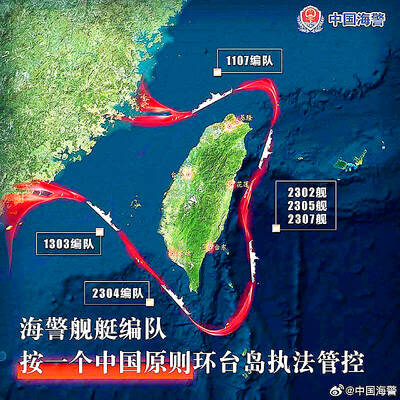
Taiwan would benefit from more integrated military strategies and deployments if the US and its allies treat the East China Sea, the Taiwan Strait and the South China Sea as a “single theater of operations,” a Taiwanese military expert said yesterday. Shen Ming-shih (沈明室), a researcher at the Institute for National Defense and Security Research, said he made the assessment after two Japanese military experts warned of emerging threats from China based on a drill conducted this month by the Chinese People’s Liberation Army’s (PLA) Eastern Theater Command. Japan Institute for National Fundamentals researcher Maki Nakagawa said the drill differed from the
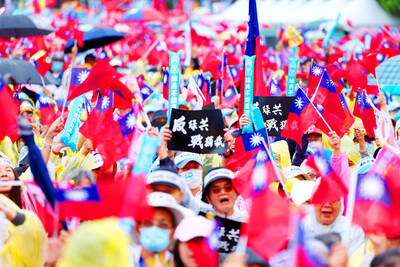
‘WORSE THAN COMMUNISTS’: President William Lai has cracked down on his political enemies and has attempted to exterminate all opposition forces, the chairman said The legislature would motion for a presidential recall after May 20, Chinese Nationalist Party (KMT) Chairman Eric Chu (朱立倫) said yesterday at a protest themed “against green communists and dictatorship” in Taipei. Taiwan is supposed to be a peaceful homeland where people are united, but President William Lai (賴清德) has been polarizing and tearing apart society since his inauguration, Chu said. Lai must show his commitment to his job, otherwise a referendum could be initiated to recall him, he said. Democracy means the rule of the people, not the rule of the Democratic Progressive Party (DPP), but Lai has failed to fulfill his

OFF-TARGET: More than 30,000 participants were expected to take part in the Games next month, but only 6,550 foreign and 19,400 Taiwanese athletes have registered Taipei city councilors yesterday blasted the organizers of next month’s World Masters Games over sudden timetable and venue changes, which they said have caused thousands of participants to back out of the international sporting event, among other organizational issues. They also cited visa delays and political interference by China as reasons many foreign athletes are requesting refunds for the event, to be held from May 17 to 30. Jointly organized by the Taipei and New Taipei City governments, the games have been rocked by numerous controversies since preparations began in 2020. Taipei City Councilor Lin Yen-feng (林延鳳) said yesterday that new measures by
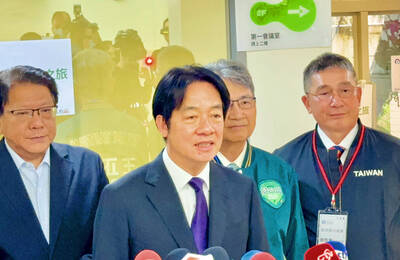
A rally held by opposition parties yesterday demonstrates that Taiwan is a democratic country, President William Lai (賴清德) said yesterday, adding that if opposition parties really want to fight dictatorship, they should fight it on Tiananmen Square in Beijing. The Chinese Nationalist Party (KMT) held a protest with the theme “against green communists and dictatorship,” and was joined by the Taiwan People’s Party. Lai said the opposition parties are against what they called the “green communists,” but do not fight against the “Chinese communists,” adding that if they really want to fight dictatorship, they should go to the right place and face


 RSS
RSS