


Chinese Nationalist Party (KMT) presidential candidate Ma Ying-jeou (
"Although feeling wronged, Mr. Ma has already cooperated with the commission's request and filled out a letter of authorization," Ma spokesman Luo Chih-chiang (
The camp presented some of the information Ma provided the CEC, including his birthdate, Republic of China (ROC) ID number, passport number, his English name on the passport and permanent address, and his latest US visa to prove that Ma's green card is no longer valid.
"Although the commission has cooperated with Democratic Progressive Party presidential candidate Frank Hsieh (
"We demand Hsieh's camp now present solid proof if it continues to accuse Ma of holding a valid green card," he said.
Hsieh has accused Ma of holding a green card since January 1977.
The commission announced earlier this week that it would investigate the allegation.
Ma has admitted applying for and receiving permanent US residency while studying in the US in the 1970s, but says his green card was invalidated 20 years ago when he began applying for visitor's visas for his trips to the US.
Ma's campaign staff showed copies of visas from an ROC passport issued to Ma 18 years ago to prove that the American Institute in Taiwan (AIT) had issued a non-immigrant visa to Ma on June 29, 1990 and on four other occasions before 2006.
Luo presented Ma's latest non-immigrant visa, issued by AIT on May 19, 2006.
The records provide solid proof that Ma's green card had been invalidated years ago in accordance with US immigration laws, Luo said.
In response to Hsieh's claim that Ma had used the name "Mark Ma" for his green card, Ma spokesman Tsai Shih-pin (
Hsieh's camp called a press conference later in the afternoon to complain that Ma's team was still dodging crucial questions by failing to prove that Ma's green card was invalid and the date that it had become invalid.
A Hsieh spokesman, Hsu Kuo-yong (
Applying for a non-immigrant visa doesn't necessarily mean that a green card holder's card becomes invalidated, he said.
Hsu said Taipei County Commissioner Chou Hsi-wei (
When asked later by reporters, Chou said he filed the form at the AIT 18 years ago to give up his green card, but that it was fine for Ma to give up his green card passively.
Earlier yesterday on the legislative floor, Premier Chang Chun-hsiung (
"Presidential candidates cannot be held to the same standards as ordinary people. Higher legal requirements should apply," Chang said during a question-and-answer session with DPP Legislator Twu Shiing-jer (
Twu had initially asked CEC Chairman Chang Cheng-hsiung (
The President and Vice President Election and Recall Law (
The Civil Servant Work Act (公務人員服務法) authorizes investigations of government officials who are involved in matters of national security or major national interests to determine if they have ever held foreign citizenship or residency, Twu said.
The legislator then asked the CEC chief if that law also applied to the president.
Although a president is involved in issues of national security and major national interest, under the the President and Vice President Election and Recall Law, the CEC can only investigate if a presidential candidate currently holds dual nationality, not if they had dual nationality or foreign residency in the past, Chang Cheng-hsiung said. But he said that once a candidate is elected, he or she is then covered by the Civil Servant Work Act.
Additional reporting by Shih Hsiu-chuan
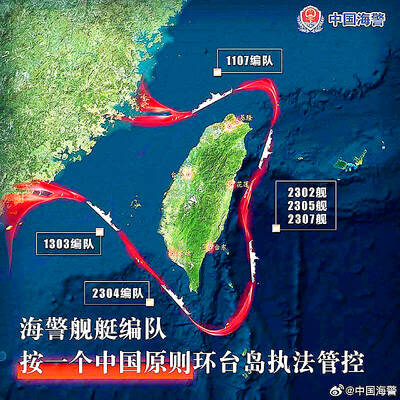
Taiwan would benefit from more integrated military strategies and deployments if the US and its allies treat the East China Sea, the Taiwan Strait and the South China Sea as a “single theater of operations,” a Taiwanese military expert said yesterday. Shen Ming-shih (沈明室), a researcher at the Institute for National Defense and Security Research, said he made the assessment after two Japanese military experts warned of emerging threats from China based on a drill conducted this month by the Chinese People’s Liberation Army’s (PLA) Eastern Theater Command. Japan Institute for National Fundamentals researcher Maki Nakagawa said the drill differed from the
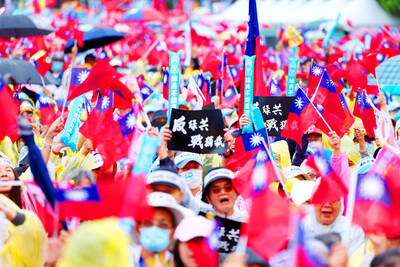
‘WORSE THAN COMMUNISTS’: President William Lai has cracked down on his political enemies and has attempted to exterminate all opposition forces, the chairman said The legislature would motion for a presidential recall after May 20, Chinese Nationalist Party (KMT) Chairman Eric Chu (朱立倫) said yesterday at a protest themed “against green communists and dictatorship” in Taipei. Taiwan is supposed to be a peaceful homeland where people are united, but President William Lai (賴清德) has been polarizing and tearing apart society since his inauguration, Chu said. Lai must show his commitment to his job, otherwise a referendum could be initiated to recall him, he said. Democracy means the rule of the people, not the rule of the Democratic Progressive Party (DPP), but Lai has failed to fulfill his

OFF-TARGET: More than 30,000 participants were expected to take part in the Games next month, but only 6,550 foreign and 19,400 Taiwanese athletes have registered Taipei city councilors yesterday blasted the organizers of next month’s World Masters Games over sudden timetable and venue changes, which they said have caused thousands of participants to back out of the international sporting event, among other organizational issues. They also cited visa delays and political interference by China as reasons many foreign athletes are requesting refunds for the event, to be held from May 17 to 30. Jointly organized by the Taipei and New Taipei City governments, the games have been rocked by numerous controversies since preparations began in 2020. Taipei City Councilor Lin Yen-feng (林延鳳) said yesterday that new measures by
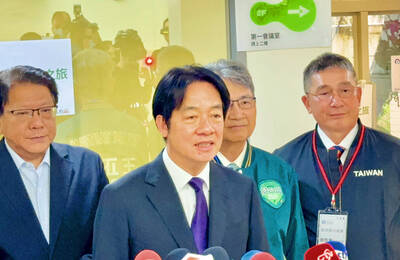
A rally held by opposition parties yesterday demonstrates that Taiwan is a democratic country, President William Lai (賴清德) said yesterday, adding that if opposition parties really want to fight dictatorship, they should fight it on Tiananmen Square in Beijing. The Chinese Nationalist Party (KMT) held a protest with the theme “against green communists and dictatorship,” and was joined by the Taiwan People’s Party. Lai said the opposition parties are against what they called the “green communists,” but do not fight against the “Chinese communists,” adding that if they really want to fight dictatorship, they should go to the right place and face


 RSS
RSS