


Increased economic prosperity has resulted in more attention being paid to the field of occupational safety and health, organizers of the seventh International Occupation Hygiene Association's (IOHA) conference said yesterday.
"We are honored to hold the IOHA conference in Taipei this year. It is an international vote of confidence in Taiwan's commitment to this field," said Chang Cheng-ping (張振平), director of the occupational hygiene division of the Institute of Occupational Safety and Health (IOSH), housed under the Council of Labor Affairs.
Researchers and experts from 34 different countries will discuss a wide range of topics pertaining to occupational safety and health, from traditional hazards such as exposure to heavy metals to new challenges such as the possible health ramifications for workers dealing with nanotechnology materials.
WHITE COLLAR
Occupational health issues affecting white-collar workers such as ergonomics and work stress have also received increased attention, said Feng Ching-an (馮靜安), editor of the Journal of the Taiwan Occupational Hygiene Association (TOHA) and a researcher in occupational safety and hygiene at Tajen University.
"You are putting yourself at risk right now just by the way you are jotting down your notes," Feng told the Taipei Times.
"The way your torso is twisted as you sit is putting stress on your spine," Feng said. "Over the years, such stresses add up and can result in back pain and other chronic issues."
Occupational safety and health is not just about preventing accidents or limiting exposure to toxic substances anymore, Feng said.
"As Taiwan becomes a wealthier country with more and more workers finding themselves in office environments, we are expanding the scope of our field to include repetitive stress injuries in white collar jobs and even worker's mental health as it relates to their job," Feng said.
"We are going beyond just worker safety issues, approaching the concept of occupational hygiene as understood in developed countries," Feng said.
INHERENT RISKS
Expanding of the field of occupational hygiene beyond blue-collar issues does not mean those problems are solved, however, Chang said.
"Of course, blue-collar workers such as construction and factory workers are still the ones who are most at-risk from their workplace," Chang said.
In addition to the inherent risk of some jobs, best practices are simply not followed in many factories and construction sites across the country, he said.
In a country where there are so many small and medium businesses, disseminating the necessary information and getting the rules enforced is difficult, Chang said.
"For instance, we have very well-crafted laws governing firecracker factories," Chang said. "However, all the serious accidents happen in unlicensed factories where the owners make these massive profits by cutting corners."

Actor Darren Wang (王大陸) was sentenced to six months in prison, commutable to a fine, by the New Taipei District Court today for contravening the Personal Data Protection Act (個人資料保護法) in a case linked to an alleged draft-dodging scheme. Wang allegedly paid NT$3.6 million (US$114,380) to an illegal group to help him evade mandatory military service through falsified medical documents, prosecutors said. He transferred the funds to Chen Chih-ming (陳志明), the alleged mastermind of a draft-evasion ring, although he lost contact with him as he was already in detention on fraud charges, they said. Chen is accused of helping a

SECURITY: Starlink owner Elon Musk has taken pro-Beijing positions, and allowing pro-China companies to control Taiwan’s critical infrastructure is risky, a legislator said Starlink was reluctant to offer services in Taiwan because of the nation’s extremely high penetration rates in 4G and 5G services, the Ministry of Digital Affairs said yesterday. The ministry made the comments at a meeting of the legislature’s Transportation Committee, which reviewed amendments to Article 36 of the Telecommunications Management Act (電信管理法). Article 36 bans foreigners from holding more than 49 percent of shares in public telecommunications networks, while shares foreigners directly and indirectly hold are also capped at 60 percent of the total, unless specified otherwise by law. The amendments, sponsored by Chinese Nationalist Party (KMT) Legislator Ko

‘SAME OLD TRICK’: Even if Beijing resumes individual travel to Taiwan, it would only benefit Chinese tourism companies, the Economic Democracy Union convener said China’s 10 new “incentives” are “sugar-coated poison,” an official said yesterday, adding that Taiwanese businesses see them clearly for what they are, but that Beijing would inevitably find some local collaborators to try to drums up support. The official, speaking on condition of anonymity, made the remark ahead of a news conference the General Chamber of Commerce is to hold today. The event, titled “Industry Perspectives on China’s Recent Pro-Taiwan Policies,” is expected to include representatives from industry associations — such as those in travel, hotels, food and agriculture — to request the government cooperate with China’s new measures, people familiar with
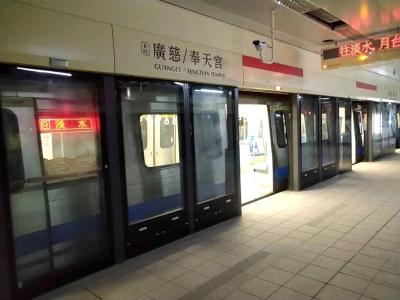
The eastern extension of the Taipei MRT Red Line could begin operations as early as late June, the Taipei Department of Rapid Transit Systems said yesterday. Taipei Rapid Transit Corp said it is considering offering one month of free rides on the new section to mark its opening. Construction progress on the 1.4km extension, which is to run from the current terminal Xiangshan Station to a new eastern terminal, Guangci/Fengtian Temple Station, was 90.6 percent complete by the end of last month, the department said in a report to the Taipei City Council's Transportation Committee. While construction began in October 2016 with an


 RSS
RSS