


Gay marriage, environmental issues, preservation of Aboriginal cultures, farmland conservation, whether the Suhua Freeway should be constructed and human rights were among the questions the nation's citizens wanted to ask the two presidential candidates in their coming debate.
Organized by the Central News Agency, the Liberty Times (the Taipei Times' sister newspaper), China Times, United Daily News, Apple Daily, and Public Television Service (PTS), the first televised debate for the March presidential election is scheduled for Feb. 24.
For the first time in history, the organizers have invited all Taiwanese to raise questions for the candidates by recording 30-second video clips and posting them on www.PeoPo.org, a free lance news service Web site created by PTS.
A total of 456 video clips were uploaded between Dec. 4 last year, when the upload period began, and last Thursday, when the period ended, the news service Web site showed.
CRITERIA
Twenty of the questions will be used during the debate.
"We first put the questions into 10 major categories ? then we picked out questions that best represent each category," senior producer at PTS' news department, Grace Tu (屠乃瑋), said during an interview on the Web site. "[Important criteria] include whether the question raiser clearly defined the question, whether they spoke in neutral terms and whether the question was good enough to represent a particular category. We also took into consideration if all regions [of the country], all age groups and both genders were well represented."
Green Party Taiwan Secretary-General Pan Han-shen (潘翰聲) was among the 20 people whose questions were chosen. Pan asked the two candidates if they would sign the Kyoto Protocol if Taiwan became a member of the UN and what they would do about heavy polluting industry.
HUMAN RIGHTS
Another contributor, Su Chien-ho (
Su and two others had been on death row for more than 11 years because of the controversial Hsichi (汐止) Trio case.
The trio -- who insist they are innocent and allege they were tortured -- were accused of committing a murder in Hsichi, Taipei County, and sentenced to death, though there was no direct evidence linking them to the murder.
The 20 finalists will be invited to the debate to ask their questions to the two candidates.

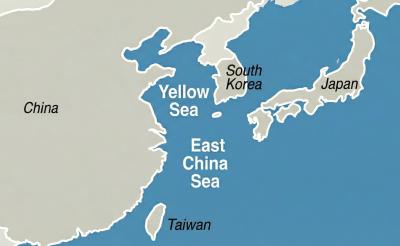
China has reserved offshore airspace in the Yellow Sea and East China Sea from March 27 to May 6, issuing alerts usually used to warn of military exercises, although no such exercises have been announced, the Wall Street Journal (WSJ) reported yesterday. Reserving such a large area for 40 days without explanation is an “unusual step,” as military exercises normally only last a few days, the paper said. These alerts, known as Notice to Air Missions (Notams), “are intended to inform pilots and aviation authorities of temporary airspace hazards or restrictions,” the article said. The airspace reserved in the alert is

South Korea is planning to revise its controversial electronic arrival card, a step Taiwanese officials said prompted them to hold off on planned retaliatory measures, a South Korean media report said yesterday. A Yonhap News Agency report said that the South Korean Ministry of Foreign Affairs is planning to remove the “previous departure place” and “next destination” fields from its e-arrival card system. The plan, reached after interagency consultations, is under review and aims to simplify entry procedures and align the electronic form with the paper version, a South Korean ministry official said. The fields — which appeared only on the electronic form

A bipartisan group of US senators has introduced a bill to enhance cooperation with Taiwan on drone development and to reduce reliance on supply chains linked to China. The proposed Blue Skies for Taiwan Act of 2026 was introduced by Republican US senators Ted Cruz and John Curtis, and Democratic US senators Jeff Merkley and Andy Kim. The legislation seeks to ease constraints on Taiwan-US cooperation in uncrewed aerial systems (UAS), including dependence on China-sourced components, limited access to capital and regulatory barriers under US export controls, a news release issued by Cruz on Wednesday said. The bill would establish a "Blue UAS
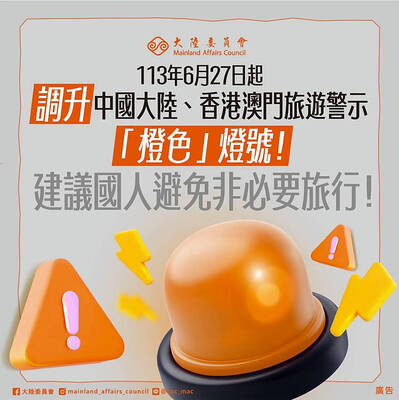
More than 6,000 Taiwanese students have participated in exchange programs in China over the past two years, despite the Mainland Affairs Council’s (MAC) “orange light” travel advisory, government records showed. The MAC’s publicly available registry showed that Taiwanese college and university students who went on exchange programs across the Strait numbered 3,592 and 2,966 people respectively. The National Immigration Agency data revealed that 2,296 and 2,551 Chinese students visited Taiwan for study in the same two years. A review of the Web sites of publicly-run universities and colleges showed that Taiwanese higher education institutions continued to recruit students for Chinese educational programs without


 RSS
RSS