


The Cabinet has completed a draft to streamline its 36 agencies to 26, with 14 ministries, seven commissions and five independent institutions, Executive Yuan Secretary-General Chen Chin-jun (陳景峻) said yesterday.
Chen said that following approval of the amendment to the Organic Law of the Executive Yuan (
In September 2004, premier Yu Shyi-kun sent an amendment to the law that suggested cutting the Executive Yuan's 36 agencies to 22, with 13 ministries, four commissions and five independent institutions.
Lawmakers from across party lines in the last legislature came close to agreeing to the earlier amendment after making some revisions at a cross-party negotiation meeting in December 2005, but it was then stalled in the legislature.
Chen said the new amendment was drafted on the basis of the conclusions reached at the negotiation meeting and in light of the pan-blue camp's three-quarter majority in the legislature.
NEW MINISTRIES
Under the new amendment, six new ministries would be established under the Executive Yuan to add to the eight ministries mandated by the Organic Law of the Executive Yuan.
The 14 ministries would cover interior and homeland security, foreign and overseas affairs, defense, finance, education and sports, judicial matters, the economy and trade, transportation and construction, labor and human resources, agriculture, public health and social security, culture and tourism, environmental resources and veterans affairs.
The seven commissions would include a new technology commission, a new maritime council, a new commission on gender equality, a new national development commission, the Hakka Council, the Aboriginal Council and the Mainland Affairs Council (MAC).
At the 2005 cross-party negotiation meeting, the Democratic Progressive Party (DPP) legislative caucus backed down on the Executive Yuan's intention to abolish the MAC and to integrate it with the premier's office.
DEFENSE
The DPP also made concessions to the opposition, as the Veterans Affairs Commission (VAC) will not be merged with the Ministry of National Defense (MND).
The Executive Yuan initially planned to create a new ministry that would combine the MND and the VAC.
The five independent institutions are the Central Bank of China, the Central Election Commission, the Fair Trade Commission, the Financial Supervisory Commission and the National Communication Commission.
The Cabinet is required by the Standard Organic Law of Central Government Agencies (中央政府機關組織基準法), passed in the legislature in June 2003, to release draft amendments to the law three months after the promulgation of the standard organic law.
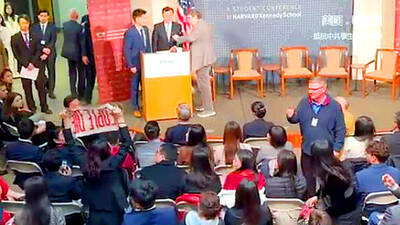
A group of Taiwanese-American and Tibetan-American students at Harvard University on Saturday disrupted Chinese Ambassador to the US Xie Feng’s (謝鋒) speech at the school, accusing him of being responsible for numerous human rights violations. Four students — two Taiwanese Americans and two from Tibet — held up banners inside a conference hall where Xie was delivering a speech at the opening ceremony of the Harvard Kennedy School China Conference 2024. In a video clip provided by the Coalition of Students Resisting the CCP (Chinese Communist Party), Taiwanese-American Cosette Wu (吳亭樺) and Tibetan-American Tsering Yangchen are seen holding banners that together read:

UNAWARE: Many people sit for long hours every day and eat unhealthy foods, putting them at greater risk of developing one of the ‘three highs,’ an expert said More than 30 percent of adults aged 40 or older who underwent a government-funded health exam were unaware they had at least one of the “three highs” — high blood pressure, high blood lipids or high blood sugar, the Health Promotion Administration (HPA) said yesterday. Among adults aged 40 or older who said they did not have any of the “three highs” before taking the health exam, more than 30 percent were found to have at least one of them, Adult Preventive Health Examination Service data from 2022 showed. People with long-term medical conditions such as hypertension or diabetes usually do not
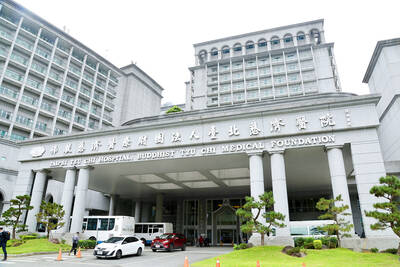
POLICE INVESTIGATING: A man said he quit his job as a nurse at Taipei Tzu Chi Hospital as he had been ‘disgusted’ by the behavior of his colleagues A man yesterday morning wrote online that he had witnessed nurses taking photographs and touching anesthetized patients inappropriately in Taipei Tzu Chi Hospital’s operating theaters. The man surnamed Huang (黃) wrote on the Professional Technology Temple bulletin board that during his six-month stint as a nurse at the hospital, he had seen nurses taking pictures of patients, including of their private parts, after they were anesthetized. Some nurses had also touched patients inappropriately and children were among those photographed, he said. Huang said this “disgusted” him “so much” that “he felt the need to reveal these unethical acts in the operating theater
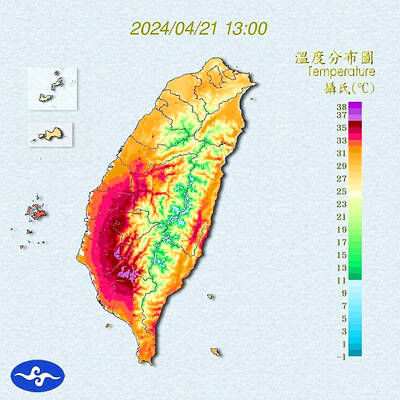
Heat advisories were in effect for nine administrative regions yesterday afternoon as warm southwesterly winds pushed temperatures above 38°C in parts of southern Taiwan, the Central Weather Administration (CWA) said. As of 3:30pm yesterday, Tainan’s Yujing District (玉井) had recorded the day’s highest temperature of 39.7°C, though the measurement will not be included in Taiwan’s official heat records since Yujing is an automatic rather than manually operated weather station, the CWA said. Highs recorded in other areas were 38.7°C in Kaohsiung’s Neimen District (內門), 38.2°C in Chiayi City and 38.1°C in Pingtung’s Sandimen Township (三地門), CWA data showed. The spell of scorching


 RSS
RSS