


For Ping-cheng (秉程), a 12-year-old student with autism who is in the special education program at Kaohsiung City's Ding Jin Junior High School, learning to express emotions has never been easy.
However, his school days have been brightened since Pipi, a stray dog, came along.
The eight-year-old stray has been able to bring Ping-cheng out of his shell and the two are now best buddies. Pipi's help with Ping-cheng earned the dog a special scarf during a ceremony held by the city government on Dec. 20 and official recognition as the "dog of Ding Jin."
Nine other stray dogs were also recognized as part of the city government's "Loving Dog on Campus" program.
The trial program, launched by the Livestock Health and Inspection Laboratory of the city's Economic Affairs Bureau, aims to ease the city's stray dog problem by finding dogs homes on school campuses.
Statistics released last year by the lab show the number of stray dogs it captured and housed each year had increased from about 2,000 a few years ago to 5,000.
Former bureau director Jason Hung (洪富峰) said last June that the lab had euthanized about 300 dogs a month over the past decade.
An unofficial estimate by the city's animal rights groups last May put the number of stray dogs euthanized by the lab over the past 10 years at 36,000.
Kaohsiung Concern Stray Animal Association director Wang Chun-ching (王春經) said there are about 8,000 strays in the city now.
"We should treat school adoption of strays as a serious project," City Government Secretary-General Hau Chien-sheng (郝建生) said. "We hope to provide them with room for survival on campuses. They can be taken care of inside the schools and they can also help ensure campus security."
Five junior high schools -- Ding Jin Junior High, Wu Fu Junior High, Hsing Jen Junior High, Chung Shan Junior High and Minzu Junior High -- have adopted a total of 10 strays.
A technical specialist at the lab, surnamed Chiu (邱), said the agency began the project last October.
Chiu, who developed the program, said the 10 strays in the trial had been evaluated by animal experts to ensure they enjoyed interacting with people.
But the adoption program is not simply about finding homes for stray dogs on campus. The lab also educates those people who will directly interact with the canines -- teachers and students in particular -- to prevent the dogs from being mistreated.
School staff -- mostly counselors -- were required to attend dog-care classes before the adoption program began, Chiu said.
The best part of the program is that students have the opportunity to learn to respect life, he said.
"The program helps students understand that stray dogs are friendly," Chiu said. "Students can come in close contact with them. Pupils will learn that they shouldn't be afraid of the dogs just because they are strays."
Schools can design courses to teach students the right way to interact with dogs, Chiu said, adding that the lab will conduct regular follow-ups to ensure the dogs are in good hands.
Animal protection organizations have praised the project.
"Students can learn to be responsible pet owners. They learn how dogs become strays and that they should not abandon their dogs if they love them," said Wang, whose association rescued a black dog -- a female named "209" -- that had been living on the freeway divider on a stretch of the Sun Yat-sen Freeway last year.
"I believe some students may still bully the strays on campus, but at least schools can correct their misbehavior right away," Wang said.
Wang urged the city officials to require every school in Kaohsiung to join the adoption program, even though "some principals are prejudiced against strays."
"It is very difficult to change parents' perception of strays ... but at least we can start by changing children's perceptions," she said.
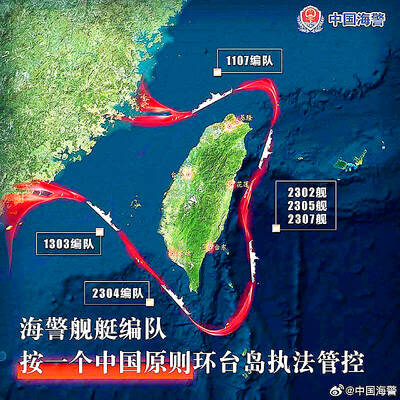
Taiwan would benefit from more integrated military strategies and deployments if the US and its allies treat the East China Sea, the Taiwan Strait and the South China Sea as a “single theater of operations,” a Taiwanese military expert said yesterday. Shen Ming-shih (沈明室), a researcher at the Institute for National Defense and Security Research, said he made the assessment after two Japanese military experts warned of emerging threats from China based on a drill conducted this month by the Chinese People’s Liberation Army’s (PLA) Eastern Theater Command. Japan Institute for National Fundamentals researcher Maki Nakagawa said the drill differed from the

‘WORSE THAN COMMUNISTS’: President William Lai has cracked down on his political enemies and has attempted to exterminate all opposition forces, the chairman said The legislature would motion for a presidential recall after May 20, Chinese Nationalist Party (KMT) Chairman Eric Chu (朱立倫) said yesterday at a protest themed “against green communists and dictatorship” in Taipei. Taiwan is supposed to be a peaceful homeland where people are united, but President William Lai (賴清德) has been polarizing and tearing apart society since his inauguration, Chu said. Lai must show his commitment to his job, otherwise a referendum could be initiated to recall him, he said. Democracy means the rule of the people, not the rule of the Democratic Progressive Party (DPP), but Lai has failed to fulfill his
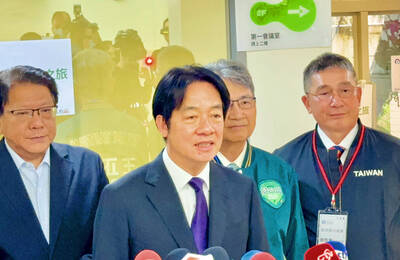
A rally held by opposition parties yesterday demonstrates that Taiwan is a democratic country, President William Lai (賴清德) said yesterday, adding that if opposition parties really want to fight dictatorship, they should fight it on Tiananmen Square in Beijing. The Chinese Nationalist Party (KMT) held a protest with the theme “against green communists and dictatorship,” and was joined by the Taiwan People’s Party. Lai said the opposition parties are against what they called the “green communists,” but do not fight against the “Chinese communists,” adding that if they really want to fight dictatorship, they should go to the right place and face
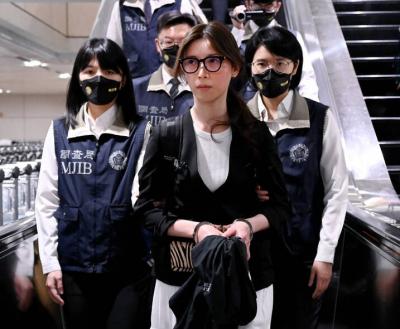
A fugitive in a suspected cosmetic surgery fraud case today returned to Taiwan from Canada, after being wanted for six years. Internet celebrity Su Chen-tuan (蘇陳端), known as Lady Nai Nai (貴婦奈奈), and her former boyfriend, plastic surgeon Paul Huang (黃博健), allegedly defrauded clients and friends of about NT$1 billion (US$30.66 million). Su was put on a wanted list in 2019 when she lived in Toronto, Canada, after failing to respond to subpoenas and arrest warrants from the Taipei District Prosecutors’ Office. Su arrived at Taiwan Taoyuan International Airport at 5am today on an EVA Air flight accompanied by a


 RSS
RSS