


The nation's politicians are wasting judicial resources by filing slander lawsuits against one another, said a Taipei District Court judge who is presiding over Chinese Nationalist Party (KMT) presidential candidate Ma Ying-jeou's (
Judge Chang Wen-chun (
Former Democratic Progressive Party (DPP) legislator Hsu Kuo-yung (
But Hsu also filed a countersuit of malicious accusation against Ma.
Ma appeared at Taipei District Court yesterday to attend the hearing at the court's request.
Chang said at the hearing he found that Hsu's remark, which is in accordance with information written in Ma's indictment paper, was not groundless.
The judge told Ma that while he was acquitted by the Taiwan High Court on charges of embezzling special allowance funds as Taipei mayor, the verdict only indicated there was insufficient evidence to support the case, but could not prove his innocence.
When the nation's politicians used slander lawsuits to accuse one another they were not only wasting judicial resources but also polluting the judicial system with politics, Chang said.
Ma was indicted last February on charges of embezzling NT$11 million (US$338,000) from his special mayoral allowance during his eight years as Taipei mayor, but he was acquitted in two trials and prosecutors have appealed the case to the Supreme Court.
Ma yesterday told reporters that he would withdraw the suit "only if Hsu apologized for his false accusations."
Ma said that his former secretary, Yu Wen (余文), a co-defendant at his trial, was found to have used fraudulent receipts to claim reimbursements from his special allowance fund, so he knew nothing about the receipts Hsu accused him of claiming reimbursements for.
Meanwhile, Cabinet Spokesman Shieh Jhy-wey (謝志偉) yesterday morning attended a slander hearing in which he was sued by Ma for alleging he once served as a "professional student" for the KMT while studying at Harvard University.
In Taiwan, the term "professional student" usually refers to individuals who studied abroad on KMT scholarships and worked as campus spies for the party, reporting on pro-independence Taiwanese students.
Shieh said in January last year that Ma should explain whether he had monitored the activities of Taiwanese students and collected information for the party while he studied law at Harvard from 1974 to 1981.
Shieh told the court yesterday his remark was based on fact and that he had evidence to question Ma's role as a student in the US.
Ma spokesman Lo Chih-chiang (羅智強), who attended the hearing representing Ma, told the court Shieh had provided no evidence to support such "a dirty accusation."

LOUD AND PROUD Taiwan might have taken a drubbing against Australia and Japan, but you might not know it from the enthusiasm and numbers of the fans Taiwan might not be expected to win the World Baseball Classic (WBC) but their fans are making their presence felt in Tokyo, with tens of thousands decked out in the team’s blue, blowing horns and singing songs. Taiwanese fans have packed out the Tokyo Dome for all three of their games so far and even threatened to drown out home team supporters when their team played Japan on Friday. They blew trumpets, chanted for their favorite players and had their own cheerleading squad who dance on a stage during the game. The team struggled to match that exuberance on the field, with
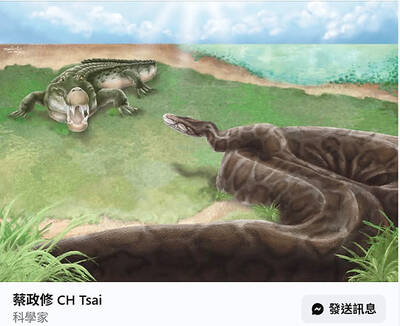
Taiwanese paleontologists have discovered fossil evidence that pythons up to 4m long inhabited Taiwan during the Pleistocene epoch, reporting their findings in the international scientific journal Historical Biology. National Taiwan University (NTU) Institute of Ecology and Evolutionary Biology associate professor Tsai Cheng-hsiu (蔡政修) led the team that discovered the largest snake fossil ever found in Taiwan. The single trunk vertebra was discovered in Tainan at the Chiting Formation, dated to between 400,000 and 800,000 years ago in the Middle Pleistocene, the paper said. The area also produced Taiwan’s first avian fossil, as well as crocodile, mammoth, saber-toothed cat and rhinoceros fossils, it said. Discoveries

Taiwanese paleontologists have discovered fossil evidence that pythons up to 4m long inhabited Taiwan during the Pleistocene epoch, reporting their findings in the international scientific journal Historical Biology. National Taiwan University (NTU) Institute of Ecology and Evolutionary Biology associate professor Tsai Cheng-hsiu (蔡政修) led the team that discovered the largest snake fossil ever found in Taiwan. A single trunk vertebra was discovered in Tainan at the Chiting Formation, dated to between 800,000 to 400,000 years ago in the Middle Pleistocene, the paper said. The area also produced Taiwan’s first avian fossil, as well as crocodile, mammoth, sabre-toothed cat and rhinoceros fossils, it said. Discoveries
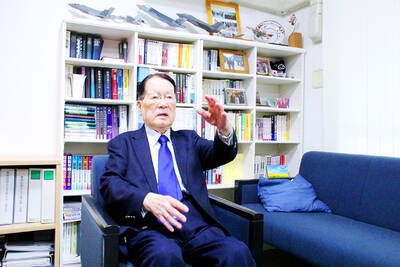
Whether Japan would help defend Taiwan in case of a cross-strait conflict would depend on the US and the extent to which Japan would be allowed to act under the US-Japan Security Treaty, former Japanese minister of defense Satoshi Morimoto said. As China has not given up on the idea of invading Taiwan by force, to what extent Japan could support US military action would hinge on Washington’s intention and its negotiation with Tokyo, Morimoto said in an interview with the Liberty Times (sister paper of the Taipei Times) yesterday. There has to be sufficient mutual recognition of how Japan could provide


 RSS
RSS