


Most Chinese spouses of Taiwanese are anticipating the Lunar New Year holiday with the same excitement as other people in Taiwan, tinged with a little disappointment that they cannot be reunited with their relatives in China to celebrate the year's most important festival.
Despite the company of the family of her husband and friends, Yin, who has lived in Taiwan for eight years with her Taiwanese husband, cannot stem her yearning for her daughter, who studies in Zhejiang Province.
The daughter is from an earlier marriage. When Yin decided to remarry and move to Taiwan, her daughter was only a teenager and she had to leave her with relatives. Yin has returned a few times to her hometown over the past eight years, yet her greatest desire -- to live close to her daughter -- will not be realized soon.
In contrast to the cheerful atmosphere of the Lunar New Year, Yin's regret seems to be more intense than usual.
"However happily you live here, the sorrow over the separation from your close relatives remains inconsolable," she said.
Yin is not alone. Feng, a young woman from Anhui Province, who had been hoping to see her parents, ditched the idea after considering the logistical problems involved.
"Procedures for applying for a family visit visa are too complicated and the maximum permitted time is just one month, at most two," Feng said.
Planning a family reunion is long because it is difficult for Chinese spouses to receive a Republic of China identity card. They often have to wait eight years to be naturalized and according to government statistics, as of last November, only 44,493 out of 250,160 Chinese spouses (17.8 percent) had been granted an identity card, while 59,906 out of 137,353 spouses from other countries (43.6 percent) had become naturalized citizens.
In addition, Chinese people can only come to Taiwan on a group tourist visa and can stay for a maximum of 10 days.
Although Chinese spouses suffer from the separation from their families in China during the Lunar New Year holiday, they are excited nevertheless about the festival.
"In Guangdong Province, families that are well-off prepare `dragon-phoenix soup' made with snake and chicken or `turtle-snake soup,'" said a young woman who was born in Shenzhen.
She said that in general, Taiwan celebrates the Lunar New Year with much the same traditions and customs as in China.
"But I was surprised that people in Taiwan keep the tradition of worshiping gods and ancestors during the Lunar New Year. This kind of tradition is no longer popular in China after the Cultural Revolution," she said.
The Taipei-based Chinese Association for Relief and Ensuring Services, organizes English, dancing and cooking courses for Chinese spouses, while on Jan. 20, the Pearl S. Buck Foundation invited low-income families of foreign spouses for an early celebration of the Lunar New Year.
These NGOs, however, do not want their activities to be seen as charity for foreigners, since they do not want to differentiate between Taiwanese and foreign spouses.
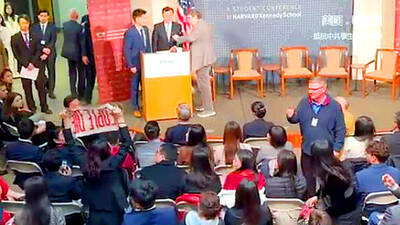
A group of Taiwanese-American and Tibetan-American students at Harvard University on Saturday disrupted Chinese Ambassador to the US Xie Feng’s (謝鋒) speech at the school, accusing him of being responsible for numerous human rights violations. Four students — two Taiwanese Americans and two from Tibet — held up banners inside a conference hall where Xie was delivering a speech at the opening ceremony of the Harvard Kennedy School China Conference 2024. In a video clip provided by the Coalition of Students Resisting the CCP (Chinese Communist Party), Taiwanese-American Cosette Wu (吳亭樺) and Tibetan-American Tsering Yangchen are seen holding banners that together read:

UNAWARE: Many people sit for long hours every day and eat unhealthy foods, putting them at greater risk of developing one of the ‘three highs,’ an expert said More than 30 percent of adults aged 40 or older who underwent a government-funded health exam were unaware they had at least one of the “three highs” — high blood pressure, high blood lipids or high blood sugar, the Health Promotion Administration (HPA) said yesterday. Among adults aged 40 or older who said they did not have any of the “three highs” before taking the health exam, more than 30 percent were found to have at least one of them, Adult Preventive Health Examination Service data from 2022 showed. People with long-term medical conditions such as hypertension or diabetes usually do not
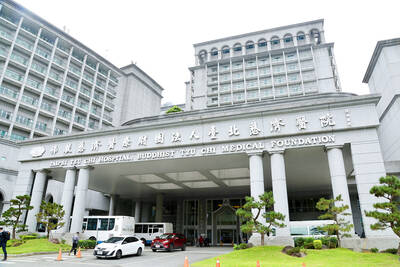
POLICE INVESTIGATING: A man said he quit his job as a nurse at Taipei Tzu Chi Hospital as he had been ‘disgusted’ by the behavior of his colleagues A man yesterday morning wrote online that he had witnessed nurses taking photographs and touching anesthetized patients inappropriately in Taipei Tzu Chi Hospital’s operating theaters. The man surnamed Huang (黃) wrote on the Professional Technology Temple bulletin board that during his six-month stint as a nurse at the hospital, he had seen nurses taking pictures of patients, including of their private parts, after they were anesthetized. Some nurses had also touched patients inappropriately and children were among those photographed, he said. Huang said this “disgusted” him “so much” that “he felt the need to reveal these unethical acts in the operating theater
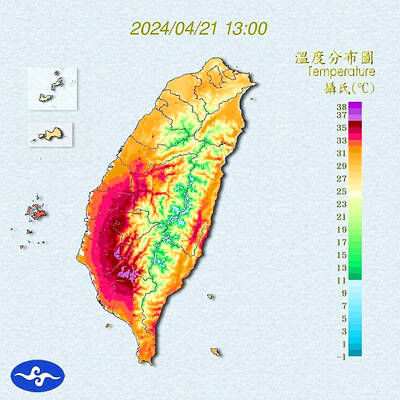
Heat advisories were in effect for nine administrative regions yesterday afternoon as warm southwesterly winds pushed temperatures above 38°C in parts of southern Taiwan, the Central Weather Administration (CWA) said. As of 3:30pm yesterday, Tainan’s Yujing District (玉井) had recorded the day’s highest temperature of 39.7°C, though the measurement will not be included in Taiwan’s official heat records since Yujing is an automatic rather than manually operated weather station, the CWA said. Highs recorded in other areas were 38.7°C in Kaohsiung’s Neimen District (內門), 38.2°C in Chiayi City and 38.1°C in Pingtung’s Sandimen Township (三地門), CWA data showed. The spell of scorching


 RSS
RSS