


Environmentally friendly designers can now dress for success in fabrics made from recycled PET bottles and win up to NT$120,000 in a creative fashion design competition sponsored by the Environmental Protection Administration (EPA).
The competition is designed to raise public awareness in the public of the importance and ease of putting theory into practice and use recycled materials in making things that are new and functional, EPA Minister Winston Dang (
"Since the emergence of global warming and the energy crisis, it is the responsibility of everyone on the Earth to care for our planet and preserve its resources," he said. "Environmental protection can be easily done in everyday life, it can also be blended into various aspects of life, such as fashion designs."
PET refers to polyethylene terephthalate, one of the most common consumer plastics used, and is a thermoplastic polymer resin of the polyester family that is very commonly used in synthetic fibers and bottles or food containers.
"Taiwanese recycle 90,000 tonnes of PET bottles a year," Dang said, "which translates to 4.5 billion 600 milliliter bottles -- enough to go around Taiwan 1,080 times."
Recycling the bottles was estimated to save NT$280 million (US$8.7 million) annually on garbage processing expenses, while creating NT3.5 billion in recycled raw materials called post-consumer PET, Dang said.
To enter the competition, designers must submit design sketches for clothing or upholstery using recycled PET fabrics that bear the "Green Mark" certified by the EPA.
The competition, which started on Thursday, will be held in two stages. Contestants can sign up for two subcategories: the practical group and the creative group.
The competition's first stage will close on March 23, after which 10 finalists will be selected from each group to design 15 different types of EPA-Green Mark recycled PET fabric.
Total prizes have a combined value of NT$1 million and the winners will walk away with NT$120,000 each.
So far the administration has granted the Green Mark to 3,640 products that together bring in an annual revenue of NT$80.5 billion for Taiwan, saving 147 million kilowatts of electricity, 48 million tonnes of water, and 96,000 tonnes of carbon emission in the process, Dang said.
More information about the competition can be found online at recycle.epa.gov.tw.
For more information about Green Mark products, visit greenliving.epa.gov.tw.

LOUD AND PROUD Taiwan might have taken a drubbing against Australia and Japan, but you might not know it from the enthusiasm and numbers of the fans Taiwan might not be expected to win the World Baseball Classic (WBC) but their fans are making their presence felt in Tokyo, with tens of thousands decked out in the team’s blue, blowing horns and singing songs. Taiwanese fans have packed out the Tokyo Dome for all three of their games so far and even threatened to drown out home team supporters when their team played Japan on Friday. They blew trumpets, chanted for their favorite players and had their own cheerleading squad who dance on a stage during the game. The team struggled to match that exuberance on the field, with
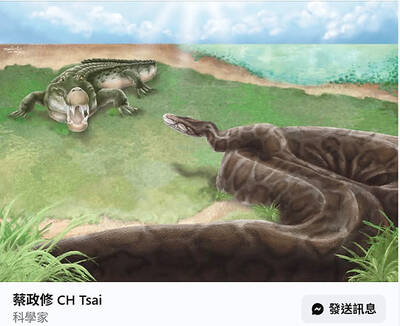
Taiwanese paleontologists have discovered fossil evidence that pythons up to 4m long inhabited Taiwan during the Pleistocene epoch, reporting their findings in the international scientific journal Historical Biology. National Taiwan University (NTU) Institute of Ecology and Evolutionary Biology associate professor Tsai Cheng-hsiu (蔡政修) led the team that discovered the largest snake fossil ever found in Taiwan. The single trunk vertebra was discovered in Tainan at the Chiting Formation, dated to between 400,000 and 800,000 years ago in the Middle Pleistocene, the paper said. The area also produced Taiwan’s first avian fossil, as well as crocodile, mammoth, saber-toothed cat and rhinoceros fossils, it said. Discoveries

Taiwanese paleontologists have discovered fossil evidence that pythons up to 4m long inhabited Taiwan during the Pleistocene epoch, reporting their findings in the international scientific journal Historical Biology. National Taiwan University (NTU) Institute of Ecology and Evolutionary Biology associate professor Tsai Cheng-hsiu (蔡政修) led the team that discovered the largest snake fossil ever found in Taiwan. A single trunk vertebra was discovered in Tainan at the Chiting Formation, dated to between 800,000 to 400,000 years ago in the Middle Pleistocene, the paper said. The area also produced Taiwan’s first avian fossil, as well as crocodile, mammoth, sabre-toothed cat and rhinoceros fossils, it said. Discoveries

Whether Japan would help defend Taiwan in case of a cross-strait conflict would depend on the US and the extent to which Japan would be allowed to act under the US-Japan Security Treaty, former Japanese minister of defense Satoshi Morimoto said. As China has not given up on the idea of invading Taiwan by force, to what extent Japan could support US military action would hinge on Washington’s intention and its negotiation with Tokyo, Morimoto said in an interview with the Liberty Times (sister paper of the Taipei Times) yesterday. There has to be sufficient mutual recognition of how Japan could provide


 RSS
RSS