


A Japanese man who came to Taiwan several years ago to learn Mandarin and happened to glimpse the outlying Penghu island group has become a longstay visitor there after succumbing to its natural beauty.
Osamu Negishi, who served as a Christian missionary before coming to Taiwan in June 2001, has been living in Penghu for four years, dividing his time between teaching Japanese at a cram school he established in Penghu's capital Makung (馬公) and lying back on the white sand beaches, feasting his eyes on the emerald sea and beautiful coastline scenery.
Negishi, 58, from Japan's central prefecture of Gunma, said he spent his first two-and-a-half years in Taichung, where he enjoyed the temperate climate.
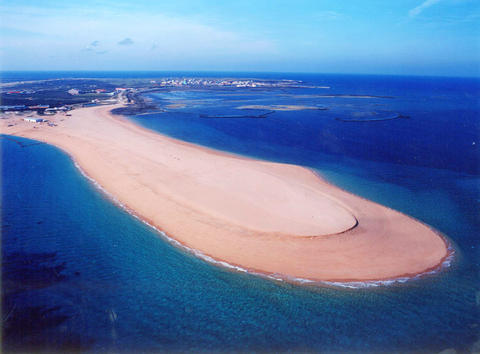
PHOTO COUTESY OF THE PENGHU NATIONAL SCENIC AREA ADMINISTRATION
He recalled that one day he was flying as a backpacker from Taichung to Kinmen when he looked down and spotted an archipelago of islets that captivated his imagination.
Attracted by this "unknown" islet chain, Negishi inquired about it and found out its name.
Without wasting another day, Negishi headed for Penghu as soon as he returned from Kinmen. Upon setting foot on Penghu in late 2003, he decided to stay for a year. Four years on, he has no plans to leave.
A born traveler, Negishi has since scouted every islet of the Penghu group and has left almost no stone unturned.
"Now I know the smallest islets, some of which even the locals have never visited," Negishi said.
Thanks to the convenience of the Internet, Negishi introduces people to the beauty of Penghu online and so far more than 20 Japanese students have been attracted to travel from Japan to study Mandarin at his cram school, called "Forrest Gump," where he employs several Penghu residents as teachers.
Negishi said economic reasons were the least of his considerations when he opened his school, adding that the rent he collects from leasing his house in Japan is enough to pay for his island living.
Asked what keeps him in Penghu, Negishi said the beautiful sea is the biggest attraction, followed by the safe environment, an easy-going lifestyle and the kindness shown to him by the local residents -- not necessarily in that order.
Consisting of 64 islets, the Penghu Islands are situated roughly midway between China and Taiwan. They form a natural demarcation between the East China Sea and the South China Sea. In the past, they were a key stop for ships sailing across the Pacific.
Penghu is the only county that is an archipelago. Only 20 of the islands are inhabited. Two of the three main islands, Yuwong (漁翁) and Baisha (白沙), are connected by two causeways, the Cross-Sea Bridge, which is the longest inter-island bridge in Southeast Asia.

Hong Kong singer Eason Chan’s (陳奕迅) concerts in Kaohsiung this weekend have been postponed after he was diagnosed with Covid-19 this morning, the organizer said today. Chan’s “FEAR and DREAMS” concert which was scheduled to be held in the coming three days at the Kaohsiung Arena would be rescheduled to May 29, 30 and 31, while the three shows scheduled over the next weekend, from May 23 to 25, would be held as usual, Universal Music said in a statement. Ticket holders can apply for a full refund or attend the postponed concerts with the same seating, the organizer said. Refund arrangements would

Former president Tsai Ing-wen (蔡英文) on Monday called for greater cooperation between Taiwan, Lithuania and the EU to counter threats to information security, including attacks on undersea cables and other critical infrastructure. In a speech at Vilnius University in the Lithuanian capital, Tsai highlighted recent incidents in which vital undersea cables — essential for cross-border data transmission — were severed in the Taiwan Strait and the Baltic Sea over the past year. Taiwanese authorities suspect Chinese sabotage in the incidents near Taiwan’s waters, while EU leaders have said Russia is the likely culprit behind similar breaches in the Baltic. “Taiwan and our European

Taiwanese indie band Sunset Rollercoaster and South Korean outfit Hyukoh collectively received the most nominations at this year’s Golden Melody Awards, earning a total of seven nods from the jury on Wednesday. The bands collaborated on their 2024 album AAA, which received nominations for best band, best album producer, best album design and best vocal album recording. “Young Man,” a single from the album, earned nominations for song of the year and best music video, while another track, “Antenna,” also received a best music video nomination. Late Hong Kong-American singer Khalil Fong (方大同) was named the jury award winner for his 2024 album

Nvidia founder and CEO Jensen Huang (黃仁勳) hosted a dinner in Taipei last night with key Taiwanese suppliers to celebrate the successful mass production of the company’s new Blackwell AI systems. Speaking to the media earlier yesterday, Huang thanked Nvidia’s Taiwanese partners for their contributions to the company’s ecosystem, while also sharing his plans to meet with Taiwan Semiconductor Manufacturing Co (TSMC) founder Morris Chang (張忠謀). In response to rumors that Nvidia will launch a downgraded Hopper H20 chip for China in July, Huang dismissed the reports, saying, “That is not true.” He clarified that there


 RSS
RSS