


The National Science Council announced in a press conference yesterday its collaboration with the US National Science Foundation (NSF) on the Atacama Large Millimeter/submillimeter Array (ALMA) project -- a powerful telescopic ground-based astronomical observatory capable of covering wavelengths of 0.3mm to 9mm, with an angular resolution of up to 4 mill-arcsec.
At this resolution, the extremely sensitive ALMA observatory will offer astronomic images that are 10 times sharper than the Hubble Space Telescope, which means that "for example, instead of seeing Pluto, we can now see volcanoes on moons orbiting around Pluto," said Paul Ho (
The observatory, which is scheduled to be completed by 2012, will consist of two main components: the 12m array, projected to contain fifty 12m telescopes, and an "Atacama Compact Array [ACA]," projected to contain four 12m and 12 7m telescopes.
Like the lenses of a telescope, by closing or expanding the distance between the two components, different resolutions can be achieved, allowing both micro and macro-observations, Ho said.
INTERNATIONAL PROJECT
The project is being executed by three teams of scientists. While ALMA-North America, responsible for the 12m array, is mainly supported by the US and Europe, ACA's main player is Japan, Ho said.
Prior to signing the agreement to participate in ALMA-North America, and providing 4 percent (US$20 million over 10 years) of the total budget, Taiwan in 2005 also agreed to join the ACA effort by funding 5 percent (US$16 million) of ACA's total budget, Ho said.
BENEFITS
Both counts of participation will earn Taiwan the right to apply for observatory time using the top-notch facilities, which would help advance the country's astronomical prowess, Ho said.
"ALMA lends insight to quantum mechanics in the universe, making it possible to obsrve spectral lines of molecules," Ho said. "We have seen molecules at different energy levels -- like an onion, each successful imaging of a molecular structure gives us a `layer' of what celestial matter is really like."
NEW DISCOVERIES
As such, ALMA would potentially allow humans to observe the formation of planets and stars, weather patterns on other planets, structures of the galaxy, movements of gas within active galactic nuclei, formation of the earliest galaxies and distant galaxies that were never before observed, Ho said.
"This, in essence, expands our `universe,'" he said.
In addition to "pure scientific advancements," the project also offers spin-offs, including industrial progression, job opportunities and economic gains for Taiwan, Academia Sinica research fellow Chen Ming-tang (陳明堂) said.
For example, Taiwan's CoTech has won a contract for the construction of subreflectors for the ALMA 12m antennas, which will bring in several million US dollars in revenue, he said.
In addition, the Chung Shan Institute of Science and Technology's Aeronautical Research Laboratory in Taichung has also established a center for the integration and verification of the front-end systems, he said, adding that the ALMA-Taiwan team has also been exploring possible projects to build back-end electronics.
Whether in science or economics, the ALMA project offers endless implications, Ho said.
"Ninety-six percent of the universe is dark mass -- we don't have promises about what we will discover, but just think about it: We are now capable of seeing things we weren't able to see before, and that is exciting," he said.
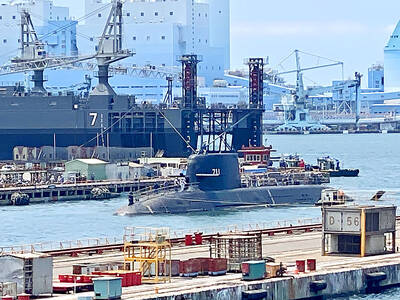
AGING: While Japan has 22 submarines, Taiwan only operates four, two of which were commissioned by the US in 1945 and 1946, and transferred to Taiwan in 1973 Taiwan would need at least 12 submarines to reach modern fleet capabilities, CSBC Corp, Taiwan chairman Chen Cheng-hung (陳政宏) said in an interview broadcast on Friday, citing a US assessment. CSBC is testing the nation’s first indigenous defense submarine, the Hai Kun (海鯤, Narwhal), which is scheduled to be delivered to the navy next month or in July. The Hai Kun has completed torpedo-firing tests and is scheduled to undergo overnight sea trials, Chen said on an SET TV military affairs program. Taiwan would require at least 12 submarines to establish a modern submarine force after assessing the nation’s operational environment and defense

A white king snake that frightened passengers and caused a stir on a Taipei MRT train on Friday evening has been claimed by its owner, who would be fined, Taipei Rapid Transit Corp (TRTC) said yesterday. A person on Threads posted that he thought he was lucky to find an empty row of seats on Friday after boarding a train on the Bannan (Blue) Line, only to spot a white snake with black stripes after sitting down. Startled, he jumped up, he wrote, describing the encounter as “terrifying.” “Taipei’s rat control plan: Release snakes on the metro,” one person wrote in reply, referring
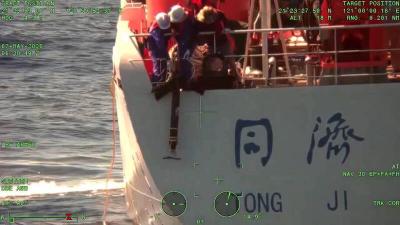
The coast guard today said that it had disrupted "illegal" operations by a Chinese research ship in waters close to the nation and driven it away, part of what Taipei sees a provocative pattern of China's stepped up maritime activities. The coast guard said that it on Thursday last week detected the Chinese ship Tongji (同濟號), which was commissioned only last year, 29 nautical miles (54km) southeast of the southern tip of Taiwan, although just outside restricted waters. The ship was observed lowering ropes into the water, suspected to be the deployment of scientific instruments for "illegal" survey operations, and the coast
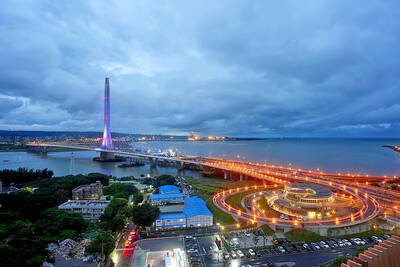
An inauguration ceremony was held yesterday for the Danjiang Bridge, the world’s longest single-mast asymmetric cable-stayed bridge, ahead of its official opening to traffic on Tuesday, marking a major milestone after nearly three decades of planning and construction. At the ceremony in New Taipei City attended by President William Lai (賴清德), Premier Cho Jung-tai (卓榮泰), Minister of Transportation and Communications Chen Shih-kai (陳世凱) and New Taipei City Mayor Hou Yu-ih (侯友宜), the bridge was hailed as both an engineering landmark and a long-awaited regional transport link connecting Tamsui (淡水) and Bali (八里)


 RSS
RSS