


Lung cancer patients may soon be granted peace of mind and be spared an uncertain prognosis, as a National Science Council sponsored team of Taiwanese medical professionals has successfully located a micro ribonucleic acid (RNA) signature that has proven to offer accurate predictions of their survival rates and the outcome of treatments.
The groundbreaking technique was published this month in Cell Cancer, a top medical journal in the field.
The same team published a paper on a messenger RNA (mRNA) signature last year in the New England Journal of Medicine that similarly gave an accurate prognosis for lung cancer patients.
"Lung cancer is the most common cause of cancer deaths worldwide," said the principle investigator of the medical team, Dean of the National Taiwan University (NTU) College of Medicine Yang Pan-chyr (楊泮池), at a press conference yesterday.
"What modern medicine knows about cancer -- its causes, progress and prognosis -- is still the tip of the iceberg. Combined, the two tests will provide us with a light in the dark on how [doctors] can proceed with a patient," said the head author of the paper, Yu Sung-liang (俞松良), an assistant professor at the NTU Center for Genomic Medicine.
The signatures each gives a patient's "hazard ratio," which is the "number of times they are at risk of a relapse compared with the patient population," he said.
Saying the technique could potentially be available within five years, Yang said the signature could save both time and money in the development of "tailor made" lung cancer treatments.
"For example, if the prognosis is poor, we may employ more aggressive treatment methods earlier on; if it is very poor, patients may even opt to withdraw from treatment," he said.
In Taiwan, 93 percent of lung cancers can be subcategorized as non-small-cell lung cancers (NSCLC), Yu said, adding that after treatment, NSCLC patients have an alarming 80 percent relapse rate within the next five years.
"Traditionally, lung cancer signatures have been on the protein level. However, protein signatures fail to provide accurate enough predictions and classifications of lung cancer patients or point to a suitable treatment method, which could contribute to the high relapse rate," Yu said. "The team aimed to find a signature that is at the RNA level [since RNAs is at the `upper stream' of protein organization] to improve upon the shortcomings."
The main function of RNA is to translate genetic information from DNA into proteins.
MicroRNA, however, is a class of RNA whose sole purpose is regulation, Yu said.
"Like the captain of a team, a single microRNA can be in charge of dozens or hundreds of mRNAs, so to obtain a microRNA signature is another step beyond our mRNA signature last year," he said.
The team is in the process of applying for a worldwide patent for their new discovery, Yang said.
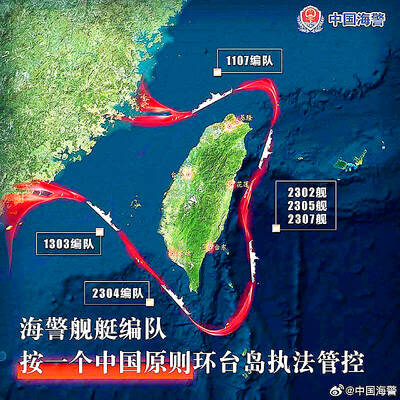
Taiwan would benefit from more integrated military strategies and deployments if the US and its allies treat the East China Sea, the Taiwan Strait and the South China Sea as a “single theater of operations,” a Taiwanese military expert said yesterday. Shen Ming-shih (沈明室), a researcher at the Institute for National Defense and Security Research, said he made the assessment after two Japanese military experts warned of emerging threats from China based on a drill conducted this month by the Chinese People’s Liberation Army’s (PLA) Eastern Theater Command. Japan Institute for National Fundamentals researcher Maki Nakagawa said the drill differed from the

‘WORSE THAN COMMUNISTS’: President William Lai has cracked down on his political enemies and has attempted to exterminate all opposition forces, the chairman said The legislature would motion for a presidential recall after May 20, Chinese Nationalist Party (KMT) Chairman Eric Chu (朱立倫) said yesterday at a protest themed “against green communists and dictatorship” in Taipei. Taiwan is supposed to be a peaceful homeland where people are united, but President William Lai (賴清德) has been polarizing and tearing apart society since his inauguration, Chu said. Lai must show his commitment to his job, otherwise a referendum could be initiated to recall him, he said. Democracy means the rule of the people, not the rule of the Democratic Progressive Party (DPP), but Lai has failed to fulfill his

A rally held by opposition parties yesterday demonstrates that Taiwan is a democratic country, President William Lai (賴清德) said yesterday, adding that if opposition parties really want to fight dictatorship, they should fight it on Tiananmen Square in Beijing. The Chinese Nationalist Party (KMT) held a protest with the theme “against green communists and dictatorship,” and was joined by the Taiwan People’s Party. Lai said the opposition parties are against what they called the “green communists,” but do not fight against the “Chinese communists,” adding that if they really want to fight dictatorship, they should go to the right place and face
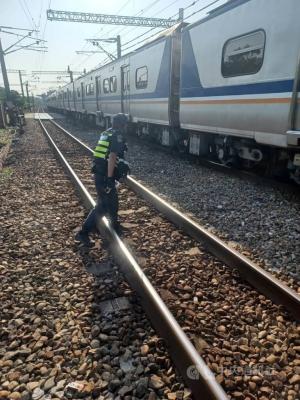
A 79-year-old woman died today after being struck by a train at a level crossing in Taoyuan, police said. The woman, identified by her surname Wang (王), crossed the tracks even though the barriers were down in Jhongli District’s (中壢) Neili (內壢) area, the Taoyuan Branch of the Railway Police Bureau said. Surveillance footage showed that the railway barriers were lowered when Wang entered the crossing, but why she ventured onto the track remains under investigation, the police said. Police said they received a report of an incident at 6:41am involving local train No. 2133 that was heading from Keelung to Chiayi City. Investigators


 RSS
RSS