

Malawi's ties with Beijing are nothing short of fraudulent, Minister of Foreign Affairs James Huang (
"We have decided to switch from Taiwan to mainland China after careful considerations of the benefits that we will be getting from mainland China," said Malawian Foreign Minister Joyce Hilda Banda on Monday in Lilongwe, adding that ties between China and Malawi actually began on Dec. 28 when both sides agreed to the alliance.
Huang, currently on a five-day visit to Central America and the Caribbean with President Chen Shui-bian (
Huang said the ministry was fully aware of the China-Malawi deal last month and "this is why I tried to visit Malawi, hoping the government would clarify its stance" before Saturday's legislative elections.
Huang was turned away by Lilongwe as he was transiting through Johannesburg two weeks ago. Banda at that time told Huang the government could not receive him because of a national holiday.
At yesterday's weekly briefing, ministry spokeswoman Phoebe Yeh (
Just earlier this month, after Malawi had agreed to dump Taiwan, Malawian Ambassador Thengo Maloya accepted Huang's invitation to go on an outing to Chihpen in southern Taiwan.
On the outing, Maloya reportedly reassured Huang that Taiwan-Malawi ties remained stable even though Lilongwe had already made the switch.
Malawian President Bingu wa Mutharika was in Taipei three months ago for the Taiwan-African summit, where he reiterated his country's support for Taiwan's bid to join several global organizations.
The Malawi embassy in Tianmu has already disconnected its telephone and Maloya has been unavailable for comment in the last few days.
All diplomatic affairs and Taiwanese government sponsored aid projects immediately ceased after the break. Yeh said it was the hope of the government that all non-governmental relationships between the two countries would be allowed to continue.
"We want our allies to know that we are different from Beijing because we offer only our utmost and sincere friendship," Yeh said.
Meanwhile, Nicaraguan President Daniel Ortega reportedly told Chen that China had intensified its pressure on Managua to ditch Taiwan.
"It is not news that China has tried to steal Taiwan's allies. But we are doing everything we can to shore up ties with our existing allies," Yeh said when asked about the rumors that other countries, such as the Marshall Islands and Guatemala, were leaning toward Beijing.
Meanwhile, the Malawian media yesterday slammed the government for shrouding the diplomatic switch in secrecy and warned it to be wary of its new ally.
"The memorandum of understanding to establish diplomatic relations with China was signed on December 28 but the country was only told yesterday [Monday]. Why the secrecy, we dare ask?" an editorial in the Nation newspaper said. "Why keep the nation in the dark for over two weeks? What was happening behind the curtains that necessitated keeping the matter under wraps?"
The Nation said the manner in which "we have severed ties with Taiwan leaves a lot to be desired. Our friend of 42 years has been humiliated. It is the suddenness and lack of civility that we find problematic."
The Daily Times, another independent newspaper, cautioned the government to "avoid demonizing ROC [the Republic of China] which has assisted us for many years and in many ways."
It also warned that Malawi should "tread cautiously on how to deal with our new-found friend in this biblical David-versus-Goliath relationship," saying the country should learn from "experiences" its neighbors have had with Beijing.
Additional reporting by AFP
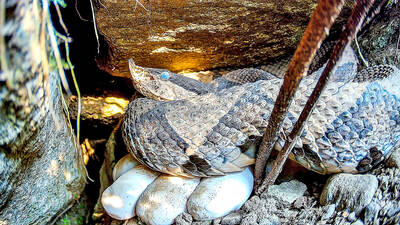
NATURE TAKES ITS COURSE: The agency’s head said he felt a sense of loss watching red-banded snakes eat the babies, as they had decided on non-intervention The Forestry and Nature Conservation Agency yesterday released a documentary on a hundred-pace viper that had incubated 16 eggs, all of which hatched, but only a baby viper escaped after they were attacked by red-banded snakes. The agency’s Taichung branch last year launched the viper reproduction monitoring project soon after forest rangers Lin Chun-yu (林俊佑) and Chou Chia-cheng (周家成) spotted a pregnant hundred-pace viper in a grass-covered burrow near a parking lot in Tbulan Village (松鶴部落). The Atayal village, in Taichung’s Heping District (和平), is headed by Ecyang Yapu, who was positive about the project and assisted in access control and power

The Coast Guard Administration (CGA) yesterday said that it had deployed vessels to “monitor” Chinese ships operating in waters off the east coast. The CGA said it dispatched vessels in response to a China Coast Guard announcement that it had carried out another “routine law-enforcement patrol” in waters off the east coast. “The CGA firmly rejects China’s cognitive warfare campaign of ‘law enforcement in name, jurisdictional expansion in practice,’” it said on X. As of 11am yesterday, two China Coast Guard ships were “loitering and drifting” about 105 nautical miles (195km) and 74 nautical miles east of Green Island (綠島) respectively, it said. It
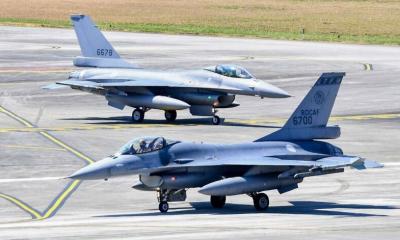
The first two F-16V Block 70 jets Taiwan purchased from the US were spotted unexpectedly turning back after departing from Hawaii yesterday, potentially further delaying delivery of the aircraft. Taiwan has purchased 66 of the F-16 C/D Block 70 jets to be deployed at Chihhang Air Base (志航基地) in Taitung County and operated by the air force's 7th Tactical Fighter Wing to defend Taiwan’s eastern region. Two single-seat jets, bearing serial No. 6727 and 6728, were spotted taking off from Hickam Field in Hawaii yesterday, observers said. Based on the precedent set during the delivery of Taiwan's older F-16 Block 20s, the new
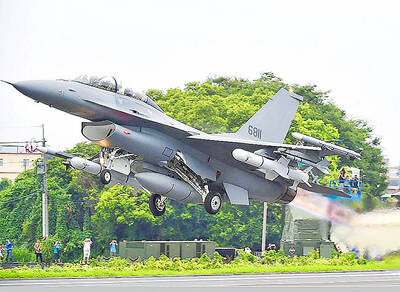
A sharp rise in compensation to be paid by air force officers who leave before completing their required service could indicate an increase in pilots leaving the military early, an analyst said on Friday, warning that the trend could worsen a shortage of experienced personnel. Chieh Chung (揭仲), a researcher at the Association for Strategic Foresight, issued the warning even though the number of volunteer military personnel is expected to increase next year. The planned headcount for volunteer military personnel, covering officers, noncommissioned officers (NCO) and enlisted soldiers, is 158,223 for next year, up 4,258 from 153,965 this year, Chieh said. The increase


 RSS
RSS