


Thousands of people visited the residence of late president Chiang Ching-kuo (
Named the Chihai (
The residence was used by the Navy to house foreign guests before Chiang moved in at the beginning of his term as minister of national defense in 1969, Taipei City's Cultural Affairs Department said.
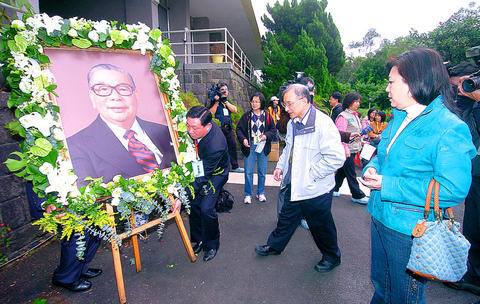
PHOTO: LIU HSIN-DE, TAIPEI TIMES
The residence was left empty after Chiang's wife, Faina Chiang (
Attending the opening of the residence, Chiang Fang Chih-yi (蔣方智怡), the daughter-in-law of the late president, said the interior of the residence had not changed since she joined the Chiang family in 1973, while lauding Chiang Ching-kuo's contributions to the country.
"The people remember him because he devoted his whole life to benefiting the country and the people. I hope our next president will do the same," she said yesterday in front of the residence.
The department has kept the interior of the residence exactly as it was, including the bedding and the furniture used by Chiang Ching-kuo and his wife.
Arriving at the residence at 6am, 80-year-old Hu Wen-ku (胡文庫) and his wife expressed their excitement about the visit.
"President Chiang lived a simple life, and we feel so excited to be able to see his residence," Hu said.
"He pushed many good policies and construction projects during his term. We have great respect for him," he said.
Because of the limited space in the residence, the department only allowed 400 visitors to enter during the opening hours between 9am and 12pm, while other people toured around the yard outside the residence.
Cultural Affairs Department Commissioner Lee Yong-ping (
Chiang Ching-kuo became president in 1978 and was re-elected in 1984 by the National Assembly for a second term. He died on Jan. 13, 1988, at the age of 78.
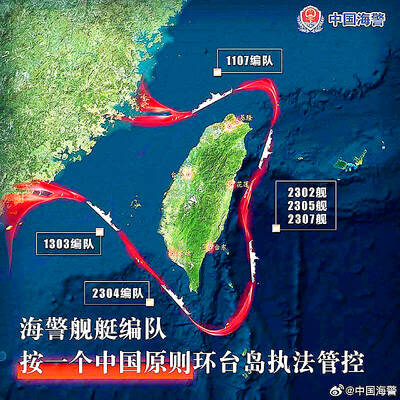
Taiwan would benefit from more integrated military strategies and deployments if the US and its allies treat the East China Sea, the Taiwan Strait and the South China Sea as a “single theater of operations,” a Taiwanese military expert said yesterday. Shen Ming-shih (沈明室), a researcher at the Institute for National Defense and Security Research, said he made the assessment after two Japanese military experts warned of emerging threats from China based on a drill conducted this month by the Chinese People’s Liberation Army’s (PLA) Eastern Theater Command. Japan Institute for National Fundamentals researcher Maki Nakagawa said the drill differed from the

‘WORSE THAN COMMUNISTS’: President William Lai has cracked down on his political enemies and has attempted to exterminate all opposition forces, the chairman said The legislature would motion for a presidential recall after May 20, Chinese Nationalist Party (KMT) Chairman Eric Chu (朱立倫) said yesterday at a protest themed “against green communists and dictatorship” in Taipei. Taiwan is supposed to be a peaceful homeland where people are united, but President William Lai (賴清德) has been polarizing and tearing apart society since his inauguration, Chu said. Lai must show his commitment to his job, otherwise a referendum could be initiated to recall him, he said. Democracy means the rule of the people, not the rule of the Democratic Progressive Party (DPP), but Lai has failed to fulfill his

A rally held by opposition parties yesterday demonstrates that Taiwan is a democratic country, President William Lai (賴清德) said yesterday, adding that if opposition parties really want to fight dictatorship, they should fight it on Tiananmen Square in Beijing. The Chinese Nationalist Party (KMT) held a protest with the theme “against green communists and dictatorship,” and was joined by the Taiwan People’s Party. Lai said the opposition parties are against what they called the “green communists,” but do not fight against the “Chinese communists,” adding that if they really want to fight dictatorship, they should go to the right place and face
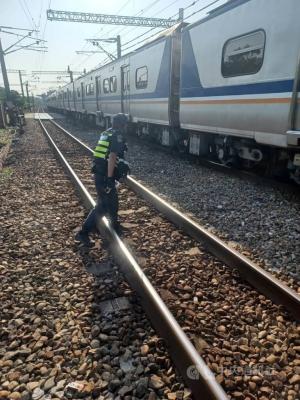
A 79-year-old woman died today after being struck by a train at a level crossing in Taoyuan, police said. The woman, identified by her surname Wang (王), crossed the tracks even though the barriers were down in Jhongli District’s (中壢) Neili (內壢) area, the Taoyuan Branch of the Railway Police Bureau said. Surveillance footage showed that the railway barriers were lowered when Wang entered the crossing, but why she ventured onto the track remains under investigation, the police said. Police said they received a report of an incident at 6:41am involving local train No. 2133 that was heading from Keelung to Chiayi City. Investigators


 RSS
RSS