


The local stock market looks set for a moderate rebound tomorrow as political uncertainty subdued after the opposition Chinese Nationalist Party (KMT) won a landslide victory in yesterday's legislative elections, an outcome most investors had expected.
Analysts said certain companies may benefit from expectations that cross-strait ties could improve, as the KMT has tended to adopt a compromising attitude in disputes with China.
Companies that stand to benefit from an easing in cross-strait relations include those in traditional industries, such as food processing conglomerate Uni-President Enterprises Corp (
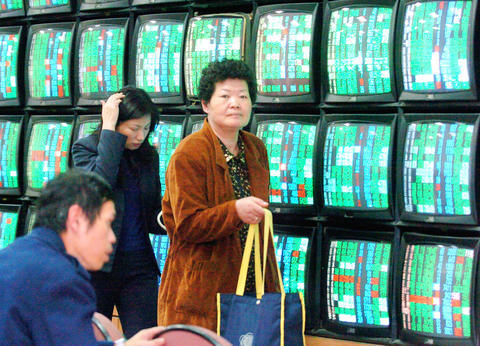
PHOTO: LIAO CHEN-HEUI, TAIPEI TIMES
These companies are likely to take the lead in a short-term rebound, analysts said.
"As the political uncertainty vanishes, at least for now, investors will be better able to pick investment targets, as their performance will reflect their fundamentals," Andrew Teng (鄧安瀾), a senior analyst with Taiwan International Securities Corp (金鼎證券), said yesterday.
The post-election rebound, however, would not be steep and may not last until the presidential election in March, which would pose a greater political concern for investors, Teng said.
Besides, the local stock market, and heavyweight tech shares in particular, are closely linked to US stock markets, he said.
Wall Street lost ground for the third straight week last week, with the Dow Jones falling to 12,606.3 points on worries about weakening consumer spending and a worsening credit crunch.
Dragged lower by the gloomy US stock market and local political uncertainty, the TAIEX has declined 3 percent since the beginning of the month.
"I believe investors will be cautious about expanding their equity portfolios, meaning the turnover on the TAIEX might not increase significantly over the next few trading sessions," Teng said.
He predicted that transportation, banking, foods and construction stocks would outpace other shares during the expected rebound, helped by anticipation that relations between Taiwan and China would improve.
Alan Tseng (
"The upcoming earnings season will be a major factor driving the local stock market, starting later this month," he said.
The nation's benchmark index may rise to between 8,000 and 8,400 points next week from an average of 8,003.58 points last week, Tseng said.
The daily turnover on the TAIEX could shrink to NT$100 billion next week from NT$132 billion last week, he said.
Over the past week, state-run financial service provider First Financial Holding Co (
"We believe companies with substantial growth from the Chinese market, such as Uni-President, and firms in traditional industries, such as Taiwan Cement Corp (台泥), will be good investment targets for investors aiming for long-term returns," Tseng said.
For investors who favor the tech sector, Tseng recommended blue-chips AU Optronics Corp (
AU Optronics is set to benefit from an expected boom in the liquid-crystal-display (LCD) industry this year, and HTC is likely to enjoy high growth as a result of its success with its own-brand mobile phones, he said.
However, politics still cast a shadow over the market.
Teng suggested that investors allocate 30 percent to 50 percent of their capital to buying local stocks gradually before the presidential election in March.
"It will be a safer time to make big investments after the presidential election," Teng said.
Shia Ben-chang (謝邦昌), professor in the statistics and information science department at Fu Jen Catholic University, said the nation's consumer confidence index was more likely to go up after the legislative elections, as the confidence reading was lower than that of other countries and had reached the bottom of the curve.
"However, consumer confidence will continue to fluctuate in the first half of this year owing to continued political uncertainties," Shia said in a telephone interview yesterday.
Last month, the nation's consumer confidence index dropped to a six-year low, dragged down mainly by a deteriorating outlook on local stocks, statistics released on Dec. 28 last year by National Central University's Research Center for Taiwan Economic Development showed.
Additional reporting by Jerry Lin

Taiwanese paleontologists have discovered fossil evidence that pythons up to 4m long inhabited Taiwan during the Pleistocene epoch, reporting their findings in the international scientific journal Historical Biology. National Taiwan University (NTU) Institute of Ecology and Evolutionary Biology associate professor Tsai Cheng-hsiu (蔡政修) led the team that discovered the largest snake fossil ever found in Taiwan. The single trunk vertebra was discovered in Tainan at the Chiting Formation, dated to between 400,000 and 800,000 years ago in the Middle Pleistocene, the paper said. The area also produced Taiwan’s first avian fossil, as well as crocodile, mammoth, saber-toothed cat and rhinoceros fossils, it said. Discoveries

Taiwanese paleontologists have discovered fossil evidence that pythons up to 4m long inhabited Taiwan during the Pleistocene epoch, reporting their findings in the international scientific journal Historical Biology. National Taiwan University (NTU) Institute of Ecology and Evolutionary Biology associate professor Tsai Cheng-hsiu (蔡政修) led the team that discovered the largest snake fossil ever found in Taiwan. A single trunk vertebra was discovered in Tainan at the Chiting Formation, dated to between 800,000 to 400,000 years ago in the Middle Pleistocene, the paper said. The area also produced Taiwan’s first avian fossil, as well as crocodile, mammoth, sabre-toothed cat and rhinoceros fossils, it said. Discoveries
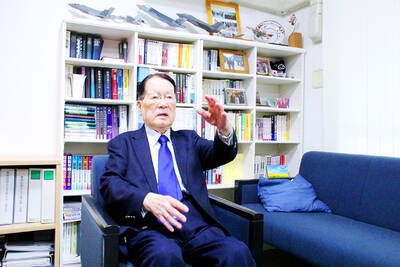
Whether Japan would help defend Taiwan in case of a cross-strait conflict would depend on the US and the extent to which Japan would be allowed to act under the US-Japan Security Treaty, former Japanese minister of defense Satoshi Morimoto said. As China has not given up on the idea of invading Taiwan by force, to what extent Japan could support US military action would hinge on Washington’s intention and its negotiation with Tokyo, Morimoto said in an interview with the Liberty Times (sister paper of the Taipei Times) yesterday. There has to be sufficient mutual recognition of how Japan could provide
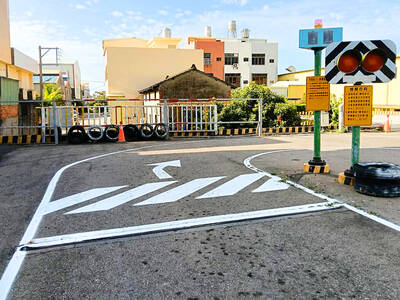
UPDATED TEST: The new rules aim to assess drivers’ awareness of risky behaviors and how they respond under certain circumstances, the Highway Bureau said Driver’s license applicants who fail to yield to pedestrians at intersections or to check blind spots, or omit pointing-and-calling procedures would fail the driving test, the Highway Bureau said yesterday. The change is set to be implemented at the end of the month, and is part of the bureau’s reform of the driving portion of the test, which has been criticized for failing to assess whether drivers can operate vehicles safely. Sedan drivers would be tested regarding yielding to pedestrians and turning their heads to check blind spots, while drivers of large vehicles would be tested on their familiarity with pointing-and-calling


 RSS
RSS