


The nation's major business groups yesterday urged the Chinese Nationalist Party (KMT)-led legislature to shift its focus from the election campaign back to economic issues to ensure a viable investment environment for local businesses.
"We hope the new legislature will return to the fundamentals and take on the responsibility of accelerating the passage of economic initiatives that will facilitate a more business-friendly environment," said Luo Huai-jia (羅懷家), executive director of the Taiwan Electrical and Electronic Manufacturers' Association (電電公會).
Luo said his association expected the new legislature to soon review three major bills that would continue to provide tax incentives to the local electronics sector as well as the Foreign Trade Act (
Addressing these bills, he said, would promote sustainable economic growth for the nation and improve the research and development capabilities of manufacturing-based companies.
General Chamber of Commerce (
Tax cuts, such as on the inheritance tax, would also help end capital flight to tax heavens and could even provide an incentive for investors to bring their assets back to Taiwan, Chang said.
Congratulating the KMT on its landslide victory, Chang said that if the party's two-thirds majority helped improve the new legislature's administrative efficiency, the results might not be a bad thing for the nation.
The results of the election also highlighted voter dissatisfaction with the DPP government's lackluster performance in propping up the local economy, said Guy Wittich, chief executive officer of the European Chamber of Commerce Taipei.
Voters not so much showed their support for the KMT, he said, but rather cast a vote of no confidence in the DPP's performance on the economic front.
Wittich urged the new legislature to focus on economic issues after little improvement had been made on domestic consumer confidence in the past eight years.
He also expressed concern over the nation's export-driven economic future, which would very likely be hit by the subprime mortgage-triggered economic slowdown in the US.
"What needs to be done is that Taiwan needs to quickly normalize its relations with China, which can provide an injection to the local economy," he said.
Wittich reiterated the chamber's calls for the local government's immediate implementation of direct cross-strait links and further relaxation of cross-strait business restrictions to ensure the nation's economic competitiveness.
The American Chamber of Commerce in Taipei would not comment on yesterday's election.
Roscher Lin (
He said he hoped the next legislature would communicate with the private sector on a frequent basis before rushing to pass any economic initiatives that may add to the difficulty of doing businesses in Taiwan.
Lin also urged the newly elected legislature to stop boycotting the central government's budget bills or initiatives that could help improve people's livelihood or reinforce the nation's infrastructure, which he said can be detrimental to the nation's economy.
Lin said he believed the outgoing legislature's decision to force companies with more than 30 employees into implementing parental leave was hastily made and represented an added burden on small companies.
It is to be hoped, he said, that the new legislature will avoid repeating such hasty policymaking.
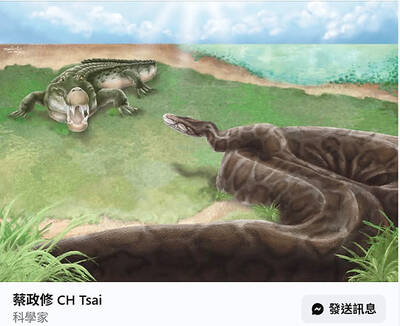
Taiwanese paleontologists have discovered fossil evidence that pythons up to 4m long inhabited Taiwan during the Pleistocene epoch, reporting their findings in the international scientific journal Historical Biology. National Taiwan University (NTU) Institute of Ecology and Evolutionary Biology associate professor Tsai Cheng-hsiu (蔡政修) led the team that discovered the largest snake fossil ever found in Taiwan. The single trunk vertebra was discovered in Tainan at the Chiting Formation, dated to between 400,000 and 800,000 years ago in the Middle Pleistocene, the paper said. The area also produced Taiwan’s first avian fossil, as well as crocodile, mammoth, saber-toothed cat and rhinoceros fossils, it said. Discoveries

Taiwanese paleontologists have discovered fossil evidence that pythons up to 4m long inhabited Taiwan during the Pleistocene epoch, reporting their findings in the international scientific journal Historical Biology. National Taiwan University (NTU) Institute of Ecology and Evolutionary Biology associate professor Tsai Cheng-hsiu (蔡政修) led the team that discovered the largest snake fossil ever found in Taiwan. A single trunk vertebra was discovered in Tainan at the Chiting Formation, dated to between 800,000 to 400,000 years ago in the Middle Pleistocene, the paper said. The area also produced Taiwan’s first avian fossil, as well as crocodile, mammoth, sabre-toothed cat and rhinoceros fossils, it said. Discoveries
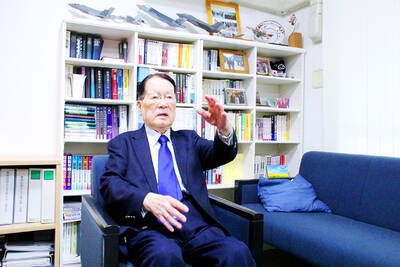
Whether Japan would help defend Taiwan in case of a cross-strait conflict would depend on the US and the extent to which Japan would be allowed to act under the US-Japan Security Treaty, former Japanese minister of defense Satoshi Morimoto said. As China has not given up on the idea of invading Taiwan by force, to what extent Japan could support US military action would hinge on Washington’s intention and its negotiation with Tokyo, Morimoto said in an interview with the Liberty Times (sister paper of the Taipei Times) yesterday. There has to be sufficient mutual recognition of how Japan could provide

UPDATED TEST: The new rules aim to assess drivers’ awareness of risky behaviors and how they respond under certain circumstances, the Highway Bureau said Driver’s license applicants who fail to yield to pedestrians at intersections or to check blind spots, or omit pointing-and-calling procedures would fail the driving test, the Highway Bureau said yesterday. The change is set to be implemented at the end of the month, and is part of the bureau’s reform of the driving portion of the test, which has been criticized for failing to assess whether drivers can operate vehicles safely. Sedan drivers would be tested regarding yielding to pedestrians and turning their heads to check blind spots, while drivers of large vehicles would be tested on their familiarity with pointing-and-calling


 RSS
RSS