


Although most polling stations reported an orderly and trouble-free voting day, a number of incidents and altercations did occur in yesterday's elections.
An alleged attempt to sabotage the referendum vote at a polling station in Taipei City's Wu Kung primary school, in which 66 referendum ballots were found deliberately tainted by black ink was reported.
Since they were legible, they were still counted, the Taipei City Election Commission said. No suspects have been identified.
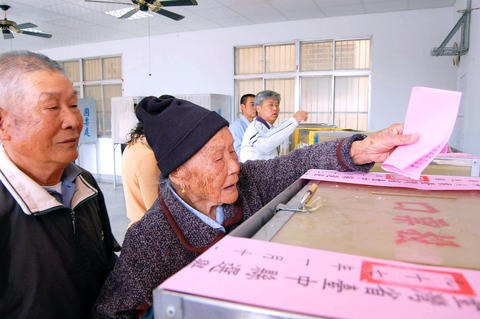
PHOTO: CHANG JUI-CHEN, TAIPEI TIMES
In Keelung, Democratic Progressive Party (DPP) legislative candidate Yu Hsiang-yao (游祥耀) was stopped by poll workers when he tried to vote while still wearing his campaign vest. They told Yu he had to remove the vest before he could vote.
Yu complied, only to be told he must also remove his polo shirt because his name was printed on it. You finally voted in his undershirt.
Most incidents reported involved confusion or disagreements surrounding the referendum ballots. Although voters were free to not pick up the ballots if they did not wish to vote, defacing ballots or removing them from polling stations are both illegal.
At press time in Taipei City a total of 11 voters had violated regulations, with six tearing up referendum ballots, three tearing up political party ballots, one tearing up legislative ballots and one carrying his political party ballots out of the polling station.
There were also reports elsewhere of voters tearing up ballots.
Although defacing a ballot may result in a fine of up to NT$50,000 (US$1,500), the local electoral commission determines the amount, taking into account the circumstances under which the ballot was defaced.
A Central News Agency (CNA) story reported that in Chiayi, a woman who did not wish to vote in the referendum accidentally picked up referendum ballots. After poll workers refused to take back the ballots, the woman ripped them up.
CNA reported that another woman in Chiayi ripped up her referendum ballots after accidentally stamping them with her own personal chop instead of the official voting chop.
A man in Miaoli County reportedly tore up his ballot because he was in a bad mood after a night of heavy drinking.
Although voting for the legislative elections and the referendum took place at the same locations, ballots were given out at separate tables.
This resulted in some confusion among voters who wished to participate in the referendums but failed to obtain the correct ballots because they were not aware of this or had not been informed by polling station personnel that they had to could pick up the ballots at separate locations.
CNA reported that in Kaohsiung, a couple complained that they did not receive referendum ballots because polling station personnel had not informed them that they had to pick up referendum ballots at a separate desk.
Having left the polling station, they were barred from returning to obtain and cast the referendum ballots.
In a similar incident, two women in Ilan were allowed to gain re-entry to a polling station to cast a referendum vote after leaving before picking up the ballots, a CNA story said.
Meanwhile, in other news, an independent aboriginal legislative candidate, Song Ching-tsai (宋進財), was detained late on Friday night by Taitung judges on suspicion of buying votes, the first legislative candidate to be detained in the election.
Prosecutors said Song was suspected of offering voters between NT$1,000 and NT$1,200 to vote for him.
An official from the Ministry of Justice yesterday said prosecutors nationwide were likely to bring about 10 legislative candidates to court for alleged involvement in vote-buying.
Kinmen prosecutor Wu Wen-cheng (
To avoid influencing yesterday's election, Wu declined to name the candidate and his party.
In Pingtung, a candidate campaigner was detained for offering several voters NT$500, while four people were released on bail for receiving cash.
The National Police Agency said that between Friday and early yesterday police had identified a total of 50 vote-buying cases nationwide, involving nearly 500 people.

Taiwanese paleontologists have discovered fossil evidence that pythons up to 4m long inhabited Taiwan during the Pleistocene epoch, reporting their findings in the international scientific journal Historical Biology. National Taiwan University (NTU) Institute of Ecology and Evolutionary Biology associate professor Tsai Cheng-hsiu (蔡政修) led the team that discovered the largest snake fossil ever found in Taiwan. The single trunk vertebra was discovered in Tainan at the Chiting Formation, dated to between 400,000 and 800,000 years ago in the Middle Pleistocene, the paper said. The area also produced Taiwan’s first avian fossil, as well as crocodile, mammoth, saber-toothed cat and rhinoceros fossils, it said. Discoveries

Taiwanese paleontologists have discovered fossil evidence that pythons up to 4m long inhabited Taiwan during the Pleistocene epoch, reporting their findings in the international scientific journal Historical Biology. National Taiwan University (NTU) Institute of Ecology and Evolutionary Biology associate professor Tsai Cheng-hsiu (蔡政修) led the team that discovered the largest snake fossil ever found in Taiwan. A single trunk vertebra was discovered in Tainan at the Chiting Formation, dated to between 800,000 to 400,000 years ago in the Middle Pleistocene, the paper said. The area also produced Taiwan’s first avian fossil, as well as crocodile, mammoth, sabre-toothed cat and rhinoceros fossils, it said. Discoveries

Whether Japan would help defend Taiwan in case of a cross-strait conflict would depend on the US and the extent to which Japan would be allowed to act under the US-Japan Security Treaty, former Japanese minister of defense Satoshi Morimoto said. As China has not given up on the idea of invading Taiwan by force, to what extent Japan could support US military action would hinge on Washington’s intention and its negotiation with Tokyo, Morimoto said in an interview with the Liberty Times (sister paper of the Taipei Times) yesterday. There has to be sufficient mutual recognition of how Japan could provide
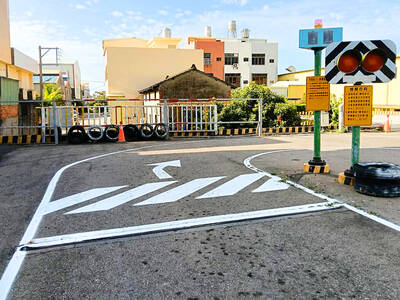
UPDATED TEST: The new rules aim to assess drivers’ awareness of risky behaviors and how they respond under certain circumstances, the Highway Bureau said Driver’s license applicants who fail to yield to pedestrians at intersections or to check blind spots, or omit pointing-and-calling procedures would fail the driving test, the Highway Bureau said yesterday. The change is set to be implemented at the end of the month, and is part of the bureau’s reform of the driving portion of the test, which has been criticized for failing to assess whether drivers can operate vehicles safely. Sedan drivers would be tested regarding yielding to pedestrians and turning their heads to check blind spots, while drivers of large vehicles would be tested on their familiarity with pointing-and-calling


 RSS
RSS