


The nation saw a dramatic shift in power yesterday after the Democratic Progressive Party (DPP) suffered a major defeat at the hands of the Chinese Nationalist Party (KMT) in legislative elections.
While the south is traditionally considered A DPP stronghold, the party fared poorly in Kaohsiung City and Kaohsiung County and garnered just one seat in central Taiwan. The party had set a goal of capturing 35 district seats and 15 legislator-at-large seats, but ended up securing only 13 district seats and 14 at-large seats.
While opinion polls predicted a DPP loss, the extent of its defeat came as a surprise to some.
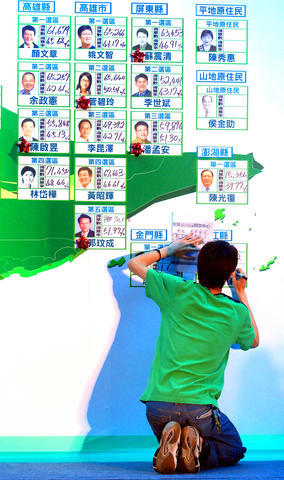
PHOTO: AP
Analysts attributed the party's failure mainly to the new electoral system, which they said put the DPP in an unfavorable position.
Chao Yung-mau (
The DPP, on the other hand, lacked a close connection at the local level, a majority of which is governed by the pan-blue camp, he said.
"Under the new electoral system, there is only one slot available in each constituency. Voters are looking for someone who can give them the best services possible and that costs money," he said.
The second-ballot voting system, in which voters pick the party of their choice, also puts the DPP at a disadvantage, because the biggest party benefits most from the design, Chao said.
"The DPP agreed on the new electoral system because it has its eyes set on two-party politics," he said. "It is well aware that it will take time to get rid of smaller parties and that it has to pay a price during the transitional period."
The game is pretty much set in some constituencies, such as the outlying islands, the east coast and Aboriginal seats, said Hawang Shiow-duan (
Another reason for the DPP's poor showing was public displeasure with the DPP administration's lackluster performance over the past eight years, analysts said.
Hawang said the economy was not as bad as some media outlets had portrayed, while admitting there was big room for improvement. Negative media reporting, however, took its toll and the administration was punished by voters for failing to give the economy a boost.
The DPP's disappointing performance also showed that focusing on identity and ethnic issues no longer worked as effectively as they used to, analysts said.
While the identity issue may stir up the passion of core DPP supporters, it may scare off more moderate voters, said Wu Chin-en (
"Those issues are like a double-edged sword," he said. "They have limited effect when they become the central issue in almost every election."
Tsai Chia-hung (
In other words, more people favor being political neutral and do not want to be identified as Chinese or Taiwanese, he said.
Other factors must also be taken into account, Hawang said. They include the corruption allegations brought against President Chen Shui-bian (
"When the public has higher expectations of the DPP, the party has to pay a price for failing their expectations," Hawang said.
With the KMT's solid victory, analysts foresee a legislature dominated by one big party and backed by big-money donors. As it is hard for smaller parties to put bigger parties in check, the future of partisan politics looks dismal, they said.
"The KMT will be like a dinosaur and the DPP a tiger, with fiercer and uglier fights continuing between the two rival parties," Chao said.
Apart from the legislative elections, the DPP-initiated referendum to reclaim the KMT's stolen assets also failed. Analysts were divided on the impact the failed referendum would have on the party.
Hawang said that that the defeat was a significant blow to the DPP, which seems to have exhausted all possible means to achieve its goal of retrieving the stolen assets.
As a minority in the legislature, Hawang said the DPP would continue to face a KMT boycott on any attempt to recover the assets.
The DPP will still face the same dilemma even if its presidential candidate, Frank Hsieh (
Wu dismissed the result of the referendum as insignificant because it was part of the election campaign strategy and the topic was a "non-issue."
Legislation is required to legally reclaim the KMT's improperly acquired assets, Wu said, and it is highly unlikely the DPP would be able to enact a law in a KMT-dominated legislature.
Wu, however, admitted that a successful referendum could have boosted the momentum for another referendum initiated by the DPP on applying to join the UN using the name Taiwan that will be held concurrently with the presidential election.
Chao said the March referendum would bear more significance and is the decisive battle.
With less than 70 days left before the presidential election, analysts said the DPP may adjust its campaign strategy to pull off a better showing in March.
Wu said Hsieh would play a more dominant role in mapping out the party's campaign strategy in the run-up to the March poll.
Chao agreed, saying that Chen, who resigned last night as DPP chairman, would be under tremendous pressure and would have to let Hsieh play a more decisive role in the race.
Chao said he did not think Chen need to to bear responsibility for the legislative defeat, but said Hsieh could face severe criticism from party members for distancing himself from the legislative polls.
The DPP would face a tougher battle ahead if the party were split and Hsieh lost the backing of his party members, Chao said.
As the presidential election looms, it is now up to voters to decide whether they want to see the country ruled by a single party holding both the executive and legislative reins, or a split government where the administration is constantly at odds with the legislature.
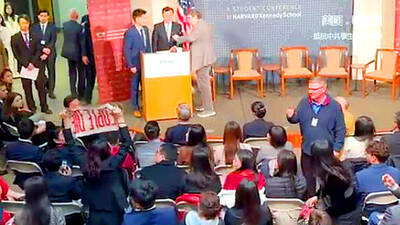
A group of Taiwanese-American and Tibetan-American students at Harvard University on Saturday disrupted Chinese Ambassador to the US Xie Feng’s (謝鋒) speech at the school, accusing him of being responsible for numerous human rights violations. Four students — two Taiwanese Americans and two from Tibet — held up banners inside a conference hall where Xie was delivering a speech at the opening ceremony of the Harvard Kennedy School China Conference 2024. In a video clip provided by the Coalition of Students Resisting the CCP (Chinese Communist Party), Taiwanese-American Cosette Wu (吳亭樺) and Tibetan-American Tsering Yangchen are seen holding banners that together read:

UNAWARE: Many people sit for long hours every day and eat unhealthy foods, putting them at greater risk of developing one of the ‘three highs,’ an expert said More than 30 percent of adults aged 40 or older who underwent a government-funded health exam were unaware they had at least one of the “three highs” — high blood pressure, high blood lipids or high blood sugar, the Health Promotion Administration (HPA) said yesterday. Among adults aged 40 or older who said they did not have any of the “three highs” before taking the health exam, more than 30 percent were found to have at least one of them, Adult Preventive Health Examination Service data from 2022 showed. People with long-term medical conditions such as hypertension or diabetes usually do not
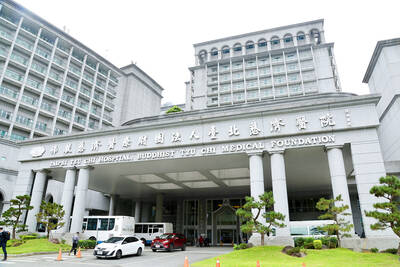
POLICE INVESTIGATING: A man said he quit his job as a nurse at Taipei Tzu Chi Hospital as he had been ‘disgusted’ by the behavior of his colleagues A man yesterday morning wrote online that he had witnessed nurses taking photographs and touching anesthetized patients inappropriately in Taipei Tzu Chi Hospital’s operating theaters. The man surnamed Huang (黃) wrote on the Professional Technology Temple bulletin board that during his six-month stint as a nurse at the hospital, he had seen nurses taking pictures of patients, including of their private parts, after they were anesthetized. Some nurses had also touched patients inappropriately and children were among those photographed, he said. Huang said this “disgusted” him “so much” that “he felt the need to reveal these unethical acts in the operating theater
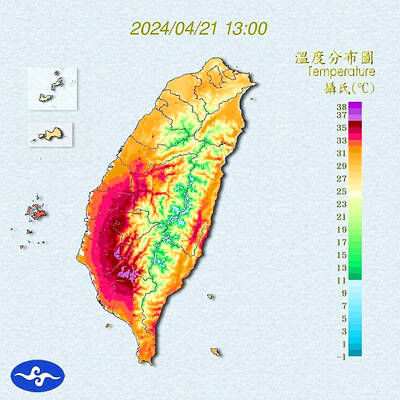
Heat advisories were in effect for nine administrative regions yesterday afternoon as warm southwesterly winds pushed temperatures above 38°C in parts of southern Taiwan, the Central Weather Administration (CWA) said. As of 3:30pm yesterday, Tainan’s Yujing District (玉井) had recorded the day’s highest temperature of 39.7°C, though the measurement will not be included in Taiwan’s official heat records since Yujing is an automatic rather than manually operated weather station, the CWA said. Highs recorded in other areas were 38.7°C in Kaohsiung’s Neimen District (內門), 38.2°C in Chiayi City and 38.1°C in Pingtung’s Sandimen Township (三地門), CWA data showed. The spell of scorching


 RSS
RSS