


The fate of the mausoleums of dictator Chiang Kai-shek (蔣介石) and president Chiang Ching-kuo (蔣經國) descended into family squabbling yesterday after Chinese Nationalist Party (KMT) Legislator John Chiang (蔣孝嚴), a son of Chiang Ching-kuo, said he did not support relocating the tombs to China.
"Those who don't understand Taiwanese politics should not get too involved in the issue. He or she should speak with caution," he said while visiting the mausoleums at Tzuhu (慈湖) and Touliao (頭寮) in Taoyuan County yesterday.
John Chiang was apparently referring to Chiang Fang Chih-yi (
Chiang Fang Chih-yi said on Sunday that the family had reached a consensus on sending the remains of the two men back to their hometown in Zhejiang Province, China, consistent with Chiang Ching-kuo's wishes, rather than relocating the remains to the Wuchihshan Military Cemetery (五指山軍人公墓) in Taipei County as the family had previously requested the government do.
In January 2004, Faina Chiang (
The government has earmarked NT$39 million (US$1.2 million) to be spent on the project. More than NT$27 million was spent on the construction of a tomb at the Wuchihshan Military Cemetery.
No one in the Chiang family was able to act as head of the household, John Chiang said yesterday. He said he would urge former premier Hau Pei-tsun (郝柏村) to convene a meeting of the extended Chiang family after next year's elections to discuss the issue.
Hau was close to Chiang Kai-shek and Chiang Ching-kuo.
When asked for comment, KMT's presidential candidate Ma Ying-jeou (馬英九) said he respected the decisions made by the Chiang family.
KMT Legislator Shuai Hua-ming (帥化民) said it was "natural and normal" for the Chiang family to propose removing Chiang Kai-shek's and Chiang Ching-kuo's mausoleums to their hometown in Zhejiang Province, China, because they wanted to prevent their deceased family members from being "insulted" by "clowns," in an apparent reference to politicians in the pan-green camp.
Nevertheless, he urged the Chiang family to understand that "Chiang Kai-shek and Chiang Ching-kuo belong to the Republic of China."
"Chiang Ching-kuo clearly expressed his dedication and love for Taiwan by establishing his father's mausoleum at Tzuhu while selecting Touliao as the location of his own mausoleum," said Shuai, a former lieutenant-general.
ADDITIONAL REPORTING BY STAFF WRITER
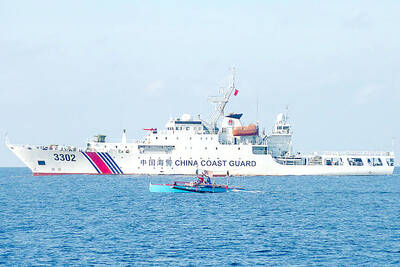
EXPANSIONIST: China deploys an average of 40 to 50 warships and coast guard vessels daily in the South China Sea, despite pledges not to militarize the region, an official said China is attempting to expand its influence across the First Island Chain and increase pressure on Japan by sending coast guard vessels into waters off of Taiwan under the pretext of maritime negotiations with Japan and the Philippines, a national security official said yesterday. China’s recent actions in the waters east of Taiwan and Japan and the Philippines’ exclusive economic zones (EEZ) are attempts to establish dominance in First Island Chain waters, said the official who declined to be named, adding that this is “expansion disguised as law enforcement.” Framing China’s actions solely as a cross-strait issue is a serious misjudgment that
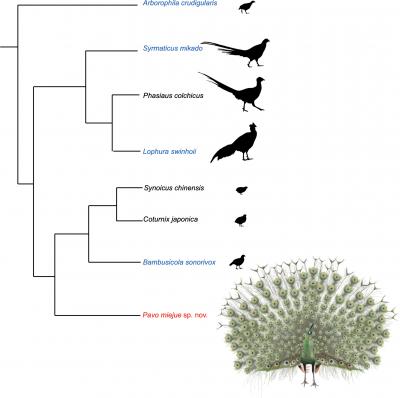
Through analyzing fossil evidence, a research team at National Taiwan University (NTU) discovered the largest endemic bird to have lived in Taiwan, naming it Pavo miejue, or extinct peafowl (滅絕孔雀). The Mikado pheasant, which is printed on the back of the NT$1,000 bank note, was previously believed to be the biggest endemic bird to Taiwan. The research team’s findings suggest that Pavo miejue lived during the Pleistocene epoch tens of thousands of years ago. It is the first endemic extinct bird species discovered and formally named in Taiwan. The study was coauthored by NTU Institute of Ecology and Evolutionary Biology professor Tsai Cheng-hsiu (蔡政修),
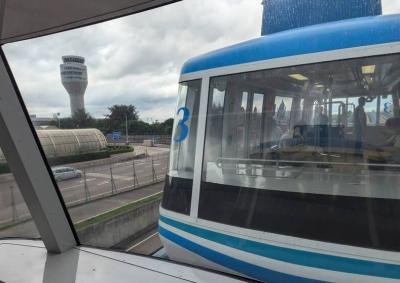
Taiwan Taoyuan International Airport is to suspend its automated Skytrain service connecting Terminal 1 and Terminal 2 starting on July 1 to facilitate connection works for the upcoming Terminal 3, the airport operator said today. Passengers and staff who need to travel between the two terminals after the suspension can instead use the Taoyuan MRT or the airport's 24-hour shuttle bus service, Taoyuan International Airport Corp said. The Taoyuan MRT Airport Line directly links the two terminals, while the shuttle buses are to operate around the clock, the company added. The Skytrain provides free transportation between the airport’s two terminals for travelers and
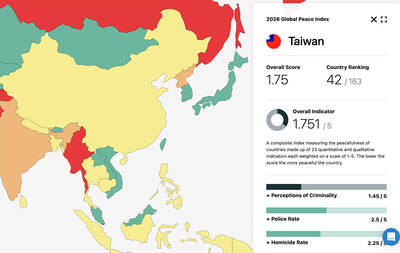
Taiwan ranked 42nd in terms of peacefulness among 163 countries, down five places from last year, according to this year’s Global Peace Index. With an overall score of 1.751, Taiwan dropped from 37th last year, the report published by the global Institute for Economics and Peace showed. The overall score measures a country’s level of peacefulness using 23 quantitative and qualitative indicators across three domains — ongoing domestic and international conflict, societal safety and security, and militarization. While Taiwan ranked 42nd worldwide, it was listed in ninth place among the 19 Asian-Pacific countries in the report, after New Zealand, Singapore, Japan, Malaysia,


 RSS
RSS