


Miss Hsu (徐) works in a technology firm. She exercises regularly and measures her blood pressure often. She watches what she eats and records her daily food intake. She usually writes all of this information on a piece of paper, which could be lost easily.
Now she enters all of this information in a "Health Notebook" (健康筆記), issued by the Taiwan Health Reform Foundation, allowing her to conveniently keep tabs on all her personal health information -- everything from weight, blood pressure and waistline measurements to the number of hours she works out. Hsu can also attach prescriptions and reminders from doctors and even receipts for clinical services in the notebook.
The creation of the notebook was inspired by the personal story of the foundation's chairwoman Chang Li-yun (張苙雲), who was recently diagnosed with hyperthyroidism.
Chang kept a journal in which she wrote items such as the names of the medication she took, the dosage and the results of blood tests. She also jotted down some of the symptoms she observed, such as heart palpitations, weariness and perspiration.
The foundation's executive director, Liu Mei-chun (劉梅君), said the Department of Health has been promoting the concept of health self-management for years, but she said few actually know what that means, much less practice it.
The concept suggests that one is fully responsible for doing whatever it takes to stay fit and manage his or her own illness.
Liu said that most people go to the doctor without a full grasp of their health condition. Even after they have returned home from the clinic, they may still remain unclear about the doctor's instructions.
"Under these circumstances, an information gap occurs between doctors and patients ," she said.
Liu said the notebook not only enables individuals to describe their symptoms in detail, but also helps doctors make a more accurate diagnosis of the diseases that the patients may have.
Besides the sections of the notebook reserved for entries on personal health information, the notebook also includes useful medical information at the back.
For example, the foundation suggests patients seek the answers to six critical questions whenever they see a doctor, such as the name of the medications they take and when they should return for a follow-up appointment.
Ho Yi-hsuan (何怡萱), a mother, said at a press conference yesterday that she used the notebook to record the growth of her eight-month-old son and to chart such things as the day he learned how to crawl.
Coming with three different cover designs, the Health Notebook costs NT$160 per copy including the cost of delivery and can only be purchased online at the foundation's Web site (www.thrf.org.tw).
The foundation hopes the sale of the notebooks will help raise funds for its operations, which is facing a NT$2 million (US$60,000) deficit this year.
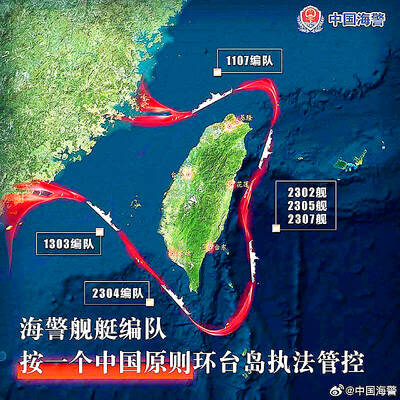
Taiwan would benefit from more integrated military strategies and deployments if the US and its allies treat the East China Sea, the Taiwan Strait and the South China Sea as a “single theater of operations,” a Taiwanese military expert said yesterday. Shen Ming-shih (沈明室), a researcher at the Institute for National Defense and Security Research, said he made the assessment after two Japanese military experts warned of emerging threats from China based on a drill conducted this month by the Chinese People’s Liberation Army’s (PLA) Eastern Theater Command. Japan Institute for National Fundamentals researcher Maki Nakagawa said the drill differed from the
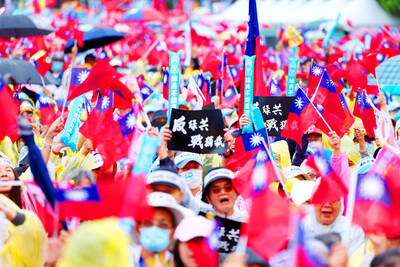
‘WORSE THAN COMMUNISTS’: President William Lai has cracked down on his political enemies and has attempted to exterminate all opposition forces, the chairman said The legislature would motion for a presidential recall after May 20, Chinese Nationalist Party (KMT) Chairman Eric Chu (朱立倫) said yesterday at a protest themed “against green communists and dictatorship” in Taipei. Taiwan is supposed to be a peaceful homeland where people are united, but President William Lai (賴清德) has been polarizing and tearing apart society since his inauguration, Chu said. Lai must show his commitment to his job, otherwise a referendum could be initiated to recall him, he said. Democracy means the rule of the people, not the rule of the Democratic Progressive Party (DPP), but Lai has failed to fulfill his
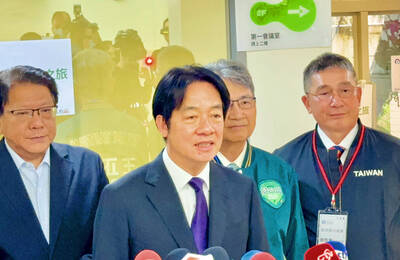
A rally held by opposition parties yesterday demonstrates that Taiwan is a democratic country, President William Lai (賴清德) said yesterday, adding that if opposition parties really want to fight dictatorship, they should fight it on Tiananmen Square in Beijing. The Chinese Nationalist Party (KMT) held a protest with the theme “against green communists and dictatorship,” and was joined by the Taiwan People’s Party. Lai said the opposition parties are against what they called the “green communists,” but do not fight against the “Chinese communists,” adding that if they really want to fight dictatorship, they should go to the right place and face
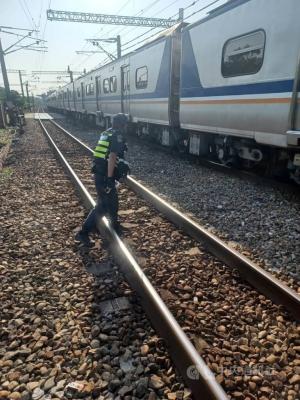
A 79-year-old woman died today after being struck by a train at a level crossing in Taoyuan, police said. The woman, identified by her surname Wang (王), crossed the tracks even though the barriers were down in Jhongli District’s (中壢) Neili (內壢) area, the Taoyuan Branch of the Railway Police Bureau said. Surveillance footage showed that the railway barriers were lowered when Wang entered the crossing, but why she ventured onto the track remains under investigation, the police said. Police said they received a report of an incident at 6:41am involving local train No. 2133 that was heading from Keelung to Chiayi City. Investigators


 RSS
RSS