


The government will not abide by a resolution that the legislature passed on Thursday stating that the Central Election Commission (CEC) cannot refuse to allocate money to local election commissions that wish to use a two-step voting system, as the resolution constitutes a violation of the Constitution, a Cabinet spokesman said yesterday.
"The Executive Yuan will not obey the resolution unless the legislature enacts a law to abolish the CEC and reduce the status of the Executive Yuan to that of a bureau under the legislature," Cabinet Spokesman Shieh Jhy-wey (
The binding resolution also requires the CEC to hold the legislative and presidential elections and four referendums either by using a two-step voting procedure, or by issuing the referendum ballots separately from the election ballots.
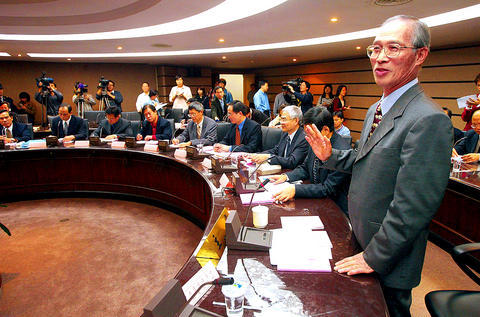
PHOTO: CNA
The CEC, however, has decided to follow a one-step procedure for the Jan. 12 legislative elections and the referendums, one of which was initiated by the Democratic Progressive Party (DPP) on recovering stolen national assets from the Chinese Nationalist Party (KMT). Another referendum topic is an anti-corruption bid initiated by the KMT.
Under the one-step system, voters will receive their legislative and referendum ballots together when they enter a polling station.
Shieh said the one-step voting procedure would be the only approach the government would accept in the election and that there would be "no compromise" about allowing the two-step procedure.
Shieh criticized Taipei Mayor Hau Lung-bin (
"Hau should not abuse his power, as it will destroy law and order," Shieh said.
Premier Chang Chun-hsiung (
"The article, which the legislature passed last month, stipulates that the referendums should be held in tandem with the elections," Chang said.
He expressed concern over the resolution during a meeting with Legislative Speaker Wang Jin-pyng (
"Everyone should think long and hard about the issue. The Executive Yuan has made its stance very clear," Chang said.
Wang, however, defended the resolution.
"The resolution passed by the Legislative Yuan carries legal weight, and it applies to all organizations," Wang said.
While Wang urged the pan-blue and pan-green camps to each make some concessions to ensure the elections proceed smoothly, the KMT caucus yesterday threatened to file malfeasance suits against the CEC if it ignored the resolutions and insisted on adopting the one-step system.
KMT caucus whip Tseng Yung-chuan (曾永權) accused CEC Commissioner Chang Cheng-hsiung (張政雄) of ignoring the independence of the commission.
Chang served as an election tool for the DPP, Tseng said.
Expressing support for the CEC, DPP caucus whip Ker Chien-ming (柯建銘) yesterday said that the KMT cited an interpretation by the Council of Grand Justices to insist that the budget bill passed by the legislature should be considered to carry the same weight as a law.
However, the grand justices were referring to the budget bill itself and not the resolutions attached to it, he said.
The Legislative Yuan should abide by the government's "division of power" principle, otherwise the Executive Yuan would be reduced to an administrative bureau of the Legislative Yuan, Ker said.
Meanwhile, the CEC and representatives from 25 local election commissions failed to reach a consensus over the dispute. It was the second time the CEC organized such a meeting in an attempt to resolve the controversy.
Representatives from 18 counties and cities governed by pan-blue parties insisted on the two-step voting scheme.
The two sides began a war of words before the meeting started.
"We will insist on following the two-step voting procedure," said Taichung Deputy Mayor Hsiao Chia-chi (
"[The two-step voting scheme] was officially chosen by all [Taichung City] Election Commission members. As the chief of the commission, I certainly cannot go against the decision," Hsiao said.
Chang Cheng-hsiung, on the other hand, said that the CEC and local election commissions "are not equal partners working together; rather, local election commissions are subordinate to the CEC."
A CEC official who spoke on condition of anonymity said that the meeting wasn't the end of negotiations.
"We've asked [local election commission representatives] to reconsider what we [the CEC] said today. Some of them did promise to do so, and said that if we avoided using the terms `one-step' or `two-step' in the future, they may be able to work something out," the official said.
Additional reporting by Shih Hsiu-chuan and CNA
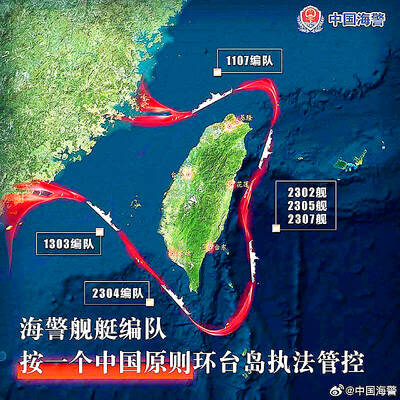
Taiwan would benefit from more integrated military strategies and deployments if the US and its allies treat the East China Sea, the Taiwan Strait and the South China Sea as a “single theater of operations,” a Taiwanese military expert said yesterday. Shen Ming-shih (沈明室), a researcher at the Institute for National Defense and Security Research, said he made the assessment after two Japanese military experts warned of emerging threats from China based on a drill conducted this month by the Chinese People’s Liberation Army’s (PLA) Eastern Theater Command. Japan Institute for National Fundamentals researcher Maki Nakagawa said the drill differed from the
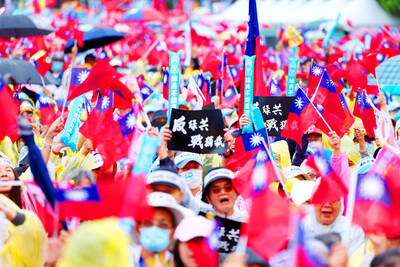
‘WORSE THAN COMMUNISTS’: President William Lai has cracked down on his political enemies and has attempted to exterminate all opposition forces, the chairman said The legislature would motion for a presidential recall after May 20, Chinese Nationalist Party (KMT) Chairman Eric Chu (朱立倫) said yesterday at a protest themed “against green communists and dictatorship” in Taipei. Taiwan is supposed to be a peaceful homeland where people are united, but President William Lai (賴清德) has been polarizing and tearing apart society since his inauguration, Chu said. Lai must show his commitment to his job, otherwise a referendum could be initiated to recall him, he said. Democracy means the rule of the people, not the rule of the Democratic Progressive Party (DPP), but Lai has failed to fulfill his

OFF-TARGET: More than 30,000 participants were expected to take part in the Games next month, but only 6,550 foreign and 19,400 Taiwanese athletes have registered Taipei city councilors yesterday blasted the organizers of next month’s World Masters Games over sudden timetable and venue changes, which they said have caused thousands of participants to back out of the international sporting event, among other organizational issues. They also cited visa delays and political interference by China as reasons many foreign athletes are requesting refunds for the event, to be held from May 17 to 30. Jointly organized by the Taipei and New Taipei City governments, the games have been rocked by numerous controversies since preparations began in 2020. Taipei City Councilor Lin Yen-feng (林延鳳) said yesterday that new measures by
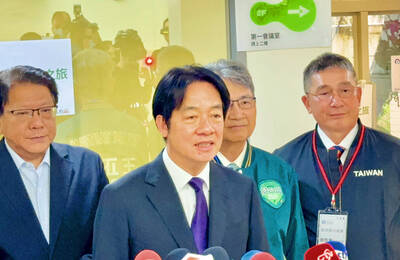
A rally held by opposition parties yesterday demonstrates that Taiwan is a democratic country, President William Lai (賴清德) said yesterday, adding that if opposition parties really want to fight dictatorship, they should fight it on Tiananmen Square in Beijing. The Chinese Nationalist Party (KMT) held a protest with the theme “against green communists and dictatorship,” and was joined by the Taiwan People’s Party. Lai said the opposition parties are against what they called the “green communists,” but do not fight against the “Chinese communists,” adding that if they really want to fight dictatorship, they should go to the right place and face


 RSS
RSS