


Two thousand senior citizens from Nantou County's Tsaotun Township (草屯) yesterday protested outside the Legislative Yuan, asking the central government to stump up the NT$216 million (US$6.7 million) in debt the township government has incurred after apparently following government policies.
The protesters, led by township Mayor Chou Hsin-li (
EPA officials responded and said the township put itself into the position by signing a seven-year contract with Chuchan Co (
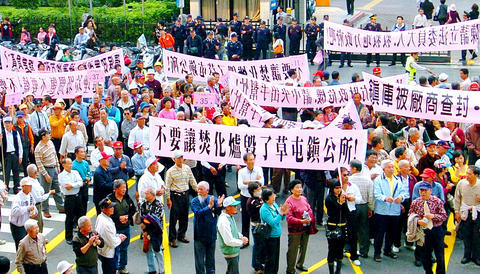
PHOTO: CHU PEI-HSIUNG, TAIPEI TIMES
Legislative Speaker Wang Jin-pyng (
To better meet the expanding demand for waste processing and in light of the difficulty procuring properties large enough to accommodate full-scale waste incinerators, in 1997 the EPA proposed a "transitional plan" and approved the construction of several smaller, temporary incinerators, Chou said.
Former Tsaotun Township Mayor Hung Tun-jen (洪敦仁) signed a seven-year BOT (Build-Operate-Transfer) contract in 2003 with GEP after receiving the EPA's authorization to subsidize the county's garbage disposal fees "until a full-scale incinerator was completed," Chou said, adding that a full-scale incinerator in Nantou was proposed to be completed by last year.
Last year, having withdrawn the plan for an incinerator in Nantou, the EPA ordered the township to ship its waste to a larger incinerator in Taichung County's Wurih (
GEP filed and won a lawsuit against the township, and the Arbitration Association (ROC) ordered Tsaotun to pay NT$216 million for ending the contract three years early, he added.
Yesterday's mediator, DPP Legislator Lin Yun-sheng (林耘生) said that the central government should take some responsibility for the township's debt since "the township signed the contract when it was unaware of the four-year cap on the subsidy," Lin said.
"Now the county is bankrupt because the central government has withdrawn its subsidies," he added.
In response to the accusations, the EPA's Inspector General Chang Hoang-jang (張晃彰) said that the county knew the regulations but signed a contract with GEP anyway.
"The transitional plan clearly stated that local governments could build temporary incinerators and use them for up to four years because that is the time needed to build a large-scale incinerator," Chang said.
"Tsaotun township applied for the subsidy under this plan -- so there is no way they would not know about the time limit on the reimbursement," he said.
In addition, "to say that [the EPA] promised to reimburse Tsaotun for its garbage fees until a full-scale incinerator was built is only telling half the story," Chang said.
"The EPA did make such a promise, on the condition that the township completed its transitional incinerator speedily [within one year], which Tsaotun failed to do, so the promise did not stand," he said.
"Despite the fact that Tsaotun's construction was one full year overdue, which defeats the purpose of having transitional incinerators, the EPA still provided it four years of payments according to the plan," he said.
"The EPA has done its bit within reasonable realms, but what the county signed with its contractor is not related to the administration," Chang said.
As for the Wang's request to come up with a resolution within a month, Chang said that the administration will form a case committee to propose a plan, however, "We will continue to subsidize Tsaotun for transporting their garbage to the Wurih incinerator, like we do for all of Nantou's townships," Chang said.
"But we cannot encourage local governments to sign contracts with contractors while thinking that the EPA will clean up after them," he said.

AGING: While Japan has 22 submarines, Taiwan only operates four, two of which were commissioned by the US in 1945 and 1946, and transferred to Taiwan in 1973 Taiwan would need at least 12 submarines to reach modern fleet capabilities, CSBC Corp, Taiwan chairman Chen Cheng-hung (陳政宏) said in an interview broadcast on Friday, citing a US assessment. CSBC is testing the nation’s first indigenous defense submarine, the Hai Kun (海鯤, Narwhal), which is scheduled to be delivered to the navy next month or in July. The Hai Kun has completed torpedo-firing tests and is scheduled to undergo overnight sea trials, Chen said on an SET TV military affairs program. Taiwan would require at least 12 submarines to establish a modern submarine force after assessing the nation’s operational environment and defense

A white king snake that frightened passengers and caused a stir on a Taipei MRT train on Friday evening has been claimed by its owner, who would be fined, Taipei Rapid Transit Corp (TRTC) said yesterday. A person on Threads posted that he thought he was lucky to find an empty row of seats on Friday after boarding a train on the Bannan (Blue) Line, only to spot a white snake with black stripes after sitting down. Startled, he jumped up, he wrote, describing the encounter as “terrifying.” “Taipei’s rat control plan: Release snakes on the metro,” one person wrote in reply, referring

The coast guard today said that it had disrupted "illegal" operations by a Chinese research ship in waters close to the nation and driven it away, part of what Taipei sees a provocative pattern of China's stepped up maritime activities. The coast guard said that it on Thursday last week detected the Chinese ship Tongji (同濟號), which was commissioned only last year, 29 nautical miles (54km) southeast of the southern tip of Taiwan, although just outside restricted waters. The ship was observed lowering ropes into the water, suspected to be the deployment of scientific instruments for "illegal" survey operations, and the coast

Taiwan’s two cases of hantavirus so far this year are on par with previous years’ case numbers, and the government is coordinating rat extermination work, so there should not be any outbreaks, Centers for Disease Control (CDC) Director-General Philip Lo (羅一鈞) said today in an interview with the Liberty Times (the Taipei Times’ sister newspaper). An increase in rat sightings in Taipei and New Taipei City has raised concerns about the spread of hantavirus, as rats can carry the disease. In January, a man in his 70s who lived in Taipei’s Daan District (大安) tested positive posthumously for hantavirus, Taiwan’s


 RSS
RSS