


The software that allows financial institutions to track transactions and retailers to optimize inventory levels could help researchers at National Yang-Ming University predict outbreaks of diseases such as the flu and produce vaccines tailored to dominant strains, researchers at a conference said yesterday.
Using epidemiological data collected by the Center of Disease Control (CDC), the analytic tool by the university team will be able to shave months off the process of predicting which strains of influenza to expect during the next flu season, said Yang Ueng-cheng (楊永正), the director of the university's center for systems and synthetic biology.
Yang said that the strains of influenza most prevalent in Taiwan during any given flu season are usually considerably different from those in other countries, which "makes it desirable to produce our own vaccines rather than use the same ones as everyone else."
"However, in order to mass-produce the vaccines in time for the coming season, we need to know the strain that will be most prevalent by March," which is not enough time, he said.
The team is working with Service Oriented Architecture (SOA) software donated by IBM.
SOA programs are used in a variety of business settings where it is necessary to cross-check information from separate databases.
Joe Lu (呂政欣), advisory specialist with IBM Taiwan, gave an example: "Withdrawing money from an ATM is one transaction for the user. But behind the scenes, a series of procedures needs to take place -- from checking the validity of the card to making sure that there are adequate funds in the account."
"It would take us years to write the software ourselves," said Li Guo-bing (
Li said that by this March, the project could be far enough along to analyze the information from this flu season, which is just now peaking.
That means the team could produce predictions theoretically in time to mass produce vaccines for next winter's flu season.
But its too soon to talk about producing influenza vaccines tailored for Taiwan, CDC deputy chairman Shih Wen-yi (
"We don't make our own vaccines yet and there is currently no choice of vaccine types on the market," he said.

LOUD AND PROUD Taiwan might have taken a drubbing against Australia and Japan, but you might not know it from the enthusiasm and numbers of the fans Taiwan might not be expected to win the World Baseball Classic (WBC) but their fans are making their presence felt in Tokyo, with tens of thousands decked out in the team’s blue, blowing horns and singing songs. Taiwanese fans have packed out the Tokyo Dome for all three of their games so far and even threatened to drown out home team supporters when their team played Japan on Friday. They blew trumpets, chanted for their favorite players and had their own cheerleading squad who dance on a stage during the game. The team struggled to match that exuberance on the field, with
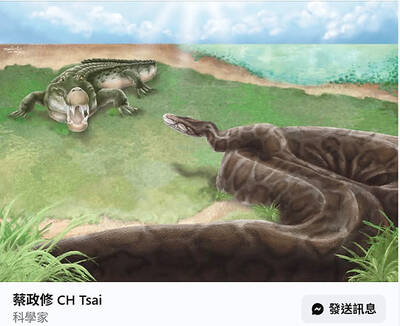
Taiwanese paleontologists have discovered fossil evidence that pythons up to 4m long inhabited Taiwan during the Pleistocene epoch, reporting their findings in the international scientific journal Historical Biology. National Taiwan University (NTU) Institute of Ecology and Evolutionary Biology associate professor Tsai Cheng-hsiu (蔡政修) led the team that discovered the largest snake fossil ever found in Taiwan. The single trunk vertebra was discovered in Tainan at the Chiting Formation, dated to between 400,000 and 800,000 years ago in the Middle Pleistocene, the paper said. The area also produced Taiwan’s first avian fossil, as well as crocodile, mammoth, saber-toothed cat and rhinoceros fossils, it said. Discoveries

Taiwanese paleontologists have discovered fossil evidence that pythons up to 4m long inhabited Taiwan during the Pleistocene epoch, reporting their findings in the international scientific journal Historical Biology. National Taiwan University (NTU) Institute of Ecology and Evolutionary Biology associate professor Tsai Cheng-hsiu (蔡政修) led the team that discovered the largest snake fossil ever found in Taiwan. A single trunk vertebra was discovered in Tainan at the Chiting Formation, dated to between 800,000 to 400,000 years ago in the Middle Pleistocene, the paper said. The area also produced Taiwan’s first avian fossil, as well as crocodile, mammoth, sabre-toothed cat and rhinoceros fossils, it said. Discoveries

Whether Japan would help defend Taiwan in case of a cross-strait conflict would depend on the US and the extent to which Japan would be allowed to act under the US-Japan Security Treaty, former Japanese minister of defense Satoshi Morimoto said. As China has not given up on the idea of invading Taiwan by force, to what extent Japan could support US military action would hinge on Washington’s intention and its negotiation with Tokyo, Morimoto said in an interview with the Liberty Times (sister paper of the Taipei Times) yesterday. There has to be sufficient mutual recognition of how Japan could provide


 RSS
RSS