

The Fulbright Program, the US government's flagship program for international exchange, has created a lasting impression on more than 2,000 academics from Taiwan and the US, American Institute in Taiwan Director Stephen Young said last night at a gala dinner celebrating five decades of the program in Taiwan.
For 50 years, Taiwan's Fulbright program has been a pioneer in responding to professional needs emerging from Taiwan's rapid economic and democratic development, Young said, adding that many of Taiwan's leaders, including Cabinet members, university presidents, professors and artists, are Fulbright alumni.
Minister of Education Tu Cheng-sheng (
The prestigious scholarship program was proposed to the US Congress in 1945 by Senator J. William Fulbright. In the aftermath of World War II, he argued the program would be a much-needed mechanism to create mutual understanding between the US and the international community. The program was approved by Congress and signed into law by US president Harry Truman the next year.
In Taiwan, the Fulbright program is administered by the Foundation for Scholarly Exchange. The foundation has sent over 1,000 Taiwan researchers to the US and more than 700 US academics to Taiwan.
For the 2007 to 2008 academic year, the program is supporting 53 Taiwan grantees and 35 US grantees. The topics that will be studied by US Fulbright scholars in Taiwan include womens studies, physics and astronomy, business administration, anthropolgy, journalism and linguistics.

Starbucks Taiwan’s decision to charge for drink customization, which had been free, has sparked consumer backlash, highlighting the challenge of raising prices without making customers feel they are losing value, experts said. Since Oct. 12, customers who order drinks with less or no ice and ask to have the volume topped up with milk or other liquid have been charged an additional NT$15. Topping off drinks without ice was previously free, and disgruntled customers posted photos on social media showing that iced drinks ordered without ice were only half full if the extra NT$15 was not paid. The posts drew tens of thousands
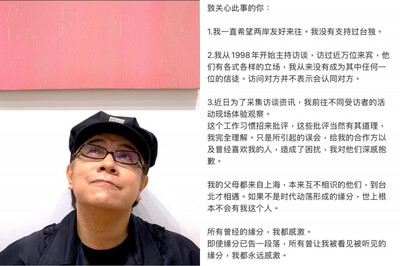
EXPLANATION: Tsai said he attended events featuring various interviewees to observe them firsthand as part of his interview research Television host Kevin Tsai (蔡康永) last night broke his silence over a controversy surrounding his appearance at a campaign event for Democratic Progressive Party Taipei mayoral candidate Puma Shen (沈伯洋), saying he had never supported Taiwan independence. “I have always hoped for friendly cross-strait relations. I have never supported Taiwan independence,” Tsai wrote in a post on the Chinese social media platform Sina Weibo. Tsai, who has hosted television shows in China, attended the opening of Shen’s campaign headquarters on Oct. 4, drawing criticism from Chinese social media users and prompting some Chinese companies to distance themselves from him. China’s Taiwan Affairs Office
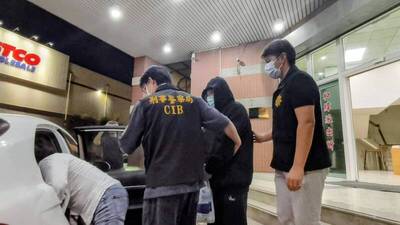
The husband of a Taiwanese woman stabbed to death at a hotel in Japan has been detained on suspicion of entering into a sham marriage and taking out high-value insurance policies in her name, Tainan prosecutors said today. A woman surnamed Ching (井), 38, was killed on Monday last week at a tourist hotel in Fujikawaguchiko, Japan. A Taiwanese woman surnamed Yang (楊) was arrested by Japanese police on suspicion of murder, Tainan District Prosecutors’ Office deputy chief prosecutor Wang Sheng-hao (王聖豪) said. Investigators suspect that Ching's new husband, surnamed Lee (李), 29, arranged a sham marriage, encouraged her to travel to Japan

Mainland Affairs Council (MAC) Minister Chiu Chui-cheng (邱垂正) today defended the government's decision to deny Chinese actor Zhang Linghe (張凌赫) entry to Taiwan for a fan meeting, citing the actor's social media posts denigrating national sovereignty and the sensitive timing ahead of local elections. Zhang, who stars in the popular Chinese period romance Pursuit of Jade (逐玉), was scheduled to visit Taiwan late this month. The rejection sparked a war of words between the council and China's Taiwan Affairs Office (TAO), which accused Taipei of imposing "unreasonable restrictions" on cross-strait cultural exchanges. Speaking to reporters at the Legislative Yuan, Chiu was asked


 RSS