


Prosecutors are investigating a company suspected of exporting equipment to North Korea that could be used in the manufacture of nuclear weapons, an official said yesterday.
The Yicheng Company (
If proven, the transfer would violate UN sanctions meant to punish North Korea for its nuclear programs.
But the alleged deal also underscores budding commercial ties between Taiwan and poverty-stricken, politically isolated North Korea.
The official declined to provide specifics on the filtering device but said it could be used to extract plutonium to make nuclear weapons and also to make biological and chemical weapons.
"The equipment is on the embargo list for export to North Korea, as Taiwan follows the UN Security Council's trade sanctions," said the official, who spoke on condition of anonymity.
Bureau investigators have handed the case to prosecutors for further investigation and possible filing of charges, the official said.
Yicheng could not be contacted for comment. The company's telephone number is not publicly listed.
The UN Security Council imposed trade sanctions against Pyongyang in October last year after North Korea conducted its first successful nuclear test. Under the sanctions, member states must prevent North Korea from importing or exporting any material for weapons of mass destruction or ballistic missiles.
The Investigation Bureau official said Yicheng would be the third company caught illegally exporting military-related equipment to North Korea this year.
In the two other incidents, investigators found that Chenghui Co (
The latest investigation comes amid progress in international efforts to get North Korea to abandon its nuclear programs. This month Pyongyang began to disable its sole functioning nuclear reactor and a related processing facility under a deal with the US, South Korea, China, Japan and Russia.
In return, North Korea will receive the equivalent of 1 million tonnes of oil and other benefits from the five negotiating partners.
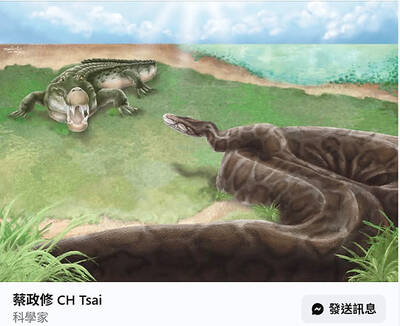
Taiwanese paleontologists have discovered fossil evidence that pythons up to 4m long inhabited Taiwan during the Pleistocene epoch, reporting their findings in the international scientific journal Historical Biology. National Taiwan University (NTU) Institute of Ecology and Evolutionary Biology associate professor Tsai Cheng-hsiu (蔡政修) led the team that discovered the largest snake fossil ever found in Taiwan. The single trunk vertebra was discovered in Tainan at the Chiting Formation, dated to between 400,000 and 800,000 years ago in the Middle Pleistocene, the paper said. The area also produced Taiwan’s first avian fossil, as well as crocodile, mammoth, saber-toothed cat and rhinoceros fossils, it said. Discoveries

Taiwanese paleontologists have discovered fossil evidence that pythons up to 4m long inhabited Taiwan during the Pleistocene epoch, reporting their findings in the international scientific journal Historical Biology. National Taiwan University (NTU) Institute of Ecology and Evolutionary Biology associate professor Tsai Cheng-hsiu (蔡政修) led the team that discovered the largest snake fossil ever found in Taiwan. A single trunk vertebra was discovered in Tainan at the Chiting Formation, dated to between 800,000 to 400,000 years ago in the Middle Pleistocene, the paper said. The area also produced Taiwan’s first avian fossil, as well as crocodile, mammoth, sabre-toothed cat and rhinoceros fossils, it said. Discoveries
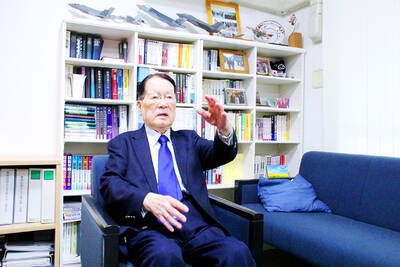
Whether Japan would help defend Taiwan in case of a cross-strait conflict would depend on the US and the extent to which Japan would be allowed to act under the US-Japan Security Treaty, former Japanese minister of defense Satoshi Morimoto said. As China has not given up on the idea of invading Taiwan by force, to what extent Japan could support US military action would hinge on Washington’s intention and its negotiation with Tokyo, Morimoto said in an interview with the Liberty Times (sister paper of the Taipei Times) yesterday. There has to be sufficient mutual recognition of how Japan could provide

UPDATED TEST: The new rules aim to assess drivers’ awareness of risky behaviors and how they respond under certain circumstances, the Highway Bureau said Driver’s license applicants who fail to yield to pedestrians at intersections or to check blind spots, or omit pointing-and-calling procedures would fail the driving test, the Highway Bureau said yesterday. The change is set to be implemented at the end of the month, and is part of the bureau’s reform of the driving portion of the test, which has been criticized for failing to assess whether drivers can operate vehicles safely. Sedan drivers would be tested regarding yielding to pedestrians and turning their heads to check blind spots, while drivers of large vehicles would be tested on their familiarity with pointing-and-calling


 RSS
RSS