

Mainland Affairs Council (MAC) Chairman Chen Ming-tong (
Chen said Tsao's vision was strikingly similar to the ideas laid out in China's "Anti-Secession" Law and was detrimental to the nation's identity and democracy.
Chen made the remarks in response to Tsao's front-page ad, published in Chinese-language newspapers this month, urging Democratic Progressive Party presidential candidate Frank Hsieh (謝長廷) and his Chinese Nationalist Party (KMT) rival Ma Ying-jeou (馬英九) to jointly promote such a law, which Tsao envisioned as a legal basis for maintaining freedom and democracy.
In his ad, Tsao proposed a law banning any referendum on independence on the basis that the nation is already independent.
Commenting on Tsao's suggestion, Chen said at a Taiwan Thinktank seminar that it was unthinkable to legislate a law that would let China hold a "unification referendum" but ban Taiwan from holding a referendum.
Chen said it was sad that Tsao envisioned legislation that would downgrade Taiwan's status from that of a sovereign nation to a "highly autonomous region" of China similar to Hong Kong or Macau.
Such a law violated the Constitution and would effectively be a "suicide law," Chen said.
Tsao's proposal echoes the "Anti-Secession" Law enacted by Beijing in March 2005, Chen said, adding that the "unification referendum" proposed by Tsao was tailor-made to the specifications of the Chinese law.
Chen said that the Republic of China is a sovereign state that now consists solely of Taiwan and is both de facto and de jure independent of the People's Republic of China.

A Hualien pomelo farmer refused to sell to China after the country announced it would permit more Taiwanese pomelo imports, prompting widespread support from Taiwanese consumers, who rallied to buy his fruit. China’s Taiwan Affairs Office last month said that China’s General Administration of Customs registered an additional 79 Taiwanese pomelo orchards and packing facilities in Hualien County, allowing more Taiwanese producers to export pomelos to China. “I am a Hualien fruit farmer and I refuse to sell to China,” Liu Tzu-hao (劉子豪) from Ruisui Township (瑞穗) said in an online post. Liu is a well-known farmer in the community and has served
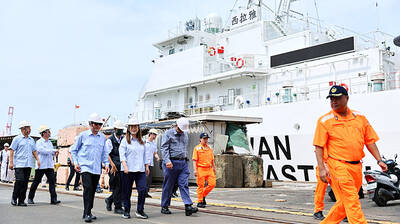
Ocean Affairs Council (OAC) Minister Kuan Bi-ling (管碧玲) on Wednesday said decommissioned coast guard vessels were given to the Philippines to enhance regional rescue capacity and would not affect Taiwanese fishers’ rights and benefits. Kuan made the remarks after confirmation on Tuesday that a 500-tonne Coast Guard Administration (CGA) patrol and rescue vessel would be given to the Philippine Coast Guard. The donation ceremony was reportedly done in Manila, but whether the vessel — previously numbered “CG123” and named Kinmen (金門) — has been handed over has yet to be confirmed. China’s Taiwan Affairs Office (TAO) on Wednesday criticized the donation for “taking
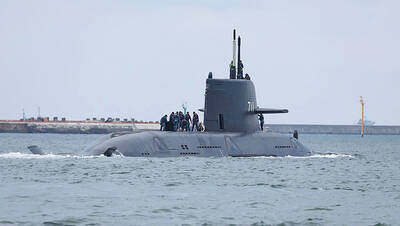
UPDATE: The submarine would need to undergo combined systems testing and crew training for navy personnel before it is ready for mission, an expert said Taiwan’s first domestically built submarine, the Hai Kun (Narwhal, 海鯤), could be delivered to the navy as early as next month, military expert and Taiwan Association for Security and Development chairman Chi Tung-yun (紀東昀) said yesterday. The submarine was yesterday morning observed departing for its 21st sea trial and its 15th submerged test. The vessel missed the initial delivery deadline of November last year due to “testing delays,” its primary contractor, shipbuilder CSBC Corp, Taiwan, said in June. The contractor also cited “political pressure from China” in procuring critical equipment. All testing operations are in the final stages, with the

OCT. 31: The antiviral drugs Tamiflu and Eraflu have been distributed to about 4,000 medical facilities nationwide for people in seven groups who develop flu-like symptoms As the domestic influenza epidemic enters its peak season and continues to escalate, the Centers for Disease Control (CDC) yesterday announced that publicly funded influenza antiviral drugs for seven eligible groups have been extended to Oct. 31, allowing those who develop flu-like symptoms to receive the medication without undergoing a rapid influenza test. The CDC has extended the expanded use of flu antiviral drugs to seven groups: healthcare and influenza-prevention personnel; residents and staff at nursing homes, long-term care facilities and similar institutions; kindergarten and daycare workers and home-based caregivers; students from kindergarten through high school, vocational high school and the


 RSS
RSS