


Ballots are often handed out together when a referendum and election are held simultaneously in other countries, academics said yesterday, arguing this helps protect voter privacy.
They made the remarks at a Taipei forum hosted by the Taiwan Thinktank on referendum procedures in Germany, Switzerland, Japan and the US.
Guenter Whittome, a former researcher at the University of Hamburg whose work focuses on Taiwan's democratization and history, introduced procedures from Germany and Switzerland.
Although German states have different election regulations, voters "generally get their [election and referendum] ballots together at the entrance of poll stations after having their identity checked," he said.
In Switzerland, where national referendums have been a staple of the country's democracy since 1874, voters also receive ballots together when a referendum and election are held jointly, Whittome said.
Whittome displayed a Swiss referendum ballot from 2004 on which three referendum questions were printed, separated by dotted lines, "so that voters may tear off the part with the referendum they don't want to vote on," Whittome said.
In addition, Swiss voters receive booklets with a detailed introduction to each referendum before voting day, he said.
"How ballots are distributed wouldn't be an issue in Germany or Switzerland -- at least not a topic of political debate," Whittome said. "Convenience for voters is the only concern."
Citing US elections, Tsai Chia-hung (
"In the US you could have several referendums and different elections on one sheet," Tsai said. "Although there are proposals to change certain election procedures, there is no suggestion to print separate ballots."
In 2003, when California governor Gray Davis was recalled, "the recall and the election for a new governor were on the same ballot," he said.
Chunghua University professor of public administration Tseng Chien-yuan (
Tseng cited the nation's 2004 referendum, held in tandem with the presidential election, as an example.
"Many voters gave up voting in the referendum because they were watched by a crowd of pan-blue supporters," which violated their freedom of choice, Tseng said.
The pan-blue and pan-green camps are locked in a debate over whether referendum and legislative election ballots should be handed to voters simultaneously in January.
The pan-green camp is pushing for voters to receive election and referendum ballots together, while the pan-blue camp says two-step voting would prevent confusion.
Two referendums -- a Democratic Progressive Party-sponsored referendum on recovering the Chinese Nationalist Party's (KMT) stolen assets and a KMT-sponsored referendum on empowering the legislature to launch corruption investigations against the president, vice-president or their families and subordinates -- will be held on Jan. 12.

Hong Kong singer Eason Chan’s (陳奕迅) concerts in Kaohsiung this weekend have been postponed after he was diagnosed with Covid-19 this morning, the organizer said today. Chan’s “FEAR and DREAMS” concert which was scheduled to be held in the coming three days at the Kaohsiung Arena would be rescheduled to May 29, 30 and 31, while the three shows scheduled over the next weekend, from May 23 to 25, would be held as usual, Universal Music said in a statement. Ticket holders can apply for a full refund or attend the postponed concerts with the same seating, the organizer said. Refund arrangements would

Taiwanese indie band Sunset Rollercoaster and South Korean outfit Hyukoh collectively received the most nominations at this year’s Golden Melody Awards, earning a total of seven nods from the jury on Wednesday. The bands collaborated on their 2024 album AAA, which received nominations for best band, best album producer, best album design and best vocal album recording. “Young Man,” a single from the album, earned nominations for song of the year and best music video, while another track, “Antenna,” also received a best music video nomination. Late Hong Kong-American singer Khalil Fong (方大同) was named the jury award winner for his 2024 album

Premier Cho Jung-tai (卓榮泰) on Friday laid out the Cabinet’s updated policy agenda and recapped the government’s achievements ahead of the one-year anniversary of President William Lai’s (賴清德) inauguration. Cho said the government had made progress across a range of areas, including rebuilding Hualien, cracking down on fraud, improving pedestrian safety and promoting economic growth. “I hope the public will not have the impression that the Cabinet only asked the legislature to reconsider a bunch of legal amendments,” Cho said, calling the moves “necessary” to protect constitutional governance and the public’s interest. The Cabinet would work toward achieving its “1+7” plan, he said. The
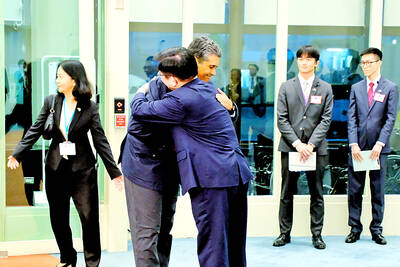
Palauan President Surangel Whipps Jr arrived in Taiwan last night to kick off his first visit to the country since beginning his second term earlier this year. After arriving at Taoyuan International Airport at around 6:30 pm, Whipps and his delegation were welcomed by Minister of Foreign Affairs Lin Chia-lung (林佳龍). Speaking to gathered media, the Palauan leader said he was excited and honored to be back in Taiwan on his first state visit to Taiwan since he was sworn in this January. Among those traveling with Whipps is Minister of State Gustav N. Aitaro, Public Infrastructure


 RSS
RSS