


Former president and spiritual leader of the Taiwan Solidarity Union (TSU) Lee Teng-hui (李登輝) expressed confidence yesterday in the growth of a third political force, saying the recent withdrawal of several TSU members would not develop into a crisis for the party.
"I happily applaud [those who quit the TSU] and urge them to leave as soon as possible," Lee said, responding to questions about developments within the party.
Four TSU members, a legislator and three Taipei City councilors, quit the party on Thursday to join the Democratic Progressive Party (DPP), following the departure of three more lawmakers in the past ten days.
They accused the TSU of having lost its Taiwan-centered values and of being infiltrated by the "red-shirt army," a campaign organized to demand President Chen Shui-bian's (
Denying that the TSU had changed its views on defending the nation's sovereignty, Lee said the defections reflected an attitude of "self-importance."
They came to the TSU when they were not favored by the DPP and now the DPP has incited them to leave the TSU because it wants to "extinguish the TSU" and "attack Lee Teng-hui," Lee said.
Lee criticized the DPP over what he sees as attempts to dominate the pro-localization issue, adding that the DPP failed to understand that the pro-localization movement would only be stronger the DPP cooperated with the TSU.
While refusing to say whether there was room for a third force in January's legislative election, Lee said a third force is what the nation really needs.
"Current politics need adjustment," Lee said, adding that social problems would worsen if the two main political parties became further polarized and neglected the problems facing the middle class and the poor.
There are many young people with clearer minds than those TSU members who are planning to join the DPP, Lee said, as "not everyone wants to follow the rich and powerful."
"Centrist voters account for more than 30 percent of the population, which does not include the many Chinese Nationalist Party (KMT) and DPP members who are unhappy with their parties," Lee said.
Asked who he would support in March's presidential election, Lee said he remained neutral and would choose the candidate who in his view would be most helpful to the nation's development.
In related news, former DPP legislator Tuan Yi-kang (
Tuan obtained nearly 57 percent of the votes, while his rival, former TSU legislator David Huang (黃適卓), garnered about 43 percent, the DPP poll results showed.
Huang, who withdrew from the TSU on Wednesday, said he would join the DPP to run in the elections if he won the poll.
In a statement yesterday, Huang said he was willing to help Tuan in his election bid. The two had agreed to let the polls decide who should run for the sake of pan-green unity.
Huang said he will continue his legislative work until his term expires on Jan. 31, adding that he would devote most of his energy helping DPP presidential candidate Frank Hsieh (謝長廷) and his running mate, Su Tseng-chang (蘇貞昌).
He also expressed an interest in going back to Taoyuan County to teach at a university, he said.
TSU Legislator Ho Min-hao (何敏豪) was rumored to be the latest TSU member to join the DPP after former chairman Yu Shyi-kun attended the inauguration of Ho's campaign office in Taichung yesterday.
Meanwhile, Liu Kun-li (
"I do not think there is anything wrong with my background or what I did for the TSU," Liu said. "I helped Huang because I support former president Lee's policies."
Liu has been accused by David Huang, among others who recently left the TSU, of sending an e-mail in August on the "destroy the pan-green plan" to TSU spokeswoman Chou Mei-li (
He said Hsu Lung-chun (
In addition to his job as a dentist, Hsu is also the former head of the DPP's Yunlin Headquarters, a former National Assembly member and a former Cabinet advisor.
"It's nothing like what some people are saying, that Liu was recommended by TSU Legislator Lai Shin-yuan (
Hsu said Liu was good at analyzing elections and poll results and that this was why he had introduced him to Huang.
Additional reporting by Staff writer
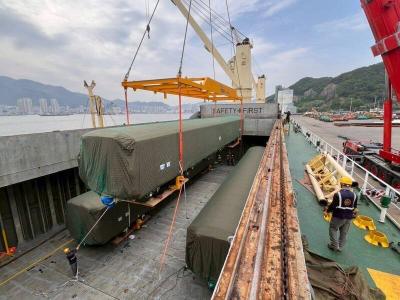
The first of 10 new high-capacity trains purchased from South Korea’s Hyundai Rotem arrived at the Port of Taipei yesterday to meet the demands of an expanding metro network, Taipei Rapid Transit Corp (TRTC) said yesterday. The train completed a three-day, 1,200km voyage from the Port of Masan in South Korea, the company said. Costing NT$590 million (US$18.79 million) each, the new six-carriage trains feature a redesigned interior based on "human-centric" transportation concepts, TRTC said. The design utilizes continuous longitudinal seating to widen the aisles and optimize passenger flow, while also upgrading passenger information displays and driving control systems for a more comfortable
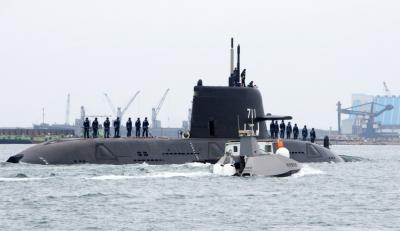
Taiwan's first indigenous defense submarine, the SS-711 Hai Kun (海鯤, or Narwhal), departed for its 13th sea trial at 7am today, marking its seventh submerged test, with delivery to the navy scheduled for July. The outing also marked its first sea deployment since President William Lai (賴清德) boarded the submarine for an inspection on March 19, drawing a crowd of military enthusiasts who gathered to show support. The submarine this morning departed port accompanied by CSBC Corp’s Endeavor Manta (奮進魔鬼魚號) uncrewed surface vessel and a navy M109 assault boat. Amid public interest in key milestones such as torpedo-launching operations and overnight submerged trials,
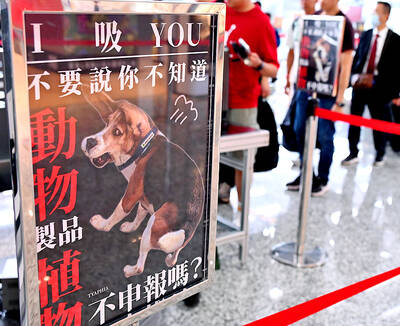
Quarantine awareness posters at Taiwan Taoyuan International Airport have gone viral for their use of wordplay. Issued by the airport branch of the Animal and Plant Health Inspection Agency, the posters feature sniffer dogs making a range of facial expressions, paired with advisory messages built around homophones. “We update the messages for holidays and campaign needs, periodically refreshing materials to attract people’s attention,” quarantine officials said. “The aim is to use the dogs’ appeal to draw focus to quarantine regulations.” A Japanese traveler visiting Taiwan has posted a photo on X of a poster showing a quarantine dog with a

Taiwan’s coffee community has launched a “one-person-one-e-mail” campaign, calling for people to send a protest-e-mail to the World Coffee Championships (WCC) urging it to redesignate Taiwanese competitors as from “Taiwan,” rather than “Chinese Taipei.” The call followed sudden action last week after the WCC changed all references to Taiwanese competitors from “Taiwan” to “Chinese Taipei,” including recent World Latte Art champion Bala (林紹興), who won the World Latte Art Championship in San Diego earlier this month. When Bala received the trophy, he was referred to as representing Taiwan, as well as in the announcement on the WCC’s Web site, until it


 RSS
RSS