


Minister of the Council for Hakka Affairs Lee Yung-teh (李永得) yesterday vowed to push for the establishment of special cultural regions to ensure sustainable development of the Hakka language once it becomes an official language.
Lee made the remarks during a keynote speech on Hakka policies at the 2007 World Hakka Culture Conference, which opened yesterday in Sansia (三峽), Taipei County.
More than 300 Hakka community leaders from 20 countries around the world attended the conference, council spokeswoman Huang Hsiao-yi (
"Without promotion or economic benefits attached to it, the Hakka language, will still be threatened by the dominant [Mandarin] language even if it becomes an official language," Lee told the Taipei Times in a telephone interview.
The Cabinet has drafted a National Languages Development Law (
The draft bill was submitted to the legislature for review earlier this year but remain stalled in the legislature because of pan-blue objection, Lee said.
"Setting up special Hakka cultural regions is one of our Hakka cultural development strategies," he said.
Under the council's plan, townships where Hakka comprise more than 50 percent of the population or make up a simple majority can be designated as "special Hakka cultural regions" through referendums.
"In these regions, all public services will be rendered in Hakka, all public servants have to pass a Hakka proficiency test and all students have to learn Hakka at schools," Lee said. "Only when the `needs' are created can Hakka become a mainstream language in these regions."
Lee added that services in Hakka language should be available in all public domains in accordance with the National Languages Development Law.
"Of course the same logic applies to Hoklo and Aboriginal languages, too," he said.
Hakka leaders from various countries also discussed developments in Hakka studies, business and community.
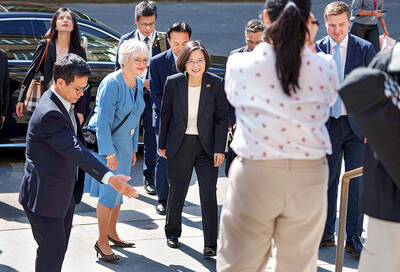
Former president Tsai Ing-wen (蔡英文) on Monday called for greater cooperation between Taiwan, Lithuania and the EU to counter threats to information security, including attacks on undersea cables and other critical infrastructure. In a speech at Vilnius University in the Lithuanian capital, Tsai highlighted recent incidents in which vital undersea cables — essential for cross-border data transmission — were severed in the Taiwan Strait and the Baltic Sea over the past year. Taiwanese authorities suspect Chinese sabotage in the incidents near Taiwan’s waters, while EU leaders have said Russia is the likely culprit behind similar breaches in the Baltic. “Taiwan and our European

The Taipei District Court sentenced babysitters Liu Tsai-hsuan (劉彩萱) and Liu Jou-lin (劉若琳) to life and 18 years in prison respectively today for causing the death of a one-year-old boy in December 2023. The Taipei District Prosecutors’ Office said that Liu Tsai-hsuan was entrusted with the care of a one-year-old boy, nicknamed Kai Kai (剴剴), in August 2023 by the Child Welfare League Foundation. From Sept. 1 to Dec. 23 that year, she and her sister Liu Jou-lin allegedly committed acts of abuse against the boy, who was rushed to the hospital with severe injuries on Dec. 24, 2023, but did not
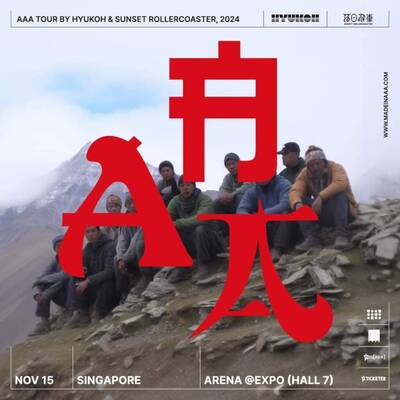
Taiwanese indie band Sunset Rollercoaster and South Korean outfit Hyukoh collectively received the most nominations at this year’s Golden Melody Awards, earning a total of seven nods from the jury on Wednesday. The bands collaborated on their 2024 album AAA, which received nominations for best band, best album producer, best album design and best vocal album recording. “Young Man,” a single from the album, earned nominations for song of the year and best music video, while another track, “Antenna,” also received a best music video nomination. Late Hong Kong-American singer Khalil Fong (方大同) was named the jury award winner for his 2024 album
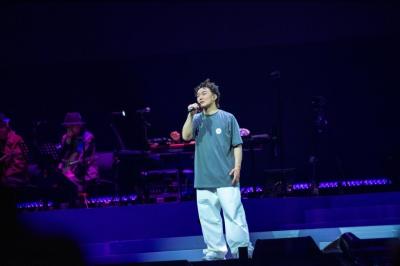
Hong Kong singer Eason Chan’s (陳奕迅) concerts in Kaohsiung this weekend have been postponed after he was diagnosed with Covid-19 this morning, the organizer said today. Chan’s “FEAR and DREAMS” concert which was scheduled to be held in the coming three days at the Kaohsiung Arena would be rescheduled to May 29, 30 and 31, while the three shows scheduled over the next weekend, from May 23 to 25, would be held as usual, Universal Music said in a statement. Ticket holders can apply for a full refund or attend the postponed concerts with the same seating, the organizer said. Refund arrangements would


 RSS
RSS