


New research by a team of neuroscientists at National Tsing Hua University could shed light on how long-term memories are formed in a way that contradicts previous studies.
The team at Tsing Hua's Brain Research Center (BRC) studied the process of memory consolidation in fruit flies, concluding that contrary to the prevailing view in fruit-fly research, long-term memories are probably formed in a separate mechanism from mid-term memories. The team's findings have been published in the this month's issue of the journal Nature Neuroscience, a first for Taiwan.
The study, part of a larger project to map the brain of the drosophila, or the common fruit fly, could have an impact in the future of memory research in humans, said Chiang Ann-shyn (
"Even though the human brain and the fruit fly brain are dramatically different, there are still analogous structures that allow us to gain insight about how memory works in humans from fruit fly research," Chiang said.
The part of the fruit fly brain called the mushroom body is functionally similar to the hippocampus in humans, while the elliptical body is functionally similar to the neocortex in the human brain, the researchers said.
"It was a surprise to us," said another author of the study, Wu Chia-lin (吳嘉霖), who is working toward his doctorate at Tsing Hua.
"Everybody assumed that all the phases of memory consolidation took place in the mushroom body, but when we knocked out receptors in the mushroom body to prevent memory formation there, we found through behavioral testing that the fruit flies still formed long-term memories," Wu said.
Wu said that he hopes the publication of a Taiwanese
study in a top journal such as Nature Neuroscience would encourage young scientists to to do research in Taiwan rather than going abroad, even though resources for research in this country is relatively lacking compared to countries such as the US.
"Most of my peers are thinking of moving abroad eventually," Wu said. "The moon is rounder overseas, as the saying goes."
"However, we have the capacity to do first-class research here in Taiwan," he said.

Former president Tsai Ing-wen (蔡英文) on Monday called for greater cooperation between Taiwan, Lithuania and the EU to counter threats to information security, including attacks on undersea cables and other critical infrastructure. In a speech at Vilnius University in the Lithuanian capital, Tsai highlighted recent incidents in which vital undersea cables — essential for cross-border data transmission — were severed in the Taiwan Strait and the Baltic Sea over the past year. Taiwanese authorities suspect Chinese sabotage in the incidents near Taiwan’s waters, while EU leaders have said Russia is the likely culprit behind similar breaches in the Baltic. “Taiwan and our European

The Taipei District Court sentenced babysitters Liu Tsai-hsuan (劉彩萱) and Liu Jou-lin (劉若琳) to life and 18 years in prison respectively today for causing the death of a one-year-old boy in December 2023. The Taipei District Prosecutors’ Office said that Liu Tsai-hsuan was entrusted with the care of a one-year-old boy, nicknamed Kai Kai (剴剴), in August 2023 by the Child Welfare League Foundation. From Sept. 1 to Dec. 23 that year, she and her sister Liu Jou-lin allegedly committed acts of abuse against the boy, who was rushed to the hospital with severe injuries on Dec. 24, 2023, but did not
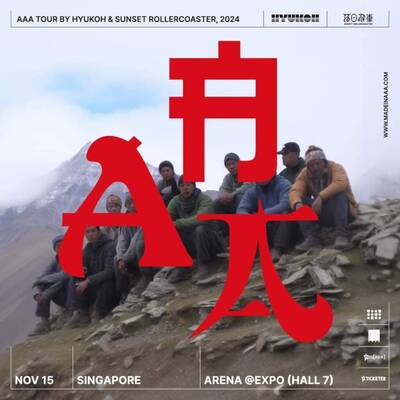
Taiwanese indie band Sunset Rollercoaster and South Korean outfit Hyukoh collectively received the most nominations at this year’s Golden Melody Awards, earning a total of seven nods from the jury on Wednesday. The bands collaborated on their 2024 album AAA, which received nominations for best band, best album producer, best album design and best vocal album recording. “Young Man,” a single from the album, earned nominations for song of the year and best music video, while another track, “Antenna,” also received a best music video nomination. Late Hong Kong-American singer Khalil Fong (方大同) was named the jury award winner for his 2024 album

Hong Kong singer Eason Chan’s (陳奕迅) concerts in Kaohsiung this weekend have been postponed after he was diagnosed with Covid-19 this morning, the organizer said today. Chan’s “FEAR and DREAMS” concert which was scheduled to be held in the coming three days at the Kaohsiung Arena would be rescheduled to May 29, 30 and 31, while the three shows scheduled over the next weekend, from May 23 to 25, would be held as usual, Universal Music said in a statement. Ticket holders can apply for a full refund or attend the postponed concerts with the same seating, the organizer said. Refund arrangements would


 RSS
RSS