

Supporters of different voting procedures debated how election and referendum ballots should be distributed during a public hearing held by the Central Election Commission (CEC) yesterday.
Two referendums, one sponsored by the Democratic Progressive Party (DPP) on retrieving the Chinese Nationalist Party's (KMT) stolen assets, and another by the KMT on giving the legislature the power to investigate the president, the vice president, their family members and subordinates for corruption, will be held alongside the legislative elections on Jan. 12.
To simplify the voting process, some commission members have proposed a "one-step voting" process, whereby the election and referendum ballots would be handed to voters at the entrance to polling stations and the voters would cast the ballots together.
Pan-blue politicians, however, insist a "two-step voting" process be maintained, whereby voters first cast their legislative election ballot before receiving their referendum ballots.
Representatives from the pan-blue camp warned yesterday that changing the procedures could create post-election problems.
"Getting too many ballots at the same time would confuse people," said People First Party representative Lee Yi-kuang (李宜光).
Under the current one-step voting process, election ballots dropped into referendum ballot boxes would be counted as valid and referendum ballots dropped into election ballot boxes would also be valid.
As election ballots would be counted first, Lee worried that election results could be overturned when election ballots from referendum boxes are tallied.
"If miscast ballots overturn the election results, an upheaval would occur," Lee said.
Soochow University political science professor Hsu Yung-ming (
"Let's recall what happened after the 2004 election -- there was still political turmoil after the election even though the two-step voting system was in place," Hsu said.
"Meanwhile, since a certain political camp was opposed to the [2004] referendum, choosing to receive a referendum ballot or not revealed your political leanings, which should be kept secret," Hsu said.
The CEC will make a final decision on the voting procedure later this month.
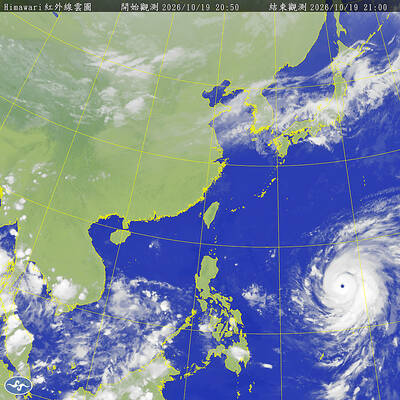
Typhoon Champi is forecast to turn northward earlier than previously expected, sparing Taiwan a direct hit but still bringing heavy rain to the north of the country on Friday and Saturday, the Central Weather Administration (CWA) said yesterday. Typhoon Champi had strengthened and increased in size over the past 12 hours, and as of yesterday afternoon, was packing sustained winds of 198kph near its center, CWA forecaster Cheng Chieh-jen (鄭傑仁) said. However, due to the weakening of a Pacific high-pressure system the storm is now expected to turn northward earlier than initially forecast, likely around Japan’s Ishigaki Island, Cheng said. As Champi brushes
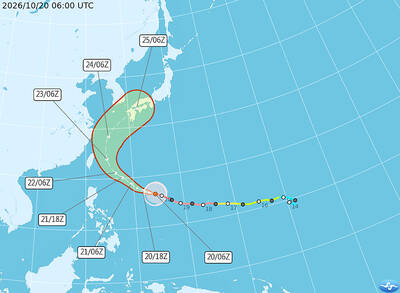
A sea warning for Typhoon Champi might be issued tonight, while the storm’s trajectory would determine whether a land warning is to be issued tomorrow night, the Central Weather Administration (CWA) said yesterday. As of 2pm yesterday, Champi was about 1,536km east-southeast of Taiwan proper’s southernmost point, Oluanpi (鵝鑾鼻), packing maximum sustained winds of 198kph, CWA forecaster Tseng Chao-cheng (曾昭誠) said. The storm was moving west-northwest at 23kph and was expected to strengthen over the next 24 hours before weakening slightly as it approaches cooler waters east of Taiwan, Tseng said. Champi is expected to turn north tomorrow, with the angle of the
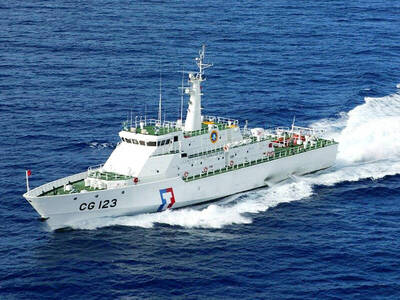
A patrol vessel donated by the Coast Guard Administration (CGA) to the Philippines would not be used in waters near Taiwan or areas where Taiwanese fishing vessels operate, Premier Cho Jung-tai (卓榮泰) said yesterday. The vessel, formerly the CGA's 500-tonne-class Kinmen (金門), was commissioned into the Philippine Coast Guard on Oct. 2. Speaking at the Legislative Yuan, Cho said the Philippines had pledged during the donation process that the vessel would be used only for designated missions and would not operate in waters related to Taiwan. The vessel could even provide assistance to Taiwan if needed, he added. Responding to questions from Chinese

Starbucks Taiwan’s decision to charge for drink customization, which had been free, has sparked consumer backlash, highlighting the challenge of raising prices without making customers feel they are losing value, experts said. Since Oct. 12, customers who order drinks with less or no ice and ask to have the volume topped up with milk or other liquid have been charged an additional NT$15. Topping off drinks without ice was previously free, and disgruntled customers posted photos on social media showing that iced drinks ordered without ice were only half full if the extra NT$15 was not paid. The posts drew tens of thousands


 RSS