


The National Communications Commission will comfortably meet its target of dismantling 1,500 mobile phone base stations this year, commission chairman Su Yeong-chin (蘇永欽) said yesterday.
While briefing the Legislative Yuan, Su said the commission was happy with the progress made by private operators in dismantling the controversy-ridden base stations.
Su said that as at the end of last month, 1,472 base stations had been dismantled and removed -- 98.13 percent of the target. He said a further 28 base stations would easily be removed in the remaining two months of the year.
Su was responding to questions from Chinese Nationalist Party (KMT) Legislator Lai Shyh-bao (
A survey performed by the commission a year ago found that there were 26,000 base stations for 2G mobile phones, 6,500 base stations for 3G mobile phones and 16,000 base stations for personal handy-phone systems, for a total of about 48,000 base stations dotted around the country.
Lawmakers have urged the commission to cut the number of base stations by at least half, as network coverage is more than five times the amount that Taiwan actually needs.
Residential neighborhoods and schools must not be exposed to the risk of radiation emitted by base stations that could cause cancer, miscarriages and diseases of the nervous system, and could even drive people to suicide, the legislators said.
The lawmakers said base stations must be moved out of high population areas, as studies show that radiation at such facilities in Taipei and Tainan exceeds safe levels.
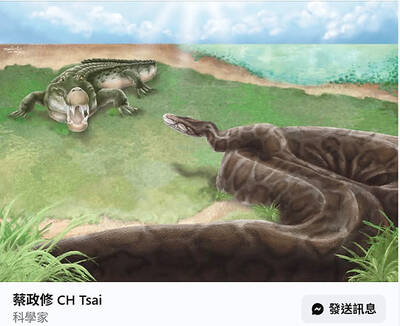
Taiwanese paleontologists have discovered fossil evidence that pythons up to 4m long inhabited Taiwan during the Pleistocene epoch, reporting their findings in the international scientific journal Historical Biology. National Taiwan University (NTU) Institute of Ecology and Evolutionary Biology associate professor Tsai Cheng-hsiu (蔡政修) led the team that discovered the largest snake fossil ever found in Taiwan. The single trunk vertebra was discovered in Tainan at the Chiting Formation, dated to between 400,000 and 800,000 years ago in the Middle Pleistocene, the paper said. The area also produced Taiwan’s first avian fossil, as well as crocodile, mammoth, saber-toothed cat and rhinoceros fossils, it said. Discoveries

Taiwanese paleontologists have discovered fossil evidence that pythons up to 4m long inhabited Taiwan during the Pleistocene epoch, reporting their findings in the international scientific journal Historical Biology. National Taiwan University (NTU) Institute of Ecology and Evolutionary Biology associate professor Tsai Cheng-hsiu (蔡政修) led the team that discovered the largest snake fossil ever found in Taiwan. A single trunk vertebra was discovered in Tainan at the Chiting Formation, dated to between 800,000 to 400,000 years ago in the Middle Pleistocene, the paper said. The area also produced Taiwan’s first avian fossil, as well as crocodile, mammoth, sabre-toothed cat and rhinoceros fossils, it said. Discoveries
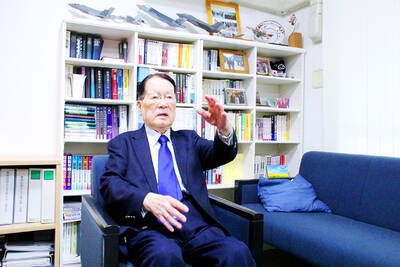
Whether Japan would help defend Taiwan in case of a cross-strait conflict would depend on the US and the extent to which Japan would be allowed to act under the US-Japan Security Treaty, former Japanese minister of defense Satoshi Morimoto said. As China has not given up on the idea of invading Taiwan by force, to what extent Japan could support US military action would hinge on Washington’s intention and its negotiation with Tokyo, Morimoto said in an interview with the Liberty Times (sister paper of the Taipei Times) yesterday. There has to be sufficient mutual recognition of how Japan could provide
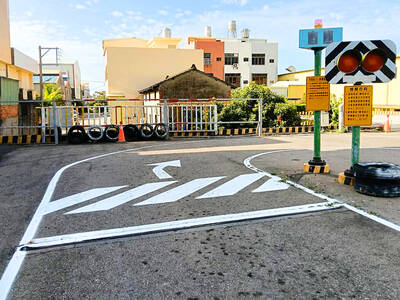
UPDATED TEST: The new rules aim to assess drivers’ awareness of risky behaviors and how they respond under certain circumstances, the Highway Bureau said Driver’s license applicants who fail to yield to pedestrians at intersections or to check blind spots, or omit pointing-and-calling procedures would fail the driving test, the Highway Bureau said yesterday. The change is set to be implemented at the end of the month, and is part of the bureau’s reform of the driving portion of the test, which has been criticized for failing to assess whether drivers can operate vehicles safely. Sedan drivers would be tested regarding yielding to pedestrians and turning their heads to check blind spots, while drivers of large vehicles would be tested on their familiarity with pointing-and-calling


 RSS
RSS