

Hundreds of motorcycle owners gathered in Anping (
The motorcycle tour kicked off with more than 500 heavy-duty bikes roaring from Taipei on their way to Tainan. Hundreds of other motorcyclists from various parts of the country joined them on the way.
"It's great. We've been waiting for this moment for decades," a high-spirited female motorcyclist was quoted by cable news network TVBS as saying.
By law, large-size motorcycles are defined as those equipped with a cylinder capacity of 550 or above.
Besides the right to drive on expressway, heavy-duty bike owners can turn left directly without having to pull over first to the right on an intersection to wait for the green light. They can also park in spaces reserved for sedans.
However, the policy allowing large-size motorcycles to operate on expressways nationwide, which took effect on Thursday, was not welcome news to some.
Karen Tseng (
"The traffic is only going to get worse with all these motorcycles on the road," she said.
Tseng was also against allowing heavy-duty motorbikes to use parking spaces for cars since it was already difficult for car owners to find parking spaces.
Joanna Hsu (
"If owners of large-size motorcycles were required to park in spaces designed for scooters, their motorcycles would not fit in and would take up two to three spaces for scooters instead," she said.
Hsu also expressed concern that some large-size motorcycle owners might think they could enjoy the privileges of both scooter and car owners.
For example, some large bike owners are likely to continue weaving their way through the traffic like scooters do, or may choose to stop at designated areas for smaller bikes while waiting for the light to turn green, she said.
Chen Li-yun (
He said he had heard complaints from other motorists.
He said one woman called and complained that she was so intimidated by so many large motorcycles on the road that she hit a rail on the side.
Residents living close to Taipei's Huanhe Expressway (環河快速道路) have also complained that they cannot sleep at night because of the noise from these large motorcycles, Chen said.
Owners of large motorcycles must learn to respect other motorists on the road and to exercise self-discipline.
"In the next six months, everything we [motorcyclists] do is going to be examined through a magnifying glass," he said.
"Everyone must be constantly reminded of his responsibility and follow the code of ethics for drivers," Chen said.
"If the Ministry of Transportation and Communications decides to take back our right, we will not have any ground to appeal if we continue to behave badly," he said.
Additional reporting by DPA
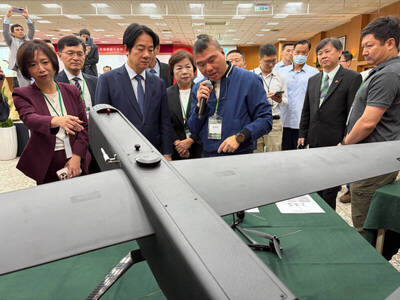
Two executives of drone supplier Jiin Ming Industry Co (錦明實業) have been detained and held incommunicado over the company's alleged use of prohibited China-made chips and camera lenses in drones supplied under recent military contracts, the Taoyuan District Prosecutors' Office said today. In a statement, prosecutors said they raided the offices of Jiin Ming — headquartered in Taoyuan — as well as those of its subsidiaries and its suppliers on Thursday last week. The raids followed a report that the company had breached its procurement contracts by putting the prohibited components into drones delivered to the military. During the raids, prosecutors summoned

The government would continue monitoring online rumors that a pneumonic plague outbreak has spread from Russia into China and could enhance existing quarantine measures, Premier Cho Jung-tai (卓榮泰) said today. During a legislative meeting, Democratic Progressive Party Legislator Wang Ting-yu (王定宇) said rumors were circulating that the disease had spread across several Chinese provinces. He asked Cho whether the government was prepared to prevent the disease from spreading to Taiwan, given the frequent exchanges between Taiwan and China, and how concerned the government was about the alleged outbreak. The Ministry of Health and Welfare implemented border quarantine measures after briefing the Executive Yuan
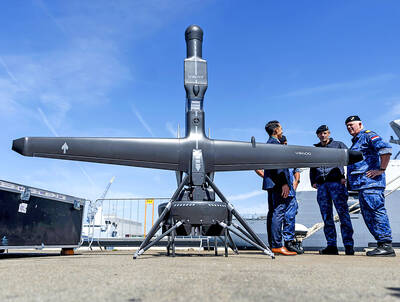
DEFENSE PROCUREMENT: Taiwan could become the largest operator of V-BAT drones outside the US once they are delivered, the Ministry of National Defense said The navy and the coast guard are acquiring 292 units of MQ-35A V-BAT vertical takeoff and landing (VTOL) surveillance drones manufactured by US-based defense technology company Shield AI, making Taiwan one of the largest buyers of the drone. The Coast Guard Administration budgeted NT$1.2 billion (US$37.1 million) to buy 12 drones, which have been delivered, Shield AI said in a report on Oct 13. The navy is planning to spend NT$36 billion under a four-year program code-named Project Yuan Xiao (遠鴞) to acquire 280 V-BAT drones, the Ministry of National Defense’s fiscal 2027 report showed. The combined procurement is expected

South Korean boy band BigBang drew 120,000 fans to three concerts at Taipei Dome from Friday through yesterday, as the band thanked them for their support over their 20-year career. The Taipei Dome concerts were part of BigBang's "2026-2027 World Tour XX: Cosmos." Friday's concert was BigBang's first performance in Taiwan in 11 years. During the encore, group leader G-Dragon (GD) shouted "I love you" in Chinese and said he was especially happy to perform in Taiwan with bandmates Taeyang and Daesung. "Taipei, I'm very grateful to you all," GD said in Chinese, asking fans to wait for the band's return. Daesung thanked


 RSS
RSS