


Taiwan should proceed with a referendum on UN membership despite US opposition if Taiwanese believe it is in their best interests, a leading authority on the initiative and referendum process said in Taipei yesterday.
"I do believe [holding the UN referendum] is a right thing for Taiwan to do ... Even though the US government opposes it because of its impact on the relationship between Washington and Beijing, every country should choose on its own," Dane Waters, founder and chairman of the Initiative & Referendum Institute-US, said at a press conference organized by the Taiwan Foundation for Democracy .
"I don't think it is due responsibility of a nation to dictate to a true democracy how it operates and how a referendum is held just because the referendum is unsettling to it," Waters said.
Waters said the UN referendum is a very "critical step" in letting the international community know how Taiwanese feel about membership in the UN.
But whether or not the referendum represents a tangible step depends on how the government handles the result and how it is perceived by the international community, he said.
In addition to Waters, Bruno Kaufmann, the president of IRI-Europe and a member of IRI-Asia International Steering Committee (ISC), as well as representatives of the seven member countries of IRI-Asia, gathered in Taipei yesterday for the IRI-Asia ISC meeting.
The press conference yesterday was held to launch the Chinese edition of IRI's Guidebook to Direct Democracy.
The book describes in detail how direct lawmaking by the voters works in Switzerland and beyond, through initiative and referendum, and shows other places in the world where it is taking root.
Kaufmann said the purpose of the book was to educate the public about the referendum process by giving examples from Switzerland, which offers the most comprehensive experience of direct democracy and shows how referendums influence everyday life.
TFD president Lin Wen-cheng (
However, Wu Nai-teh (
In response, Waters said it's appropriate for parties to use referendums as an opportunity to bring issues to the forefront and encourage voters to discuss the issue.
Members of the IRI also met Vice President Annette Lu (
The figure is equivalent to 68 percent of the voter turnout in the 2004 presidential election.
Water said he was surprised that 2.25 million people had signed to back the referendum bid, adding that his estimation was made based on his observation experience in the US.

A group of Taiwanese-American and Tibetan-American students at Harvard University on Saturday disrupted Chinese Ambassador to the US Xie Feng’s (謝鋒) speech at the school, accusing him of being responsible for numerous human rights violations. Four students — two Taiwanese Americans and two from Tibet — held up banners inside a conference hall where Xie was delivering a speech at the opening ceremony of the Harvard Kennedy School China Conference 2024. In a video clip provided by the Coalition of Students Resisting the CCP (Chinese Communist Party), Taiwanese-American Cosette Wu (吳亭樺) and Tibetan-American Tsering Yangchen are seen holding banners that together read:

UNAWARE: Many people sit for long hours every day and eat unhealthy foods, putting them at greater risk of developing one of the ‘three highs,’ an expert said More than 30 percent of adults aged 40 or older who underwent a government-funded health exam were unaware they had at least one of the “three highs” — high blood pressure, high blood lipids or high blood sugar, the Health Promotion Administration (HPA) said yesterday. Among adults aged 40 or older who said they did not have any of the “three highs” before taking the health exam, more than 30 percent were found to have at least one of them, Adult Preventive Health Examination Service data from 2022 showed. People with long-term medical conditions such as hypertension or diabetes usually do not
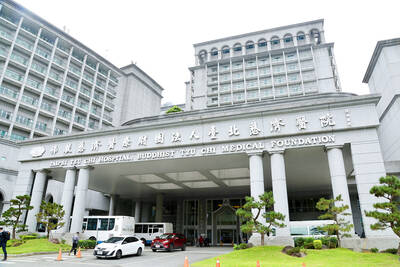
POLICE INVESTIGATING: A man said he quit his job as a nurse at Taipei Tzu Chi Hospital as he had been ‘disgusted’ by the behavior of his colleagues A man yesterday morning wrote online that he had witnessed nurses taking photographs and touching anesthetized patients inappropriately in Taipei Tzu Chi Hospital’s operating theaters. The man surnamed Huang (黃) wrote on the Professional Technology Temple bulletin board that during his six-month stint as a nurse at the hospital, he had seen nurses taking pictures of patients, including of their private parts, after they were anesthetized. Some nurses had also touched patients inappropriately and children were among those photographed, he said. Huang said this “disgusted” him “so much” that “he felt the need to reveal these unethical acts in the operating theater
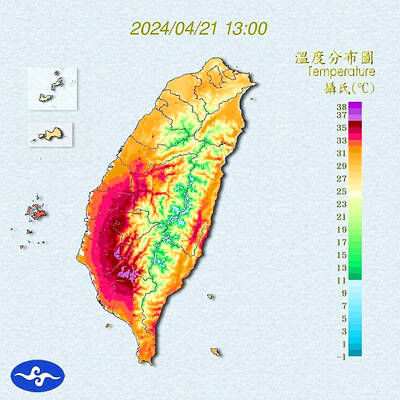
Heat advisories were in effect for nine administrative regions yesterday afternoon as warm southwesterly winds pushed temperatures above 38°C in parts of southern Taiwan, the Central Weather Administration (CWA) said. As of 3:30pm yesterday, Tainan’s Yujing District (玉井) had recorded the day’s highest temperature of 39.7°C, though the measurement will not be included in Taiwan’s official heat records since Yujing is an automatic rather than manually operated weather station, the CWA said. Highs recorded in other areas were 38.7°C in Kaohsiung’s Neimen District (內門), 38.2°C in Chiayi City and 38.1°C in Pingtung’s Sandimen Township (三地門), CWA data showed. The spell of scorching


 RSS
RSS