


Actress Lu Ching (盧靚) yesterday had the 32 month prison sentence she received for her part in the blackmail of TV personality Peng Chia-chia (澎恰恰) reduced to two years by the Taiwan High Court.
Her uncle Lu Chao-chin's (
Lu Chao-chin, a former gangster, once topped the list of the nation's most wanted criminals.
Yesterday's verdict was final.
illegal
"This is simply a case of Lu Ching trying to extract revenge after constant sexual harassment by Peng. The court regards it as illegal, but would not deem it a serious crime," the verdict read.
Peng said that he was prepared to let bygones be bygones.
The Lus made no comment while Kuo said it had not been his day, but he would face up to the consequences.
"For me, the entire thing was already over when I decided to step forward and face it in person," Peng said.
`life goes on'
"Currently, I do not have any thoughts or feelings about the case. Life goes on," he said.
Peng was believed to have paid out a total of NT$41.7 million (US$1.24 million) to the various parties to suppress a video that Lu Ching claimed to have made secretly to protect herself from Peng's sexual advances.
The threat to release the VCD -- which shows Peng masturbating in a room with Lu -- was made in August 2003.
Peng claimed he didn't remember how the footage came to be shot as he was under the influence of flunitrazepan (rohypnol) which he took for an undisclosed psychological condition.
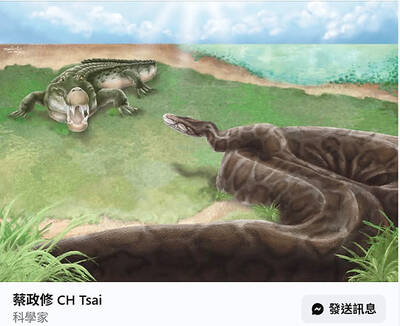
Taiwanese paleontologists have discovered fossil evidence that pythons up to 4m long inhabited Taiwan during the Pleistocene epoch, reporting their findings in the international scientific journal Historical Biology. National Taiwan University (NTU) Institute of Ecology and Evolutionary Biology associate professor Tsai Cheng-hsiu (蔡政修) led the team that discovered the largest snake fossil ever found in Taiwan. The single trunk vertebra was discovered in Tainan at the Chiting Formation, dated to between 400,000 and 800,000 years ago in the Middle Pleistocene, the paper said. The area also produced Taiwan’s first avian fossil, as well as crocodile, mammoth, saber-toothed cat and rhinoceros fossils, it said. Discoveries

Taiwanese paleontologists have discovered fossil evidence that pythons up to 4m long inhabited Taiwan during the Pleistocene epoch, reporting their findings in the international scientific journal Historical Biology. National Taiwan University (NTU) Institute of Ecology and Evolutionary Biology associate professor Tsai Cheng-hsiu (蔡政修) led the team that discovered the largest snake fossil ever found in Taiwan. A single trunk vertebra was discovered in Tainan at the Chiting Formation, dated to between 800,000 to 400,000 years ago in the Middle Pleistocene, the paper said. The area also produced Taiwan’s first avian fossil, as well as crocodile, mammoth, sabre-toothed cat and rhinoceros fossils, it said. Discoveries
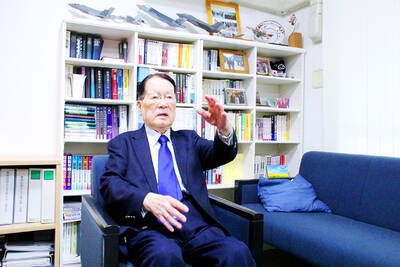
Whether Japan would help defend Taiwan in case of a cross-strait conflict would depend on the US and the extent to which Japan would be allowed to act under the US-Japan Security Treaty, former Japanese minister of defense Satoshi Morimoto said. As China has not given up on the idea of invading Taiwan by force, to what extent Japan could support US military action would hinge on Washington’s intention and its negotiation with Tokyo, Morimoto said in an interview with the Liberty Times (sister paper of the Taipei Times) yesterday. There has to be sufficient mutual recognition of how Japan could provide
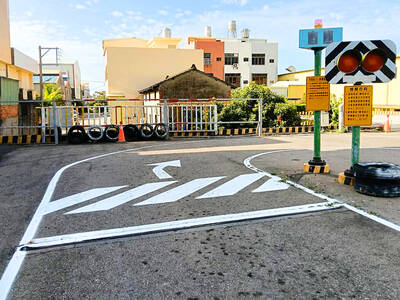
UPDATED TEST: The new rules aim to assess drivers’ awareness of risky behaviors and how they respond under certain circumstances, the Highway Bureau said Driver’s license applicants who fail to yield to pedestrians at intersections or to check blind spots, or omit pointing-and-calling procedures would fail the driving test, the Highway Bureau said yesterday. The change is set to be implemented at the end of the month, and is part of the bureau’s reform of the driving portion of the test, which has been criticized for failing to assess whether drivers can operate vehicles safely. Sedan drivers would be tested regarding yielding to pedestrians and turning their heads to check blind spots, while drivers of large vehicles would be tested on their familiarity with pointing-and-calling


 RSS
RSS