


Taiwan could be the place from which all Austronesian peoples originated, Academia Sinica vice-president Liu Tsui-jung (劉翠溶) said yesterday, citing the results of research conducted over the past decades.
Liu made the remark during a keynote speech at the opening of a conference on issues concerning indigenous peoples worldwide organized by the International Geographical Union.
The conference, which opened in Taipei yesterday, will continue through Saturday.
The Austronesian family refers to indigenous peoples found in a region that stretches "from Taiwan in the north to New Zealand in the south, and from Easter Island in the east to Madagascar in the west," Liu said, adding that this excludes indigenous people in Australia.
For a long time, academics have attempted to trace the origin of Austronesian peoples through linguistic, anthropologist and archaeological research, and had raised several theories, Liu said.
Theories include the Indo-China Peninsula as the origin, southern China as well as the southeast coast of the Asian continent, Liu said.
Although Taiwan was first considered as a possible origin of the Austronesian peoples in 1965, it was not until 10 years later that the theory was taken seriously.
"In 1975, archeologist Richard Shutler and linguist Jeffrey Marck ... contended that archeological and linguistic evidence demonstrated that cord-marked pottery found in Taiwan from around 9000BC to 2500BC represented the earliest Austronesian community," Liu said. "Taiwan was thus the earliest homeland of the Austronesian people."
Advanced biotechnology allowed a team from New Zealand to conduct DNA tests on New Zealand Maoris in 1998.
"[The] finding reveals that Maori ancestors came originally from Taiwan and confirms Maori beliefs about their origins," Liu said.
DNA tests of 640 Taiwanese Aborigines by the Transfusion Medicine Laboratory at Mackay Memorial Hospital in 2005 also showed that "Taiwanese Aboriginal populations are more closely related to Southeast Asian island populations than to those from mainland East Asia," overturning earlier continental origin theories, Liu said.
In addition to Liu's keynote speech, relations between the state and its Aboriginal populations, as well as Taiwan's Aboriginal cultural and knowledge systems, were also explored by academics in essays presented at the conference.

FUKUOKA SITUATION: Japanese media reported that the pathogen is expected to be identified by the summer, while the CDC downplayed the idea that it was hMPV A “mysterious cold-like illness” reported in Japan’s Fukuoka Prefecture does not seem to be a new disease, but Japanese authorities have been asked about the situation, the Centers for Disease Control (CDC) said yesterday. The Fukuoka Prefectural Medical Association on Wednesday told a news conference that a “mystery cold” that has become a hot topic on social media is “highly likely to be caused by some kind of viral infection,” Japan’s KBC News reported. “Many people are experiencing symptoms starting with a sore throat, followed by a runny nose, phlegm and a severe cough,” KBC News reported, citing association officials. Health authorities are

Nvidia Corp CEO Jensen Huang (黃仁勳) arrived in Taiwan yesterday ahead of upcoming AI and technology events, saying he plans to meet with clients and Taiwan Semiconductor Manufacturing Co Chairman C.C. Wei (魏哲家) during his visit. After landing at Taipei Songshan Airport, Huang posed for photos with fans and handed out Yakult drinks to reporters and supporters waiting at the scene, saying he has “a lot to do” during the trip. Asked about reports that Nvidia’s planned headquarters site in Taipei’s Beitou Shilin Technology Park could break ground on May 27, Huang said that if the company holds an event, he would

Carrefour Taiwan is to begin using a new name from the start of July, but it cannot divulge the name until then, the chairman of the supermarket chain's parent company said today. President Chain Store Co chairman Lo Chih-hsien (羅智先) was asked by reporters after a shareholders' meeting to confirm whether the company has settled on a new name for the supermarket brand. In March, the government-registered name of two Carrefour Taiwan branches was quietly changed to "Le Chia Kang" (樂家康) in Chinese, raising speculation that has been selected as the name. Lo said that because of local regulations and contractual obligations, the
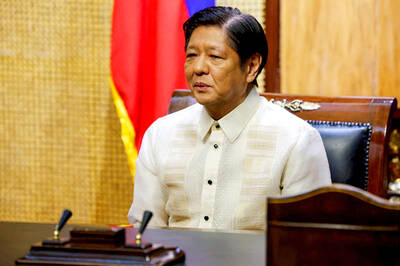
The Philippines would likely be involved in any conflict over Taiwan due to its proximity to the democracy claimed by China, President Ferdinand Marcos Jr said, reiterating a stance that risks angering Beijing. “In the Philippines, we do not have a choice because Taiwan is so close to the Philippines and we have almost 200,000 Filipino nationals living and working in Taiwan,” Marcos said in an interview with Japanese media in Manila on Monday. The Philippine leader’s comments come ahead of a state visit to Japan next week, where he is to meet with Japanese Prime Minister Sanae Takaichi to discuss security


 RSS
RSS