


Disregarding protests from the National Police Agency (NPA), Taipei County Commissioner Chou Hsi-wei (
Chou said Legislative Speaker Wang Jin-pyng (王金平) had called him three times on Wednesday night at the request of NPA Director Hou You-yi (侯友宜) in an attempt to dissuade him from making the promotions.
"If the central government still considers the promotions controversial, it is welcome to send the case to the Legislative Yuan for a vote," Chou said.
Of the 140 promoted officers, 122 will receive a NT$4,150 monthly raise with the remainder getting a NT$2,600 monthly raise.
"I will not budge on my decision to promote the officers in accordance with the laws," Chou said.
"If the central government refuses to negotiate with us, there will be more promotions in the near future," he said.
special municipality
Chou announced the promotions last Friday after the county government was formally upgraded to the status of special municipality on Oct. 1.
While Chou cited the Local Government Act (
Chou said the promotions were intended to boost morale ahead of the legislative elections in January and the presidential elections in March, when police officers would have to take on additional responsibilities.
"Promoting local officers also represents the county government's determination to improve public order ... We are willing to discuss the issue with the NPA to resolve the controversy," he said, while urging Minister of the Interior Lee Yi-yang (
`invalid'
Hou said yesterday that Chou's promotions were invalid.
"Chou's promotions are invalid because they lack legal basis," Hou said when asked for comment outside the Home and Nations Committee meeting.
"Public servants should act according to the law, but [the] Taipei County [Government] is going against that principle now," Hou said. "[The promotions] are detrimental to the police force."
Hou added that he would continue to negotiate with the Taipei County Government for the sake of the police force.
Additional reporting by Loa Iok-sin

Taiwanese paleontologists have discovered fossil evidence that pythons up to 4m long inhabited Taiwan during the Pleistocene epoch, reporting their findings in the international scientific journal Historical Biology. National Taiwan University (NTU) Institute of Ecology and Evolutionary Biology associate professor Tsai Cheng-hsiu (蔡政修) led the team that discovered the largest snake fossil ever found in Taiwan. The single trunk vertebra was discovered in Tainan at the Chiting Formation, dated to between 400,000 and 800,000 years ago in the Middle Pleistocene, the paper said. The area also produced Taiwan’s first avian fossil, as well as crocodile, mammoth, saber-toothed cat and rhinoceros fossils, it said. Discoveries

Taiwanese paleontologists have discovered fossil evidence that pythons up to 4m long inhabited Taiwan during the Pleistocene epoch, reporting their findings in the international scientific journal Historical Biology. National Taiwan University (NTU) Institute of Ecology and Evolutionary Biology associate professor Tsai Cheng-hsiu (蔡政修) led the team that discovered the largest snake fossil ever found in Taiwan. A single trunk vertebra was discovered in Tainan at the Chiting Formation, dated to between 800,000 to 400,000 years ago in the Middle Pleistocene, the paper said. The area also produced Taiwan’s first avian fossil, as well as crocodile, mammoth, sabre-toothed cat and rhinoceros fossils, it said. Discoveries

Whether Japan would help defend Taiwan in case of a cross-strait conflict would depend on the US and the extent to which Japan would be allowed to act under the US-Japan Security Treaty, former Japanese minister of defense Satoshi Morimoto said. As China has not given up on the idea of invading Taiwan by force, to what extent Japan could support US military action would hinge on Washington’s intention and its negotiation with Tokyo, Morimoto said in an interview with the Liberty Times (sister paper of the Taipei Times) yesterday. There has to be sufficient mutual recognition of how Japan could provide
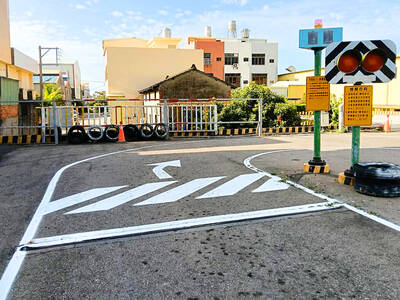
UPDATED TEST: The new rules aim to assess drivers’ awareness of risky behaviors and how they respond under certain circumstances, the Highway Bureau said Driver’s license applicants who fail to yield to pedestrians at intersections or to check blind spots, or omit pointing-and-calling procedures would fail the driving test, the Highway Bureau said yesterday. The change is set to be implemented at the end of the month, and is part of the bureau’s reform of the driving portion of the test, which has been criticized for failing to assess whether drivers can operate vehicles safely. Sedan drivers would be tested regarding yielding to pedestrians and turning their heads to check blind spots, while drivers of large vehicles would be tested on their familiarity with pointing-and-calling


 RSS
RSS