


The "magazine wave" during the pre-Martial Law period represented the people's thirst for democracy and freedom of expression and the forced termination of these publications typified the regime at that time, a Cabinet official said yesterday at the unveiling of an exhibit in Taipei.
Government Information Office Minister Shieh Jhy-wey (謝志偉) made the comments during the opening of the National Central Library's exhibition featuring more than 200 publications that were curtailed by the government during the Martial Law period.
Shieh praised the courage of the literary forefathers, who spoke out against an oppressive regime, saying their sacrifice was crucial in giving rise to democracy in the nation.
The exhibition organizers said that more than 110 new magazine publications emerged between October 1945 and March 1947 -- between the Chinese Nationalist Party's (KMT) initial occupation of Taiwan and the infamous 228 Incident, where an estimated 20,000 Taiwanese were killed or tortured for standing up against KMT rule.
Another 100 magazines published in the early 1950s were also short-lived because of government censorship.
The biggest common denominator of these 200 banned publications is a majority had no connection with those published during the Japanese colonial period and most of them disappeared after the 228 Incident, the organizers said.
Ho Yi-ling (
The common usage of "new," he said, demonstrated the collective strive for a new Taiwan among the people.
Most of the magazines that came out after the 228 Incident were either government publications or government sponsored. The phenomenon, he said, indicated that freedom of speech and expression was greatly restricted and downsized after the KMT fled from China to Taiwan in 1949.
One example he gave was The Liberty Weekly, a political critique that was popular among the youth but condemned by the KMT government.
The weekly was shut down after the 228 Incident and the government refused to grant the publication a license. The publisher reportedly made repeated attempts to dodge government hound dogs by changing the name of the weekly several times, he said.
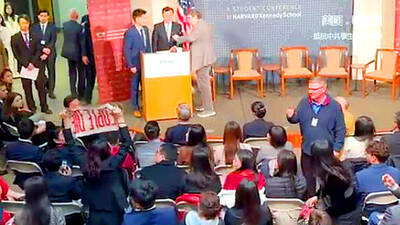
A group of Taiwanese-American and Tibetan-American students at Harvard University on Saturday disrupted Chinese Ambassador to the US Xie Feng’s (謝鋒) speech at the school, accusing him of being responsible for numerous human rights violations. Four students — two Taiwanese Americans and two from Tibet — held up banners inside a conference hall where Xie was delivering a speech at the opening ceremony of the Harvard Kennedy School China Conference 2024. In a video clip provided by the Coalition of Students Resisting the CCP (Chinese Communist Party), Taiwanese-American Cosette Wu (吳亭樺) and Tibetan-American Tsering Yangchen are seen holding banners that together read:

UNAWARE: Many people sit for long hours every day and eat unhealthy foods, putting them at greater risk of developing one of the ‘three highs,’ an expert said More than 30 percent of adults aged 40 or older who underwent a government-funded health exam were unaware they had at least one of the “three highs” — high blood pressure, high blood lipids or high blood sugar, the Health Promotion Administration (HPA) said yesterday. Among adults aged 40 or older who said they did not have any of the “three highs” before taking the health exam, more than 30 percent were found to have at least one of them, Adult Preventive Health Examination Service data from 2022 showed. People with long-term medical conditions such as hypertension or diabetes usually do not
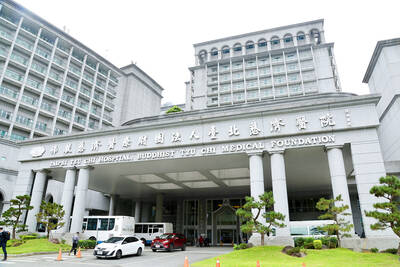
POLICE INVESTIGATING: A man said he quit his job as a nurse at Taipei Tzu Chi Hospital as he had been ‘disgusted’ by the behavior of his colleagues A man yesterday morning wrote online that he had witnessed nurses taking photographs and touching anesthetized patients inappropriately in Taipei Tzu Chi Hospital’s operating theaters. The man surnamed Huang (黃) wrote on the Professional Technology Temple bulletin board that during his six-month stint as a nurse at the hospital, he had seen nurses taking pictures of patients, including of their private parts, after they were anesthetized. Some nurses had also touched patients inappropriately and children were among those photographed, he said. Huang said this “disgusted” him “so much” that “he felt the need to reveal these unethical acts in the operating theater
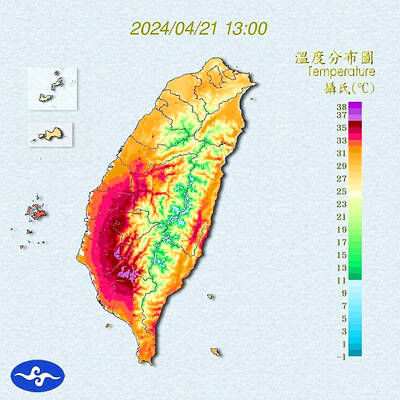
Heat advisories were in effect for nine administrative regions yesterday afternoon as warm southwesterly winds pushed temperatures above 38°C in parts of southern Taiwan, the Central Weather Administration (CWA) said. As of 3:30pm yesterday, Tainan’s Yujing District (玉井) had recorded the day’s highest temperature of 39.7°C, though the measurement will not be included in Taiwan’s official heat records since Yujing is an automatic rather than manually operated weather station, the CWA said. Highs recorded in other areas were 38.7°C in Kaohsiung’s Neimen District (內門), 38.2°C in Chiayi City and 38.1°C in Pingtung’s Sandimen Township (三地門), CWA data showed. The spell of scorching


 RSS
RSS