


Taiwan ranked No. 1 among Asian countries and No. 32 in the world on press freedom this year, said the Worldwide Press Freedom Index 2007 released on Tuesday by the Paris-based Reporters Without Borders.
Taiwan ranked No. 43 in the world last year and No. 51 in 2005, the organization said.
Taiwan came ahead of Japan, which ranked No. 37 in the world, and the US, which ranked No. 48 this year. China, meanwhile, ranked No. 163 among the 169 countries measured in the index.
Commenting on Taiwan's improving ranking, Cabinet spokesman Shieh Jhy-wey (
Welcoming the nation's improved ranking, Shieh, who is also minister of the Government Information Office, said it was a result of democratization, in which human rights, freedom of speech and press freedom are fully respected.
"Taiwan's ranking is the pride of all Chinese [sic] communities in the world," Shieh said, adding there is still room for improvement and that the administration would not grow complacent on the subject.
The government will work to continue improving press freedom, with the hope that it will allow the international community to get a better understanding of the developments Taiwan has made on matters of democratization, freedom and human rights, he said.
In this year's report, Iceland ranked No. 1, followed, in order, by Norway, Estonia, Slovakia, Belgium, Finland, Sweden, Denmark, Ireland and Portugal. Turkmenistan, North Korea and Eritrea were at the bottom of the list.
Of the 20 countries at the bottom of the list, seven were located in Asia (Pakistan, Sri Lanka, Laos, Vietnam, China, Myanmar and North Korea). Five were in Africa, four were in the Middle East, three were former Soviet republics and one was in the Americas (Cuba).

SECURITY: Starlink owner Elon Musk has taken pro-Beijing positions, and allowing pro-China companies to control Taiwan’s critical infrastructure is risky, a legislator said Starlink was reluctant to offer services in Taiwan because of the nation’s extremely high penetration rates in 4G and 5G services, the Ministry of Digital Affairs said yesterday. The ministry made the comments at a meeting of the legislature’s Transportation Committee, which reviewed amendments to Article 36 of the Telecommunications Management Act (電信管理法). Article 36 bans foreigners from holding more than 49 percent of shares in public telecommunications networks, while shares foreigners directly and indirectly hold are also capped at 60 percent of the total, unless specified otherwise by law. The amendments, sponsored by Chinese Nationalist Party (KMT) Legislator Ko

The eastern extension of the Taipei MRT Red Line could begin operations as early as late June, the Taipei Department of Rapid Transit Systems said yesterday. Taipei Rapid Transit Corp said it is considering offering one month of free rides on the new section to mark its opening. Construction progress on the 1.4km extension, which is to run from the current terminal Xiangshan Station to a new eastern terminal, Guangci/Fengtian Temple Station, was 90.6 percent complete by the end of last month, the department said in a report to the Taipei City Council's Transportation Committee. While construction began in October 2016 with an

NON-RED SUPPLY: Boosting the nation’s drone industry is becoming increasingly urgent as China’s UAV dominance could become an issue in a crisis, an analyst said Taiwan’s drone exports to Europe grew 41.7-fold from 2024 to last year, with demand from Ukraine’s fight against Russian aggression the most likely driver of growth, a study showed. The Institute for Democracy, Society and Emerging Technology (DSET) in a statement on Wednesday said it found that many of Taiwan’s uncrewed aerial vehicle (UAV) sales were from Poland and the Czech Republic. These countries likely transferred the drones to Ukraine to aid it in its fight against the Russian invasion that started in 2022, it said. Despite the gains, Taiwan is not the dominant drone exporter to these markets, ranking second and fourth
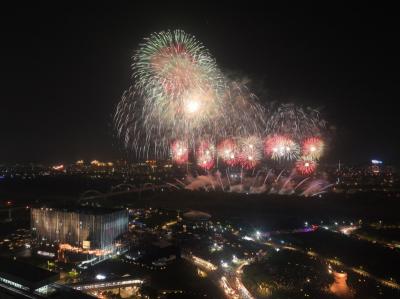
The New Taipei City Art Museum this weekend plans to celebrate its first anniversary with a two-day extravaganza featuring live concerts and a large-scale synchronized fireworks and drone display, the New Taipei City Cultural Affairs Department said. The two-day celebrations are to take place in the museum’s outdoor park, with markets and live performances by singers including Ann Bai (白安), Bii (畢書盡) and the Cosmos People (宇宙人), the department said. The highlight on both evenings would be the "Echoes of Light" show, an aerial spectacle combining fireworks and drone performances designed around the concept of "dual stages in the sky," it


 RSS
RSS