


Bureau of High Speed Rail Director-General Pang Jia-hua (龐家驊) said yesterday that the bureau had yet to approve the Taiwan High Speed Rail Co's (THSRC) proposal to let passengers board any train without reserving seats.
Pang said the bureau was also unlikely to allow THSRC to offer a NT$100 discount on commuter travel, as it would take commuter business away from the Taiwan Railway Administration (TRA) and did not fit the company's role as a long-distance carrier.
"The high speed rail should be used to carry long-distance travelers, whereas the TRA is mainly in charge of commuter transport and short-distance travelers," Pang said. "There will most assuredly be confusion if the THSRC starts servicing short-distance travelers."
Pang made the comments after the Chinese-language Apple Daily reported yesterday that the THSRC was mulling offering a discount scheme for short-distance travelers.
The report said the discount would reduce the cost of a high speed rail ticket from Hsinchu to Banciao (板橋) to NT$160, making it cheaper to take the high speed rail than a TRA Tzuchiang Express, which charges NT$180 for the same trip.
Pang said that the bureau would create a taskforce to review the proposal, adding that the company still needs to work out some complementary measures before the proposal could become reality.
Pang said the high speed rail stations must be equipped with facilities and signs guiding passengers to the designated cars.
Pang added that the company must also solve problems such as refunds for train delays, as the tickets show neither the boarding time nor the train number.
Bureau Deputy Director-General Hu Hsiang-ling (胡湘麟) raised questions about the special discount the THSRC intends to offer.
"Say a person is heading to Taichung. He could then take advantage of the offer and buy two tickets -- one from Taipei to Hsinchu and the other from Hsinchu to Taichung. That way, he could save more than he would if he bought a Taipei to Taichung ticket," Hu said.
As the company intends to increase the number of two-way runs to 113 next month, Hu said the bureau would also examine its ability to complete maintenance with a shortened timeframe.
THSRC spokesman Ted Chia (賈先德) said the special price offer could be based on the principle of increasing discounts, meaning the farther one travels, the greater the discount.
Chia said another option would be for the company to offer a 5 percent to 7 percent discount on all purchases.

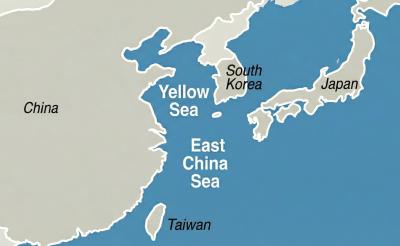
China has reserved offshore airspace in the Yellow Sea and East China Sea from March 27 to May 6, issuing alerts usually used to warn of military exercises, although no such exercises have been announced, the Wall Street Journal (WSJ) reported yesterday. Reserving such a large area for 40 days without explanation is an “unusual step,” as military exercises normally only last a few days, the paper said. These alerts, known as Notice to Air Missions (Notams), “are intended to inform pilots and aviation authorities of temporary airspace hazards or restrictions,” the article said. The airspace reserved in the alert is

South Korea is planning to revise its controversial electronic arrival card, a step Taiwanese officials said prompted them to hold off on planned retaliatory measures, a South Korean media report said yesterday. A Yonhap News Agency report said that the South Korean Ministry of Foreign Affairs is planning to remove the “previous departure place” and “next destination” fields from its e-arrival card system. The plan, reached after interagency consultations, is under review and aims to simplify entry procedures and align the electronic form with the paper version, a South Korean ministry official said. The fields — which appeared only on the electronic form

A bipartisan group of US senators has introduced a bill to enhance cooperation with Taiwan on drone development and to reduce reliance on supply chains linked to China. The proposed Blue Skies for Taiwan Act of 2026 was introduced by Republican US senators Ted Cruz and John Curtis, and Democratic US senators Jeff Merkley and Andy Kim. The legislation seeks to ease constraints on Taiwan-US cooperation in uncrewed aerial systems (UAS), including dependence on China-sourced components, limited access to capital and regulatory barriers under US export controls, a news release issued by Cruz on Wednesday said. The bill would establish a "Blue UAS
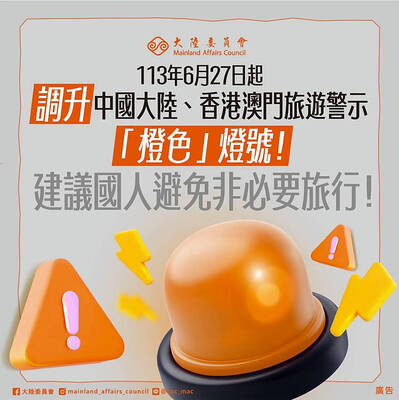
More than 6,000 Taiwanese students have participated in exchange programs in China over the past two years, despite the Mainland Affairs Council’s (MAC) “orange light” travel advisory, government records showed. The MAC’s publicly available registry showed that Taiwanese college and university students who went on exchange programs across the Strait numbered 3,592 and 2,966 people respectively. The National Immigration Agency data revealed that 2,296 and 2,551 Chinese students visited Taiwan for study in the same two years. A review of the Web sites of publicly-run universities and colleges showed that Taiwanese higher education institutions continued to recruit students for Chinese educational programs without


 RSS
RSS