


Several colleges around the country have revoked a policy that allowed students to wipe out demerits by collecting sales slips or invoices. Some parents had complained that the practice was unfair to students from less well-to-do families and could be counterproductive in moral terms.
People can win money if the numbers of their receipts match numbers drawn by the government in the bimonthly Uniform Invoices Lottery. The prizes range from a few hundred dollars to NT$2 million (US$60,000).
The Genesis Social Welfare Foundation and other civic groups and charities began collecting the invoices several years ago. It has become a common sight nationwide to see young people holding boxes and asking for invoices from passers by.
Some schools had allowed their students to receive a lesser punishment if they could collect a certain number of invoices. One report said that schools in Pingtung County collected more than 258,000 invoices last year alone.
Although the initial idea was to have the students help these charities raise funds, some parents were worried the practice was sending the wrong message to the students.
They wondered if collecting invoices from strangers as a punishment was effective in helping the students learn about humanitarian work or even understand what they did was wrong.
Some suspected that the schools were keeping the invoices to make money.
National Pingtung Senior High School has denied mishandling invoice collections, but agreed that some students had abused the policy by demanding invoices from classmates or family members.
A school in Taipei County said that instead of using the collection of invoices as a way to exact punishment, it had turned the collection into an competition between classrooms. This way, the school said, students would be collecting invoices to win points, not to avoid responsibility for their actions.
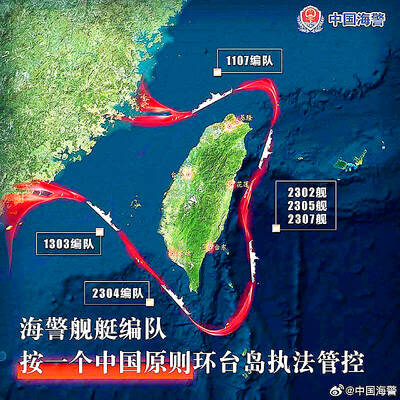
Taiwan would benefit from more integrated military strategies and deployments if the US and its allies treat the East China Sea, the Taiwan Strait and the South China Sea as a “single theater of operations,” a Taiwanese military expert said yesterday. Shen Ming-shih (沈明室), a researcher at the Institute for National Defense and Security Research, said he made the assessment after two Japanese military experts warned of emerging threats from China based on a drill conducted this month by the Chinese People’s Liberation Army’s (PLA) Eastern Theater Command. Japan Institute for National Fundamentals researcher Maki Nakagawa said the drill differed from the
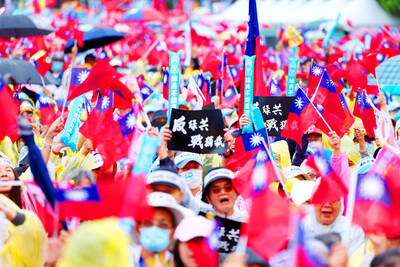
‘WORSE THAN COMMUNISTS’: President William Lai has cracked down on his political enemies and has attempted to exterminate all opposition forces, the chairman said The legislature would motion for a presidential recall after May 20, Chinese Nationalist Party (KMT) Chairman Eric Chu (朱立倫) said yesterday at a protest themed “against green communists and dictatorship” in Taipei. Taiwan is supposed to be a peaceful homeland where people are united, but President William Lai (賴清德) has been polarizing and tearing apart society since his inauguration, Chu said. Lai must show his commitment to his job, otherwise a referendum could be initiated to recall him, he said. Democracy means the rule of the people, not the rule of the Democratic Progressive Party (DPP), but Lai has failed to fulfill his

A rally held by opposition parties yesterday demonstrates that Taiwan is a democratic country, President William Lai (賴清德) said yesterday, adding that if opposition parties really want to fight dictatorship, they should fight it on Tiananmen Square in Beijing. The Chinese Nationalist Party (KMT) held a protest with the theme “against green communists and dictatorship,” and was joined by the Taiwan People’s Party. Lai said the opposition parties are against what they called the “green communists,” but do not fight against the “Chinese communists,” adding that if they really want to fight dictatorship, they should go to the right place and face
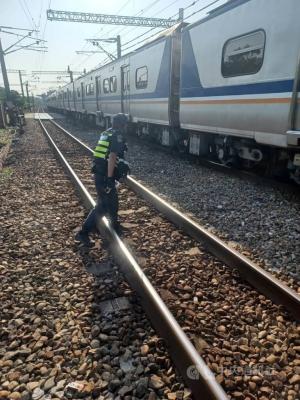
A 79-year-old woman died today after being struck by a train at a level crossing in Taoyuan, police said. The woman, identified by her surname Wang (王), crossed the tracks even though the barriers were down in Jhongli District’s (中壢) Neili (內壢) area, the Taoyuan Branch of the Railway Police Bureau said. Surveillance footage showed that the railway barriers were lowered when Wang entered the crossing, but why she ventured onto the track remains under investigation, the police said. Police said they received a report of an incident at 6:41am involving local train No. 2133 that was heading from Keelung to Chiayi City. Investigators


 RSS
RSS