


The Taiwan High Court has selected eight senior chief judges in preparation for an imminent appeal by President Chen Shui-bian (
According to the Council of Grand Justices (CGJ) Ruling No. 627, issued on June 15, the High Court must form a special tribunal to deal with a dispute between the president and the prosecution and district courts over the exercise of the head of state's "state secrets privilege."
The ruling stipulates that such a tribunal should be led by a senior chief judge and include another four judges.
Eight of the 16 chief judges at the High Court meet the seniority requirement to head the special tribunal, as each has been on the bench for more than 10 years, the sources said.
The sources said the High Court would unveil a roster with the names of eight five-member tribunals today.
After the High Court receives Chen's appeal, it will determine which tribunal handles the case through a draw.
Chen is expected to appeal the Taipei District Court's ruling on Friday that rejected his request for the return of documents and articles held by the court as evidence in the probes into allegations of corruption involving the first family.
According to Ruling No. 627, Chen can appeal the District Court ruling to the High Court within five days.
The District Court obtained the documents from a prosecutorial team that indicted first lady Wu Shu-jen (
The collection consists of invoices, vouchers, magnetic records, written testimony by concerned individuals and data related to six secret diplomatic projects from 2002 to last December.
Chen asked for the return of the documents on Sept. 6 on the grounds that they contained "strictly confidential" information under the protection of the State Secrets Act (
Chen said in his petition that the collection had been labeled "strictly confidential" in line with Ruling No. 627, which confirms the president's constitutional right to decide what constitutes a state secret and his right to refuse disclosure.
However, the District Court ruled that Chen's declaration of the documents as top secret was illegal, saying that although the June 15 constitutional interpretation states that the president has the right to keep classified information secret, that right should be exercised in line with the constitutional principle of balance of powers.
In a news release late on Friday, the Presidential Office said the District Court had no power to deny the president's right ask for the return of the documents as "strictly confidential," since the grand justices had already confirmed the president's "state secrets privilege."
Even if the exercise of that privilege were subject to judicial scrutiny, the release said it should be conducted by a more suitable judicial organ than the District Court, adding that the District Court had made biased allegations in its ruling about the pending state affairs fund case.
The Presidential Office also accused the District Court of making presuming guilt by saying that the president was trying to cover up a trail of corruption. Such a judgment is a violation of the Criminal Procedure Law, which stipulates that all defendants are considered innocent until proven guilty, it said.
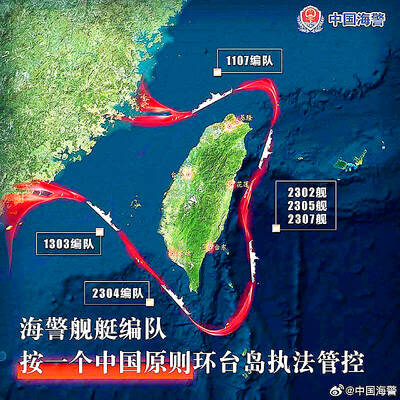
Taiwan would benefit from more integrated military strategies and deployments if the US and its allies treat the East China Sea, the Taiwan Strait and the South China Sea as a “single theater of operations,” a Taiwanese military expert said yesterday. Shen Ming-shih (沈明室), a researcher at the Institute for National Defense and Security Research, said he made the assessment after two Japanese military experts warned of emerging threats from China based on a drill conducted this month by the Chinese People’s Liberation Army’s (PLA) Eastern Theater Command. Japan Institute for National Fundamentals researcher Maki Nakagawa said the drill differed from the
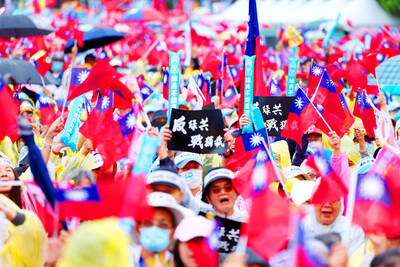
‘WORSE THAN COMMUNISTS’: President William Lai has cracked down on his political enemies and has attempted to exterminate all opposition forces, the chairman said The legislature would motion for a presidential recall after May 20, Chinese Nationalist Party (KMT) Chairman Eric Chu (朱立倫) said yesterday at a protest themed “against green communists and dictatorship” in Taipei. Taiwan is supposed to be a peaceful homeland where people are united, but President William Lai (賴清德) has been polarizing and tearing apart society since his inauguration, Chu said. Lai must show his commitment to his job, otherwise a referendum could be initiated to recall him, he said. Democracy means the rule of the people, not the rule of the Democratic Progressive Party (DPP), but Lai has failed to fulfill his
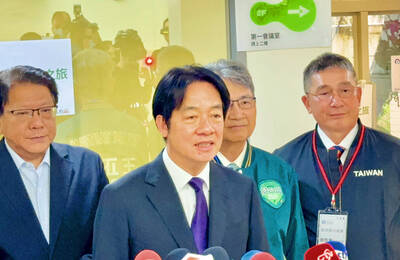
A rally held by opposition parties yesterday demonstrates that Taiwan is a democratic country, President William Lai (賴清德) said yesterday, adding that if opposition parties really want to fight dictatorship, they should fight it on Tiananmen Square in Beijing. The Chinese Nationalist Party (KMT) held a protest with the theme “against green communists and dictatorship,” and was joined by the Taiwan People’s Party. Lai said the opposition parties are against what they called the “green communists,” but do not fight against the “Chinese communists,” adding that if they really want to fight dictatorship, they should go to the right place and face
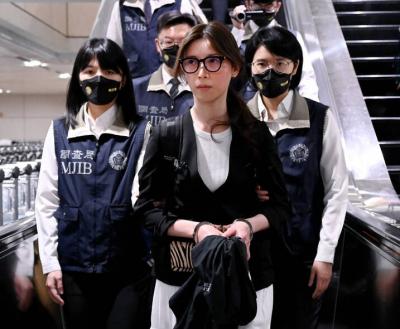
A fugitive in a suspected cosmetic surgery fraud case today returned to Taiwan from Canada, after being wanted for six years. Internet celebrity Su Chen-tuan (蘇陳端), known as Lady Nai Nai (貴婦奈奈), and her former boyfriend, plastic surgeon Paul Huang (黃博健), allegedly defrauded clients and friends of about NT$1 billion (US$30.66 million). Su was put on a wanted list in 2019 when she lived in Toronto, Canada, after failing to respond to subpoenas and arrest warrants from the Taipei District Prosecutors’ Office. Su arrived at Taiwan Taoyuan International Airport at 5am today on an EVA Air flight accompanied by a


 RSS
RSS