


Stricter criteria for physical fitness will apply to ranking officers starting next year, the Army said yesterday.
"Whoever fails to meet standards will face potential administrative punishment -- and the punishment will affect her or his promotion," said Lieutenant-General Chou Yen-chung (周彥中), spokesman for the Army.
Those who fail the tests will also be asked to attend an intensive physical training camp until they have made satisfactory progress, he said.
"We hope these high-ranking officers will follow [physical fitness standards] themselves while they are requiring stricter physical training for their soldiers," Chou said.
The stricter physical fitness requirements will apply mainly to colonel-class and general-class officers, Chou said.
For majors and lieutenants-colonel, a test will be carried out every three months.
Colonels will face testing every six months and generals will be tested every year.
New physical fitness standards for higher-ranking officers have yet to be decided.
In related news, last Friday, 86 officers, including seven female officers, graduated from the Army Infantry School's "intensive physical training program" and became physical training instructors for Army units.
"Since the intensive program was established in 1969, more than 20,000 physical instructors have been recruited, and the number is still growing," said Lieutenant-General Liu Hung-ming (
"Almost every company has an officer who graduated from the program, but it is our goal that in the future every platoon will have one," Liu said.
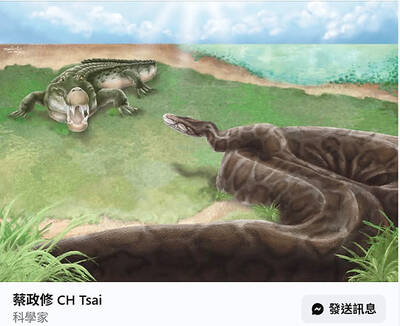
Taiwanese paleontologists have discovered fossil evidence that pythons up to 4m long inhabited Taiwan during the Pleistocene epoch, reporting their findings in the international scientific journal Historical Biology. National Taiwan University (NTU) Institute of Ecology and Evolutionary Biology associate professor Tsai Cheng-hsiu (蔡政修) led the team that discovered the largest snake fossil ever found in Taiwan. The single trunk vertebra was discovered in Tainan at the Chiting Formation, dated to between 400,000 and 800,000 years ago in the Middle Pleistocene, the paper said. The area also produced Taiwan’s first avian fossil, as well as crocodile, mammoth, saber-toothed cat and rhinoceros fossils, it said. Discoveries

Taiwanese paleontologists have discovered fossil evidence that pythons up to 4m long inhabited Taiwan during the Pleistocene epoch, reporting their findings in the international scientific journal Historical Biology. National Taiwan University (NTU) Institute of Ecology and Evolutionary Biology associate professor Tsai Cheng-hsiu (蔡政修) led the team that discovered the largest snake fossil ever found in Taiwan. A single trunk vertebra was discovered in Tainan at the Chiting Formation, dated to between 800,000 to 400,000 years ago in the Middle Pleistocene, the paper said. The area also produced Taiwan’s first avian fossil, as well as crocodile, mammoth, sabre-toothed cat and rhinoceros fossils, it said. Discoveries

Whether Japan would help defend Taiwan in case of a cross-strait conflict would depend on the US and the extent to which Japan would be allowed to act under the US-Japan Security Treaty, former Japanese minister of defense Satoshi Morimoto said. As China has not given up on the idea of invading Taiwan by force, to what extent Japan could support US military action would hinge on Washington’s intention and its negotiation with Tokyo, Morimoto said in an interview with the Liberty Times (sister paper of the Taipei Times) yesterday. There has to be sufficient mutual recognition of how Japan could provide
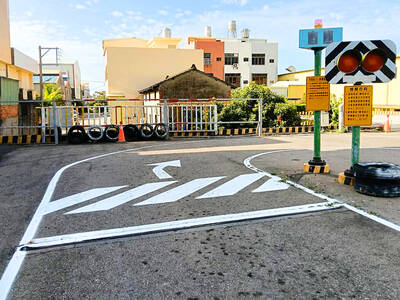
UPDATED TEST: The new rules aim to assess drivers’ awareness of risky behaviors and how they respond under certain circumstances, the Highway Bureau said Driver’s license applicants who fail to yield to pedestrians at intersections or to check blind spots, or omit pointing-and-calling procedures would fail the driving test, the Highway Bureau said yesterday. The change is set to be implemented at the end of the month, and is part of the bureau’s reform of the driving portion of the test, which has been criticized for failing to assess whether drivers can operate vehicles safely. Sedan drivers would be tested regarding yielding to pedestrians and turning their heads to check blind spots, while drivers of large vehicles would be tested on their familiarity with pointing-and-calling


 RSS
RSS