


Faced with a threatening military buildup by China, an outgunned Taiwan is quietly proceeding with plans to develop missiles that could strike China, defense and security experts say.
Taiwan has in recent months tested a land attack cruise missile with a range of 1,000km that could carry a 360kg warhead to targets as distant as Shanghai, according to military analysts.
Some Taiwanese military specialists have argued for decades that Taiwan should develop offensive weapons, including missiles, as a deterrent to China, which has threatened to attack the self-governing island if it moves toward formal independence. The US Defense Department estimates that China has deployed 900 missiles opposite Taiwan.
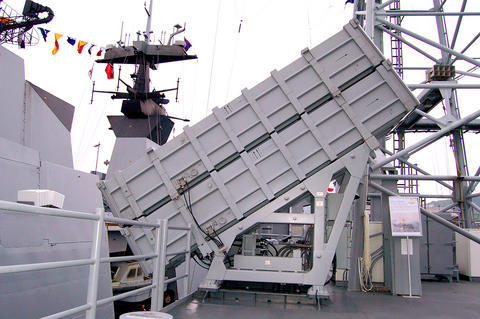
PHOTO: CHEN CHING-MIN, TAIPEI TIMES
Taiwan's military currently has no long-range missiles that could be used to attack distant targets in China.
Senior military officials and lawmakers in the governing Democratic Progressive Party (DPP) of President Chen Shui-bian (
They said these missiles were essential to Taiwan's defense because China's soaring defense spending was tilting the military balance in the China's favor.
"They want to make mainland China hesitate before launching any attack," said Andrei Chang, a Hong Kong-based expert on the Chinese and Taiwanese militaries and editor in chief of Kanwa Defense Review magazine. "These missiles could not only destroy military targets, but financial and economic targets as well."
"They want to create massive panic," he added.
There have also been unconfirmed news reports in Taiwan that the military is developing short-range ballistic missiles.
Chen's administration refuses to comment on the existence of a ballistic missile program.
The administration of US President George W. Bush has signaled that it opposes any effort by Taiwan to develop offensive weapons, including missiles.
At a time when DPP campaigns its proposal to hold a referendum on the island's bid to join the UN under the name "Taiwan," and not its official name the Republic of China, the deployment of missiles capable of striking China could further increase tensions.
There were reports in the Taiwanese media this month that the Chen administration, under pressure from Washington, had dropped plans to deploy surface-to-surface missiles on Taiwan's outlying island of Matsu near the coast of China's Fujian province.
Missiles deployed on Matsu would be able to strike targets in China where there are concentrated air, missile and land forces opposite Taiwan.
Taiwan's military refused to comment, but Beijing this week reacted sharply to the reports.
"We sternly warn the Taiwan authorities not to play with fire," Li Weiyi (
But analysts believe it will be difficult for the Bush administration to restrain Taipei while China continues its rapid buildup of missile forces that could be used to conduct strikes against military targets and vital infrastructure facilities on Taiwan.
The US and Taiwanese militaries estimate that China adds up to 100 new missiles a year to its forces arrayed against Taiwan.
"Taiwan will go ahead," said Andrew Yang (
Chang and other experts are confident that the land attack cruise missile, the Hsiung Feng-2E, developed at the Taiwan military's Chungshan Institute of Science and Technology, could soon be in production. "I am sure it is almost ready," Chang said.
In March, the Washington-based Defense News reported that this missile had been tested on Feb. 2 at the Jiupeng testing range in Pingtung County on Taiwan's southeastern coast. The newspaper reported that the Ministry of National Defense had confirmed the test without giving any further details.
Defense analysts note that Taiwan publicly acknowledged for the first time this year that offensive missile strikes were now part of its planned response to an attack from China.
In the first phase of its annual Han Kuang exercise in April, Taiwan's military conducted a computer simulation of an engagement with China in which missiles were fired at military targets on the mainland.
A US delegation, including the retired commander of US forces in the Pacific, Admiral Dennis Blair, observed the exercise, Taiwanese defense analysts said.
In the aftermath of the exercise, the Bush administration urged Taipei to avoid destabilizing the Taiwan Strait and concentrate on defensive weapons.
"We think that offensive capabilities on either side of the Taiwan Strait are destabilizing and therefore not in the interests of peace and stability," said Dennis Wilder, senior director of East Asian Affairs at the National Security Council.
The Ministry of National Defense denied that the missiles still under development were offensive weapons. It said that if a decision was made to deploy them, they would only be used if the island was attacked.
"Our country would not make provocations on its own," the ministry said in a statement. "Only if we suffered an enemy attack would we actually strike back."
Yang of the Council of Advanced Policy Studies said Taiwan's decision to develop longer-range missiles was part of a strategic reassessment of the most effective method to counter the firepower of China's improving land, air and sea forces.
The US and other powers were unwilling to supply these kinds of weapons to Taiwan, so Taiwan had no choice but to develop its own, Yang said.
Research and development teams from Taiwan's military had continued to improve the range, payload and guidance systems of domestically designed anti-ship cruise missiles to the point where they could be used against coastal military targets in China.
Yang also said some of the reports about the capabilities of these new cruise missiles could be exaggerated.
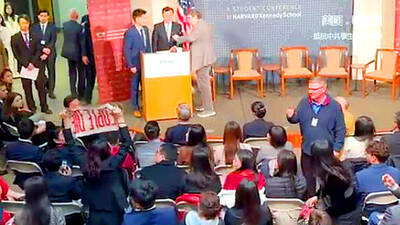
A group of Taiwanese-American and Tibetan-American students at Harvard University on Saturday disrupted Chinese Ambassador to the US Xie Feng’s (謝鋒) speech at the school, accusing him of being responsible for numerous human rights violations. Four students — two Taiwanese Americans and two from Tibet — held up banners inside a conference hall where Xie was delivering a speech at the opening ceremony of the Harvard Kennedy School China Conference 2024. In a video clip provided by the Coalition of Students Resisting the CCP (Chinese Communist Party), Taiwanese-American Cosette Wu (吳亭樺) and Tibetan-American Tsering Yangchen are seen holding banners that together read:

UNAWARE: Many people sit for long hours every day and eat unhealthy foods, putting them at greater risk of developing one of the ‘three highs,’ an expert said More than 30 percent of adults aged 40 or older who underwent a government-funded health exam were unaware they had at least one of the “three highs” — high blood pressure, high blood lipids or high blood sugar, the Health Promotion Administration (HPA) said yesterday. Among adults aged 40 or older who said they did not have any of the “three highs” before taking the health exam, more than 30 percent were found to have at least one of them, Adult Preventive Health Examination Service data from 2022 showed. People with long-term medical conditions such as hypertension or diabetes usually do not
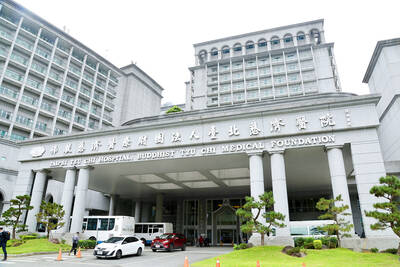
POLICE INVESTIGATING: A man said he quit his job as a nurse at Taipei Tzu Chi Hospital as he had been ‘disgusted’ by the behavior of his colleagues A man yesterday morning wrote online that he had witnessed nurses taking photographs and touching anesthetized patients inappropriately in Taipei Tzu Chi Hospital’s operating theaters. The man surnamed Huang (黃) wrote on the Professional Technology Temple bulletin board that during his six-month stint as a nurse at the hospital, he had seen nurses taking pictures of patients, including of their private parts, after they were anesthetized. Some nurses had also touched patients inappropriately and children were among those photographed, he said. Huang said this “disgusted” him “so much” that “he felt the need to reveal these unethical acts in the operating theater
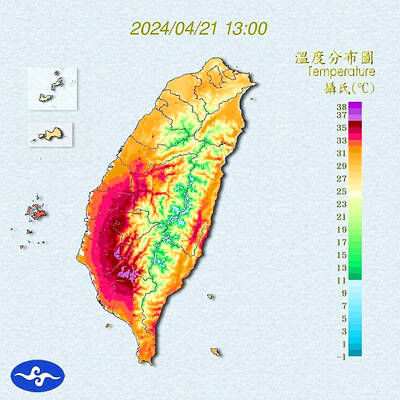
Heat advisories were in effect for nine administrative regions yesterday afternoon as warm southwesterly winds pushed temperatures above 38°C in parts of southern Taiwan, the Central Weather Administration (CWA) said. As of 3:30pm yesterday, Tainan’s Yujing District (玉井) had recorded the day’s highest temperature of 39.7°C, though the measurement will not be included in Taiwan’s official heat records since Yujing is an automatic rather than manually operated weather station, the CWA said. Highs recorded in other areas were 38.7°C in Kaohsiung’s Neimen District (內門), 38.2°C in Chiayi City and 38.1°C in Pingtung’s Sandimen Township (三地門), CWA data showed. The spell of scorching


 RSS
RSS