

Three more allies of Taiwan expressed support for its bid to join the UN on Friday during the annual session of the UN General Assembly.
Speaking for Taiwan on day four of the general debate were representatives of the Marshall Islands, Saint Lucia and Saint Vincent and the Grenadines.
In his statement, Marshall Islands President Kessai Note told member states that the UN still turns a blind eye to the people of Taiwan and silences their voices, at the same time as the world body is working with its members to resolve disputes peacefully and help create democratic societies.
"The absence of Taiwan at the United Nations creates a gap in the global network of cooperation, goes against the ideals and concepts of justice upheld by the United Nations and contravenes the principle of universality," Note said.
Saint Lucia Prime Minister Stephenson King said that Taiwan has continued to abide by the principles enshrined in the UN Charter, even though the country is not a member of the world body.
In addition, Taiwan has made significant contributions to global development by providing economic and technical assistance to developing countries, King said.
"We are therefore saddened that the will of the people of Taiwan, expressed by their duly elected representatives, continues to be ignored by this body," he said.
Meanwhile, Saint Vincent and the Grenadines Prime Minister Ralph Gonsalves said Taiwan possesses all the attributes and qualifications for membership and urged UN Secretary-General Ban Ki-moon to accept and deal with Taiwan's membership application in accordance with the UN Charter.
"There is no adequate justification for the continued exclusion of Taiwan from participation in the numerous global exchanges in the United Nations and other international bodies," Gonsalves said.
Also taking the floor on Friday was Chinese Minister of Foreign Affairs Yang Jiechi (楊潔箎), who repeated Beijing's claim that "Taiwan is an inalienable part of China's territory."
Yang also said that China will not permit any challenge to the "one China" principle and to UN Resolution 2758 adopted by the General Assembly in 1971, based on which the People's Republic of China (PRC) replaced the Republic of China (ROC) as the sole legitimate representative of China to the UN.
Yang accused Taiwanese authorities of "obstinately clinging to the separatist course of Taiwan independence" by pushing for a referendum on applying for UN membership under the name "Taiwan," a move he said will "gravely endanger peace and stability" across the Taiwan Strait and in the Asia-Pacific region.
In Taipei, Vice President Annette Lu (呂秀蓮) said yesterday that the differences between the pan-blue and the pan-green camps over the name of the country can be resolved through the Constitution.
Lu said that regardless of the name the country is known by, Taiwan's status as a sovereign state was confirmed when the first popular election for the country's president and vice president was held on March 23, 1996.
"No matter which party you voted for, you were confirming Taiwan's status as a sovereign independent state with concrete action," Lu said while addressing a leadership camp organized by the Democratic Progressive Party's (DPP) Department of Social Development.
She urged the Chinese Nationalist Party (KMT) and the DPP to cooperate to push for the country's goal of becoming a member of the UN by putting aside their differences over what name to use in the bid.
Additional reporting by AP

The donation of offshore patrol vessel Kinmen to the Philippines includes provisions that protect Taiwanese fishers and facilitate security cooperation across the First Island Chain, officials said yesterday. The comment was made during the Cabinet’s comprehensive administrative report at the legislature after Chinese Nationalist Party (KMT) Legislator Hsu Yu-chen (許宇甄) expressed concerns about the decision to give a ship to a country whose coast guard had in 2013 fired on a Taiwanese trawler and killed its captain without provocation. The Cabinet should lay out the safeguards that have been established to prevent the Philippine government from using the Kinmen to harass, expel
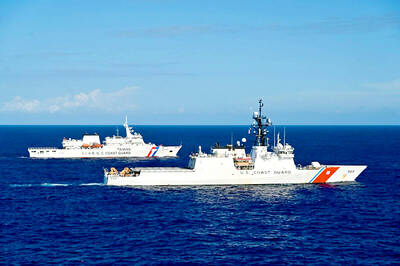
GROWING TIES: The CGA is planning a goodwill mission to the Philippines, in what would be the first time since 1975 a Taiwanese paramilitary vessel has visited the country The Coast Guard Administration (CGA) plans to significantly expand its participation in international security cooperative frameworks and its operational capabilities, a budget proposal for next year showed. The budget indicates a transformation of the CGA from a maritime law enforcement arm into a national defense and intelligence gathering entity capable of tackling larger regional security matters. The proposal showed that personnel from the coast guard’s Intelligence Division and Special Action Support Center are to participate in high-level national security talks with the US. As the CGA has dealt with China’s rising “gray zone” threats around Taiwan, it has become a valuable asset to
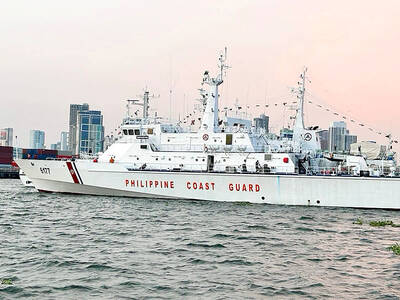
A patrol vessel donated by the Coast Guard Administration (CGA) to the Philippines was commissioned into the Philippine Coast Guard (PCG) on Friday, a Philippine non-governmental organization said. The CGA on Sept. 16 confirmed media reports that Taiwan had donated a retired 500-tonne patrol vessel to the Philippines. The Manila-based We Protect Our Seas (WPS) foundation, which served as an intermediary in the transfer, said that the vessel was formerly the CGA’s 500-tonne petrol vessel Kinmen (CG123). The WPS, in a statement issued on Friday, said the vessel, renamed as the BRP Sarangani, had been commissioned into the PCG the
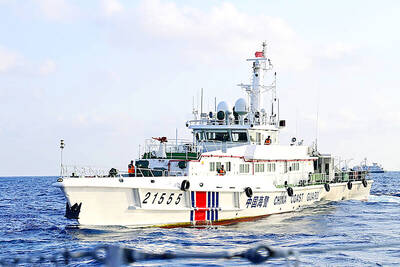
‘GRAY ZONE’ TACTICS: Beijing sent two China Coast Guard vessels to escort a ‘supposedly private research ship,’ a Philippine Coast Guard spokesman said The Coast Guard Administration (CGA) yesterday confirmed that it had recently deployed three patrol vessels to waters in Taiwan’s overlapping exclusive economic zone with the Philippines to monitor three Chinese vessels. CGA Deputy Director-General Hsieh Ching-chin (謝慶欽) said the agency regularly monitors Chinese vessels around Taiwan, and that the deployment south of Oluanpi (鵝鑾鼻), Taiwan proper’s southernmost point, was carried out in accordance with standard procedures. He added that the waters fall within the overlapping exclusive economic zones of Taiwan and the Philippines, which extend 200 nautical miles (370km) from their coastlines. Hsieh made the comments when asked about a


 RSS
RSS