


Aboriginal rights activists yesterday lauded the UN's adoption of the Declaration on Rights of Indigenous Peoples and urged the government to respect Aboriginal rights before making efforts to gain UN membership.
Activists made the call during a press conference in Taipei.
The declaration, passed by the UN General Assembly last week, seeks to protect Aboriginal peoples' rights on land, culture and self-determination.
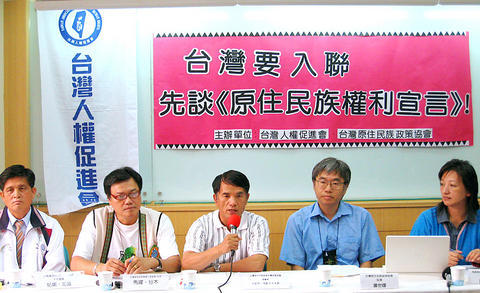
PHOTO: CNA
"The passage of the declaration is one great leap forward in terms of protecting the collective rights of indigenous peoples," Taiwan Association for Human Rights secretary-general Lin Shu-ya (林淑雅) told the news conference.
"To become a UN member, [the government] must understand the responsibility of a member state in the global community," Lin said. "Which includes respecting and protecting indigenous peoples' rights."
The core values outlined in the declaration already exist in Taiwan's Aboriginal Basic Law (原住民族基本法), but have never been respected by government authorities, Truku Autonomy Promotion Committee chairman Teyra Yudaw said.
"Aboriginal rights are a reflection of the condition of a country's human rights," Teyra said.
Teyra mentioned several cases, such as the Smangus incident and the Sun Moon Lake hotel construction plan, as examples of how the government violates Aboriginal rights on land, and thus violates the Aboriginal Basic Law.
The Smangus incident refers to a case in which three Atayal tribesmen from Smangus in Hsinchu County were accused by the Forestry Bureau of stealing national property when they picked up a tree felled during a typhoon.
The people of Smangus insisted the tree had fallen within the community's traditional domain, which meant it was within their rights to handle it. The bureau, however, defined the site as part of a national forest.
The other case, in which the Nantou County Government seeks to build a luxury hotel near Sun Moon Lake, has met with protests by the local Thao people, as the site would intrude on holy ground and part of a Thao community.
"Democracy isn't just about elections. Taiwan is not a complete democracy until everyone's rights are well-protected," Teyra said.

FUKUOKA SITUATION: Japanese media reported that the pathogen is expected to be identified by the summer, while the CDC downplayed the idea that it was hMPV A “mysterious cold-like illness” reported in Japan’s Fukuoka Prefecture does not seem to be a new disease, but Japanese authorities have been asked about the situation, the Centers for Disease Control (CDC) said yesterday. The Fukuoka Prefectural Medical Association on Wednesday told a news conference that a “mystery cold” that has become a hot topic on social media is “highly likely to be caused by some kind of viral infection,” Japan’s KBC News reported. “Many people are experiencing symptoms starting with a sore throat, followed by a runny nose, phlegm and a severe cough,” KBC News reported, citing association officials. Health authorities are

Nvidia Corp CEO Jensen Huang (黃仁勳) arrived in Taiwan yesterday ahead of upcoming AI and technology events, saying he plans to meet with clients and Taiwan Semiconductor Manufacturing Co Chairman C.C. Wei (魏哲家) during his visit. After landing at Taipei Songshan Airport, Huang posed for photos with fans and handed out Yakult drinks to reporters and supporters waiting at the scene, saying he has “a lot to do” during the trip. Asked about reports that Nvidia’s planned headquarters site in Taipei’s Beitou Shilin Technology Park could break ground on May 27, Huang said that if the company holds an event, he would

The Ministry of Finance this afternoon announced the winning numbers for the March-April uniform invoice lottery. The winning number for the NT$10 million (US$318,060) special prize is 19531471, and the winning number for the NT$2 million grand prize is 85941329. Three numbers were drawn for the NT$200,000 first prize: 07225810, 20231230 and 83518781. Those with receipts matching the last seven digits of any of the first-prize numbers will win the NT$40,000 second prize, while those matching the last six digits will win the NT$10,000 third prize. Those whose receipts match the last five digits of the first-prize numbers can claim the NT$4,000 fourth prize,

SIX SUBSIDIES: The monthly allowance for older farmers is to increase to NT$10,000, and NT$5,000 is to be given to homemakers under the national pension system, Lai said The government is to implement major welfare policies for disadvantaged groups, including raising the monthly allowance for older farmers to NT$10,000 and providing homemakers with NT$5,000 per month, President William Lai (賴清德) said yesterday. Lai made the remarks during a visit to Wangling Temple in Chiayi County, saying that the planned increases were being introduced amid economic growth and an increase in tax revenue. Touting a policy, in which the government plans to provide a monthly allowance of NT$5,000 for every child under the age of 18 in a bid to address Taiwan’s low birthrate, Lai said that if received for the


 RSS
RSS