


Democratic Progressive Party Chairman Yu Shyi-kun yesterday denounced the US' "one China" policy as "outdated" and urged the US government to review it.
"The US' `one China' policy is self-contradictory," Yu said during a visit to a photography exhibition in Ilan.
"For example, the US has said Taiwan is not a country, but it regards our referendum [on seeking UN membership under the name `Taiwan'] as a move to change our national title. If we aren't a country, why do we have a national title?" he said.
Yu said that the US also contradicted itself by encouraging Taiwan to develop its democracy, but discouraging it from holding a referendum, joining the UN, writing a new constitution, changing its national title and declaring de jure independence.
Over the past months, US officials have on several occasions voiced opposition to President Chen Shui-bian's (
On Aug. 30, Dennis Wilder, senior director for East Asian affairs at the US National Security Council, told reporters that Taiwan's status was an undecided issue and that it was therefore not qualified to be a member of the UN.
Prior to this, US Deputy Secretary of State John Negroponte said on Aug. 27 that the US government opposed Taiwan's plan for a UN membership referendum because Washington believed it would constitute a move toward a declaration of de jure independence.
"There is no need for the US to be so nervous about this and oppose our proposed referendum on seeking UN membership because the referendum is a tool to demonstrate the will and resolution of the Taiwanese people," Yu said yesterday, while repeatedly stressing the value of the friendship between Washington and Taipei.
"The US is an important ally of our nation," Yu said.
Separately, Chinese Nationalist Party (KMT) presidential candidate Ma Ying-jeou (馬英九) yesterday said the nation should maintain the "status quo," rather than making any moves toward either unification with China or independence.
Ma also voiced concern about Taiwan-US relations, urging President Chen to prioritize the nation's interests.
"President Chen's planned referendum on a UN bid crossed the red line drawn by the US and has put Taiwan in a difficult situation," Ma said yesterday during a visit to Kaohsiung.
Ma said the KMT's version of the UN referendum did not address the issue of changing the "status quo," and therefore would not draw criticism from the US.
Additional reporting by Mo Yan-chih
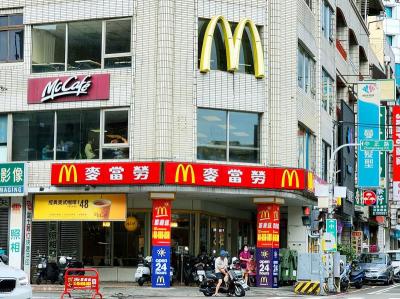
Fast food chain McDonald's is to raise prices by up to NT$5 on some products at its restaurants across Taiwan, starting on Wednesday next week, the company announced today. The prices of all extra value meals and sharing boxes are to increase by NT$5, while breakfast combos and creamy corn soup would go up by NT$3, the company said in a statement. The price of the main items of those meals, if ordered individually, would remain the same. Meanwhile, the price of a medium-sized lemon iced tea and hot cappuccino would rise by NT$3, extra dipping sauces for chicken nuggets would go up
Carrefour Taiwan is to begin using a new name from the start of July, but it cannot divulge the name until then, the chairman of the supermarket chain's parent company said today. President Chain Store Co chairman Lo Chih-hsien (羅智先) was asked by reporters after a shareholders' meeting to confirm whether the company has settled on a new name for the supermarket brand. In March, the government-registered name of two Carrefour Taiwan branches was quietly changed to "Le Chia Kang" (樂家康) in Chinese, raising speculation that has been selected as the name. Lo said that because of local regulations and contractual obligations, the

Nvidia Corp CEO Jensen Huang (黃仁勳) arrived in Taiwan yesterday ahead of upcoming AI and technology events, saying he plans to meet with clients and Taiwan Semiconductor Manufacturing Co Chairman C.C. Wei (魏哲家) during his visit. After landing at Taipei Songshan Airport, Huang posed for photos with fans and handed out Yakult drinks to reporters and supporters waiting at the scene, saying he has “a lot to do” during the trip. Asked about reports that Nvidia’s planned headquarters site in Taipei’s Beitou Shilin Technology Park could break ground on May 27, Huang said that if the company holds an event, he would
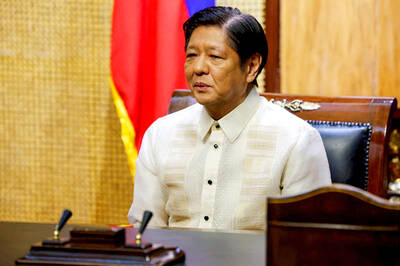
The Philippines would likely be involved in any conflict over Taiwan due to its proximity to the democracy claimed by China, President Ferdinand Marcos Jr said, reiterating a stance that risks angering Beijing. “In the Philippines, we do not have a choice because Taiwan is so close to the Philippines and we have almost 200,000 Filipino nationals living and working in Taiwan,” Marcos said in an interview with Japanese media in Manila on Monday. The Philippine leader’s comments come ahead of a state visit to Japan next week, where he is to meet with Japanese Prime Minister Sanae Takaichi to discuss security


 RSS
RSS