


People advocating preservation of the culture of military villages called on the government yesterday to appropriate funds to record the living memories of these communities, which are due to be demolished by 2009.
Military villages, better known as juan cun (
To save the juan cun, the group has long pushed for passage of an amendment to the Statute Governing Reconstruction of Old Military Dependents' Villages (國軍老舊眷村改建條例) to preserve about 15, or one-tenth, of the remaining villages as historical sites.
At one time, there were as many as 880 military residential compounds housing more than 100,000 families. More than 80 percent of these have been either demolished or replaced with modern housing since the government passed the statute in 1996.
The amendment suggests the government use an existing fund earmarked for rebuilding veteran villages to help pay for the conservation of 15 sites, which have yet to be selected.
But what worries the group the most is that even the preservation of these communities will not "preserve" what a juan cun used to be like if no action is taken to collect the stories of the people who lived in these villages over the past 60 years, Wang Chih-hsin (王繼新), a veteran village chairman of Sanchung's Air Force First Village (空軍三重一村), said at a press conference yesterday.
"Juan cun are a precious part of Taiwan's modern history. It would be tragic and a great loss to the country if we lose these memories," he said.
Former Democratic Progressive Party (DPP) lawmaker Lee Wen-chung (李文忠) and DPP Legislator Tien Chiu-chin (田秋堇) joined the group in urging the government to provide funding before the amendment is passed by the legislature.
"Even if the amendment clears the legislature by this year, the budget for preservation won't be available until next year. However, the culture in the communities is already in danger of fading away," said Huang Luo-fei (黃洛斐), chief executive of the Association of Mainlander Taiwanese.
Tasks that need to be done include collecting items used by juan cun residents and training researchers and filmmakers to record the residents' stories, he said.
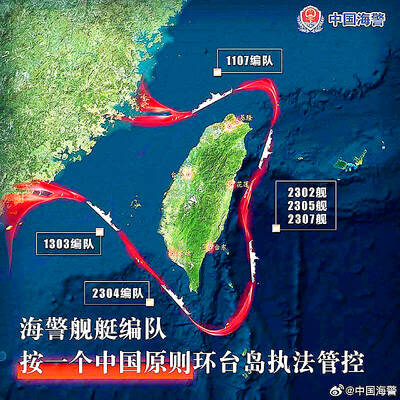
Taiwan would benefit from more integrated military strategies and deployments if the US and its allies treat the East China Sea, the Taiwan Strait and the South China Sea as a “single theater of operations,” a Taiwanese military expert said yesterday. Shen Ming-shih (沈明室), a researcher at the Institute for National Defense and Security Research, said he made the assessment after two Japanese military experts warned of emerging threats from China based on a drill conducted this month by the Chinese People’s Liberation Army’s (PLA) Eastern Theater Command. Japan Institute for National Fundamentals researcher Maki Nakagawa said the drill differed from the
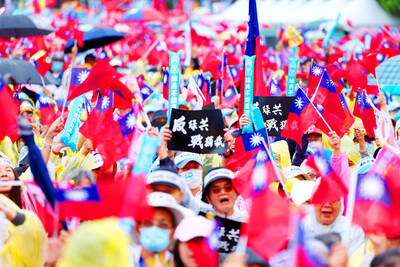
‘WORSE THAN COMMUNISTS’: President William Lai has cracked down on his political enemies and has attempted to exterminate all opposition forces, the chairman said The legislature would motion for a presidential recall after May 20, Chinese Nationalist Party (KMT) Chairman Eric Chu (朱立倫) said yesterday at a protest themed “against green communists and dictatorship” in Taipei. Taiwan is supposed to be a peaceful homeland where people are united, but President William Lai (賴清德) has been polarizing and tearing apart society since his inauguration, Chu said. Lai must show his commitment to his job, otherwise a referendum could be initiated to recall him, he said. Democracy means the rule of the people, not the rule of the Democratic Progressive Party (DPP), but Lai has failed to fulfill his

OFF-TARGET: More than 30,000 participants were expected to take part in the Games next month, but only 6,550 foreign and 19,400 Taiwanese athletes have registered Taipei city councilors yesterday blasted the organizers of next month’s World Masters Games over sudden timetable and venue changes, which they said have caused thousands of participants to back out of the international sporting event, among other organizational issues. They also cited visa delays and political interference by China as reasons many foreign athletes are requesting refunds for the event, to be held from May 17 to 30. Jointly organized by the Taipei and New Taipei City governments, the games have been rocked by numerous controversies since preparations began in 2020. Taipei City Councilor Lin Yen-feng (林延鳳) said yesterday that new measures by
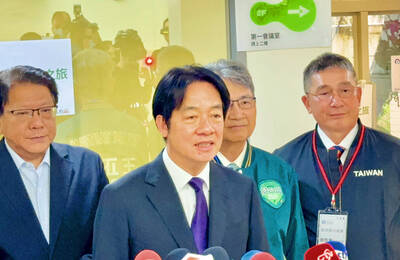
A rally held by opposition parties yesterday demonstrates that Taiwan is a democratic country, President William Lai (賴清德) said yesterday, adding that if opposition parties really want to fight dictatorship, they should fight it on Tiananmen Square in Beijing. The Chinese Nationalist Party (KMT) held a protest with the theme “against green communists and dictatorship,” and was joined by the Taiwan People’s Party. Lai said the opposition parties are against what they called the “green communists,” but do not fight against the “Chinese communists,” adding that if they really want to fight dictatorship, they should go to the right place and face


 RSS
RSS