


Taiwan is performing badly on the International English Language Testing System (IELTS), a recent report said.
In a report which listed the 20 countries that had the most people taking the language-proficiency test, Taiwan was only 17th, after Japan (12) and South Korea (14), and worse than Vietnam (13) and Pakistan (15), the Chinese-language United Evening News reported yesterday.
IELTS was developed by the University of Cambridge and is used to assess the English ability of students. About 700,000 people take the test every year.
The results are accepted in many countries, including England, Australia, New Zealand and some European countries, and more than 100 colleges in the US accept IELTS in addition to the Test of English as a Foreign Language (TOEFL).
The IELTS is offered in two formats: Academic, for those hoping to enroll in a foreign university, and General Training, for prospective immigrants. Listening, speaking, reading and writing are all tested, the highest score in each subject being nine. The average score on these four subjects makes up the IELTS score.
Last year, Taiwan had a test average of 5.62, with an average of 5.81 points on the reading section, 5.66 for speaking, 5.52 for listening, and only 5.23 points for writing, the report said.
The United Evening News cited research by the British Council in the story as saying that Taiwan's English-learning environment faces five main obstacles to effective English learning: first, it has no standardized teaching materials; second, there is no communication or guidance to improve students' weak points; third, teaching design is restricting; fourth, teachers and material are not in accordance with international standards and fifth, a lack of sufficient learning facilities.
The report also quoted statistics from 104 Job Bank, an online recruitment service, that showed almost half of the jobs in Taiwan require a basic command of English. But although the demand for English in the workplace has gone up, the English level of Taiwanese is not improving, it said.
An employee with the British Council was quoted as saying that in an ideal situation, the students' level is first tested, and then they are taught according to their level.
Taiwan has implemented a General English Proficiency Test (GEPT), but this test does not fit into the Common European Framework of Reference for Languages.
It is hard for students to learn English well when teaching methods are lacking, the staff member was reported as saying.

Fast food chain McDonald's is to raise prices by up to NT$5 on some products at its restaurants across Taiwan, starting on Wednesday next week, the company announced today. The prices of all extra value meals and sharing boxes are to increase by NT$5, while breakfast combos and creamy corn soup would go up by NT$3, the company said in a statement. The price of the main items of those meals, if ordered individually, would remain the same. Meanwhile, the price of a medium-sized lemon iced tea and hot cappuccino would rise by NT$3, extra dipping sauces for chicken nuggets would go up
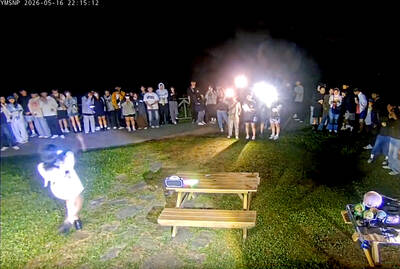
Yangmingshan National Park’s Qingtiangang (擎天崗) nature area has gone viral after a park livestream camera observed a couple in the throes of intimate congress, which was broadcast live on YouTube, drawing large late-night crowds and sparking a backlash over noise, bright lights and disruption to wildlife habitat. The area’s livestream footage appeared to show a couple engaging in sexual activity on a picnic table in the park on Friday last week, with the uncensored footage streamed publicly online. The footage quickly spread across social media, prompting a tide of visitors to travel to the site to “check in” and recreate the

Minister of Digital Affairs Lin Yi-ching (林宜敬) yesterday cited regulatory issues and national security concerns as an expert said that Taiwan is among the few Asian regions without Starlink. Lin made the remarks on Facebook after funP Innovation Group chief executive officer Nathan Chiu (邱繼弘) on Friday said Taiwan and four other countries in Asia — China, North Korea, Afghanistan and Syria — have no access to Starlink. Starlink has become available in 166 countries worldwide, including Ukraine, Malaysia, the Philippines and Vietnam, in the six years since it became commercial, he said. While China and North Korea block Starlink, Syria is not
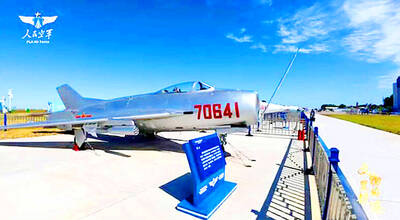
GROUNDED: A KMT lawmaker proposed eliminating drone development programs and freezing funding for counterdrone systems, despite China’s adoption of the technology China has deployed attack drones at air bases near the Taiwan Strait in a strategy aimed at overwhelming Taiwan’s air defense systems through saturation attacks, the Mainland Affairs Council (MAC) said. The council’s latest quarterly report on China said that satellite imagery and open-source intelligence indicate that the Chinese People’s Liberation Army (PLA) had converted retired J-6 fighter jets into J-6W drones, which the PLA has stationed at six air bases near Taiwan, five in China’s Fujian Province and one in Guangdong Province. The report cited J. Michael Dahm, a senior fellow at the US-based Mitchell Institute, as saying that China has


 RSS
RSS