


Most state media have been banned from reporting on the deadly collapse of a bridge in southern China, with local officials punching journalists and chasing them from the scene, reporters said.
Rescue crews blasted away stone and concrete on Friday to better search the rubble. They uncovered six more bodies, and said it was unlikely any survivors would be found, Xinhua reported.
The ban, issued by the Central Propaganda Department, came on Thursday while reporters swarmed the tourist town of Fenghuang to report on Monday's accident.
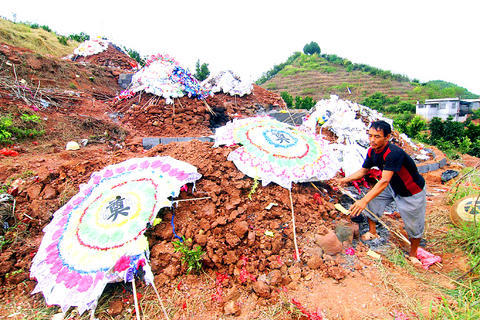
PHOTO: AP
Unidentified local residents roughed up five reporters as they interviewed relatives of the dead, according to a photographer and a reporter whose colleague was allegedly among those pushed around. They declined to be identified, saying they feared reprisals.
The collapse of the bridge, which had been under construction, left at least 47 people dead, making it one of China's worst building accidents in years.
The rough treatment of journalists was at odds with the responsible, concerned image China's Communist Party leadership has tried to convey ahead of the 2008 Beijing Olympics, and following the collapse. Officials have promised a thorough investigation into the collapse, and punishment for any wrongdoing.
The accident raises troubling questions about shoddy building and possible corruption between officials and contractors -- suspicions fueled by trying to control reporting on the disaster.
"The local government does not want the media to uncover the collapse," said Li Datong, a veteran journalist forced from a top editing job two years ago for running reports that angered authorities.
Li said reporters told him about the harassment in Fenghuang.
A duty officer in the Fenghuang police department, Liu Xiajun, said reporters had made an emergency call reporting the harassment on Thursday.
An official in the Propaganda Department's information office said he was "not clear" about the ban. He declined to give his name.
All China media are state controlled, but some outlets have engaged in lively, aggressive reporting in recent years, as social freedoms accompanied economic growth. However, accounts of journalists being hurt by local thugs have increased.

The military has spotted two Chinese warships operating in waters near Penghu County in the Taiwan Strait and sent its own naval and air forces to monitor the vessels, the Ministry of National Defense (MND) said. Beijing sends warships and warplanes into the waters and skies around Taiwan on an almost daily basis, drawing condemnation from Taipei. While the ministry offers daily updates on the locations of Chinese military aircraft, it only rarely gives details of where Chinese warships are operating, generally only when it detects aircraft carriers, as happened last week. A Chinese destroyer and a frigate entered waters to the southwest

Japanese Prime Minister Sanae Takaichi’s comment last year on Tokyo’s potential reaction to a Taiwan-China conflict has forced Beijing to rewrite its invasion plans, a retired Japanese general said. Takaichi told the Diet on Nov. 7 last year that a Chinese naval blockade or military attack on Taiwan could constitute a “survival-threatening situation” for Japan, potentially allowing Tokyo to exercise its right to collective self-defense. Former Japan Ground Self-Defense Force general Kiyofumi Ogawa said in a recent speech that the remark has been interpreted as meaning Japan could intervene in the early stages of a Taiwan Strait conflict, undermining China’s previous assumptions
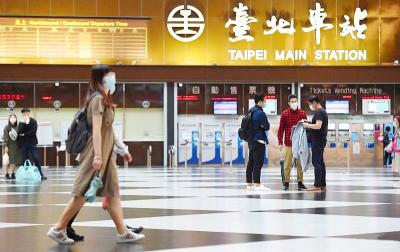
Taiwan Railways Corp (TRC) today announced that Shin Kong Mitsukoshi has been selected as the preferred bidder to operate the Taipei Railway Station shopping mall, replacing the current operator, Breeze Development Co Ltd. Among eight qualified firms that delivered presentations and were evaluated by a review committee, Shin Kong Mitsukoshi was ranked first, while Breeze was named the runner-up, the rail company said in a statement. Contract negotiations are to proceed in accordance with regulations, it said, adding that if negotiations with the top bidder fail, it could invite the second-ranked applicant to enter talks. Breeze in a statement today expressed doubts over
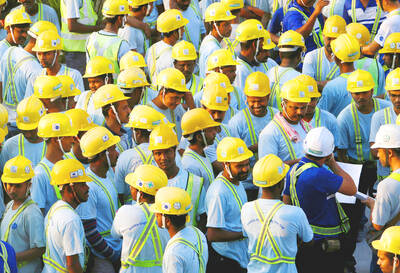
UNFOUNDED CONCERNS: Public concerns that allowing Indian workers to come and work in Taiwan would lead to increased sex crimes are baseless, the labor ministry said Amid public concern over the government’s plan to bring Indian workers to Taiwan, the Ministry of Labor (MOL) pointed to past intake and said that public safety remained stable. Minister of Labor Hung Sun-han (洪申翰) on April 9 told the legislature that the first group of Indian workers could arrive as early as the end of this year. Taiwan and India signed a memorandum of understanding (MOU) in February 2024 to address Taiwan’s labor shortage. The MOU was sent to the Legislative Yuan for review in mid-2024 and received cross-party backing, prompting the MOL to begin follow-up negotiations with India, Hung said. Public


 RSS
RSS